

Table of Contents
- Start with the central kitchen operating model
- Build container families around food and handling
- Compare materials against the complete journey
- Create a packaging product matrix
- Standardize labels for production and outlet receiving
- Specify delivery packs as complete assemblies
- Validate food packaging for central kitchens before rollout
- Control MOQ, production, storage, and replenishment
- Frequently asked questions
- Conclusion: standardize the system, then approve the pack
Central kitchens need packaging that works from filling and dispatch through outlet receiving and service. Learn how to standardize container families, label fields, delivery packs, approval checks, and replenishment across multiple outlets.
Start with the central kitchen operating model
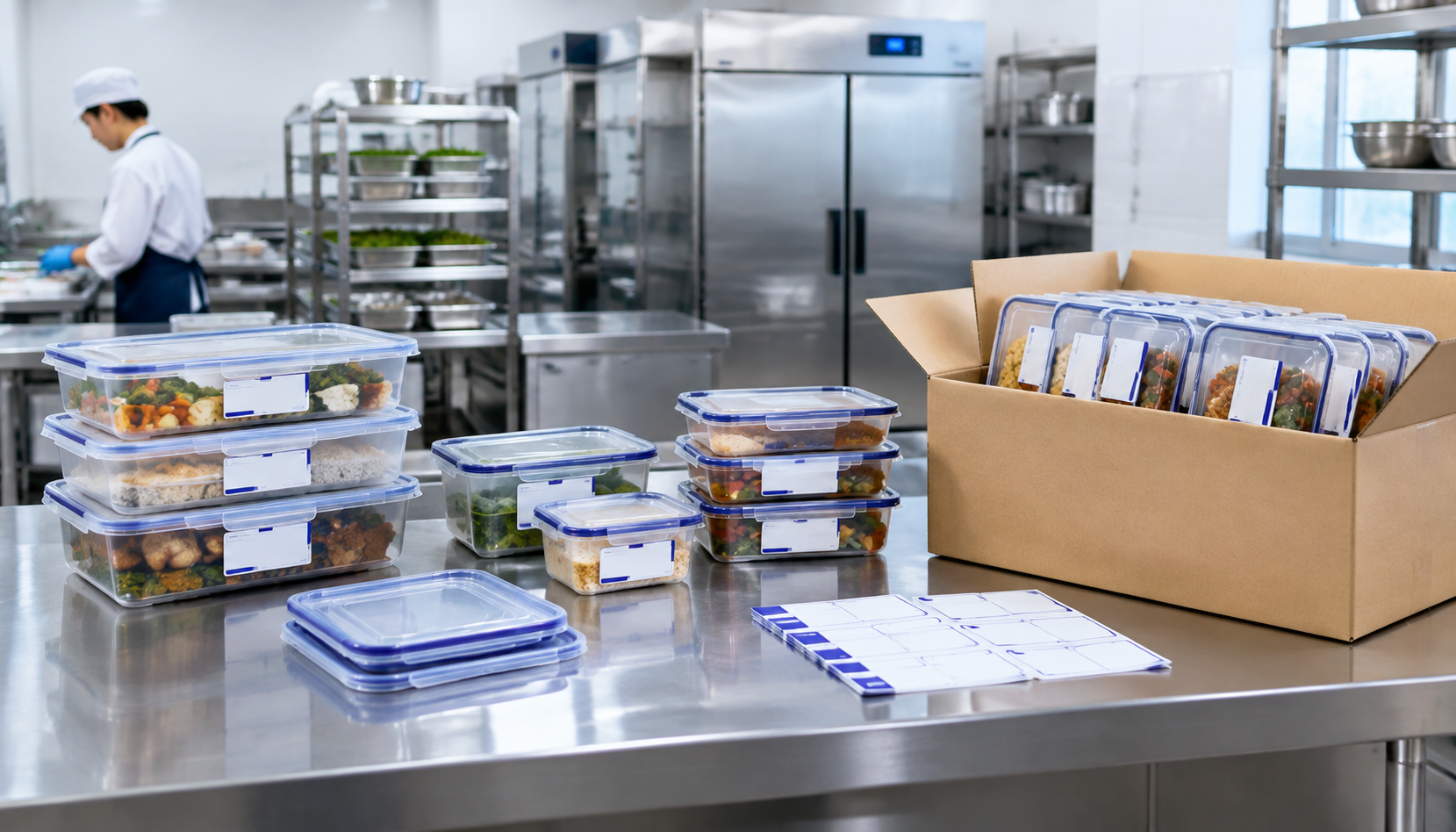
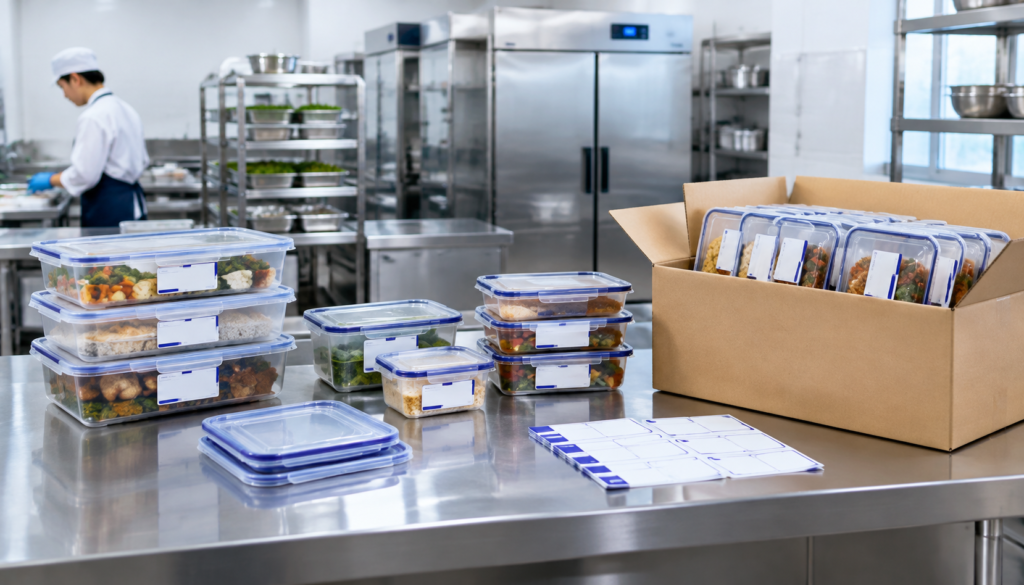
The best food packaging for central kitchens uses a controlled range of containers, compatible lids, consistent label fields, and delivery packs validated for the journey to each outlet. Start with food conditions and receiving procedures, then standardize formats that meet those requirements. A single container rarely suits every product or handling route.
Definition: A central kitchen prepares food for multiple outlets or service points. Primary packaging directly contains the food; secondary packaging groups containers for handling; transport packaging protects and organizes loads during distribution. A packaging SKU is one separately controlled item with an exact specification.
Map whether food travels as bulk ingredients, semi-prepared components, or finished meals. Record filling conditions, chilling or freezing, transit, outlet storage, reheating, and final service. Packaging must support this process, while validated food-safety controls govern time and temperature.
Key takeaways:
- Standardize compatible container families rather than forcing every menu item into one format.
- Connect food batches, packaging lots, and outlet destinations through records.
- Approve the assembled pack under representative distribution conditions.
- Manage purchasing through shared specifications and controlled changes.
Build container families around food and handling
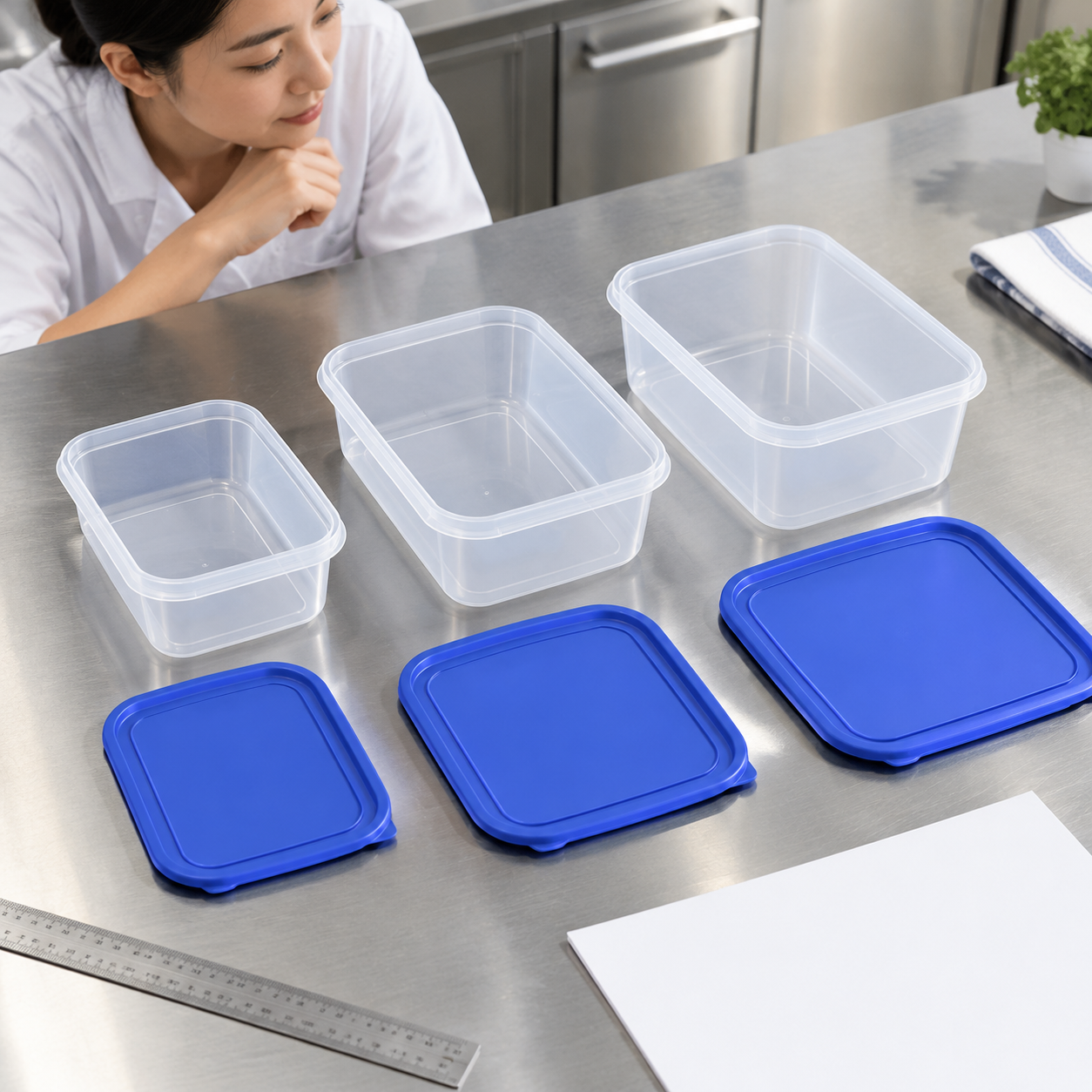
Group foods by handling requirements before choosing container sizes. Useful families include chilled components, liquid-rich dishes, dry bakery items, and meals intended for reheating at the outlet.
Define usable fill volume separately from nominal capacity. Allow headspace where required for closure, movement, or the validated process. Standardize portion tools alongside meal prep containers so operators do not compensate for an unsuitable size by overfilling.
- Geometry: Record internal dimensions, external footprint, depth, and rim profile.
- Material: Identify resin or board grade, thickness or weight, and any coating.
- Closure: Specify the exact lid code, closure method, and any seal.
- Handling: Document nesting, separation, filled stacking, and case orientation.
A shared lid can simplify stockholding only when every container pairing has been verified. Similar-looking rims do not establish container and lid compatibility. Use the packaging dimensions and capacity guide to align supplier drawings with kitchen measurements.
Compare materials against the complete journey
Select materials for the full preparation, distribution, and outlet-use sequence. Material names alone do not establish temperature suitability, food-contact compliance, or leak performance.
| Material or format | Application to evaluate | Main trade-off | Approval checks |
|---|---|---|---|
| PP container | Meal components and outlet reheating where approved | Performance depends on grade, geometry, and lid | Actual filling, cooling, reheating, closure, and stacking conditions |
| PET container | Chilled foods requiring visibility | Conventional PET should not be assumed suitable for hot filling or reheating | Exact PET type, permitted use, cold handling, and lid retention |
| Coated paperboard | Prepared meals, bakery items, or takeaway service | Barrier performance and stiffness depend on the complete construction | Moisture exposure, grease resistance, seams, and compression |
| Aluminum foil tray | Outlet heating applications where approved | Rim damage and deformation can affect closure | Gauge, rim, lid, load support, and equipment compatibility |
| Molded fiber or bagasse | Meal service where the specified structure suits the food | Moisture resistance and rigidity vary by formulation | Food contact, soak-through, closure, and loaded stacking |
For paper structures, compare the food packaging coating options against grease and moisture exposure. Recyclable means compatible with an available collection and recycling route. Compostable requires substantiation under specified conditions; biodegradable does not establish a disposal route or timescale. Plastic-free is a composition claim that must account for coatings, liners, and other components.
Create a packaging product matrix
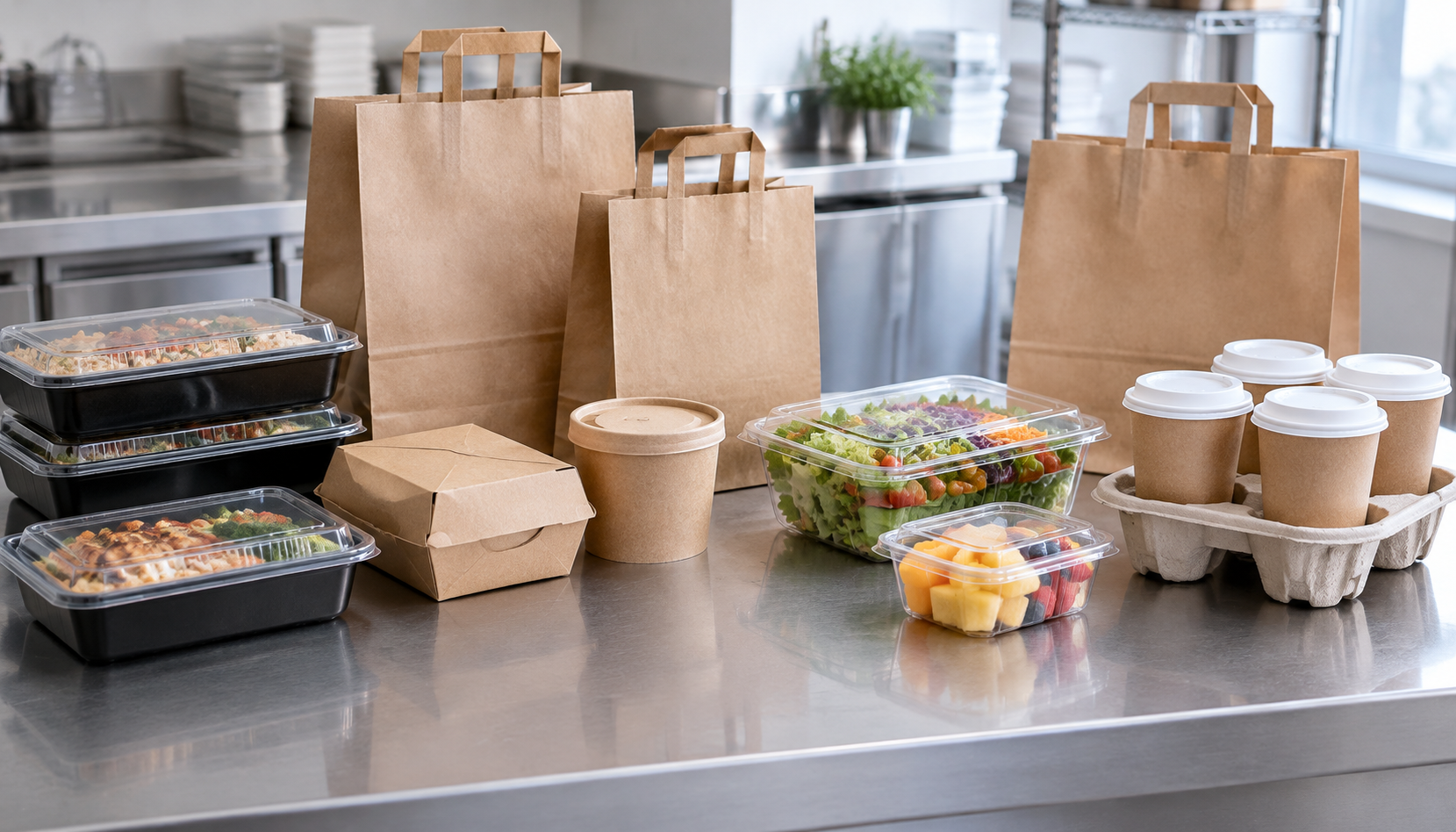
A product matrix gives purchasing, production, and outlets one reference for approved packaging. The entries below are planning categories, not confirmed product specifications or availability.
| Packaging item | Central kitchen role | Fields to standardize | Receiving check |
|---|---|---|---|
| Meal container and lid | Portioned finished food | Usable capacity, footprint, compartments, material, lid code | Correct pairing and intact closure |
| Bulk tray and cover | Components transferred to outlet service equipment | Dimensions, loaded weight, handling support, cover | No deformation or contamination |
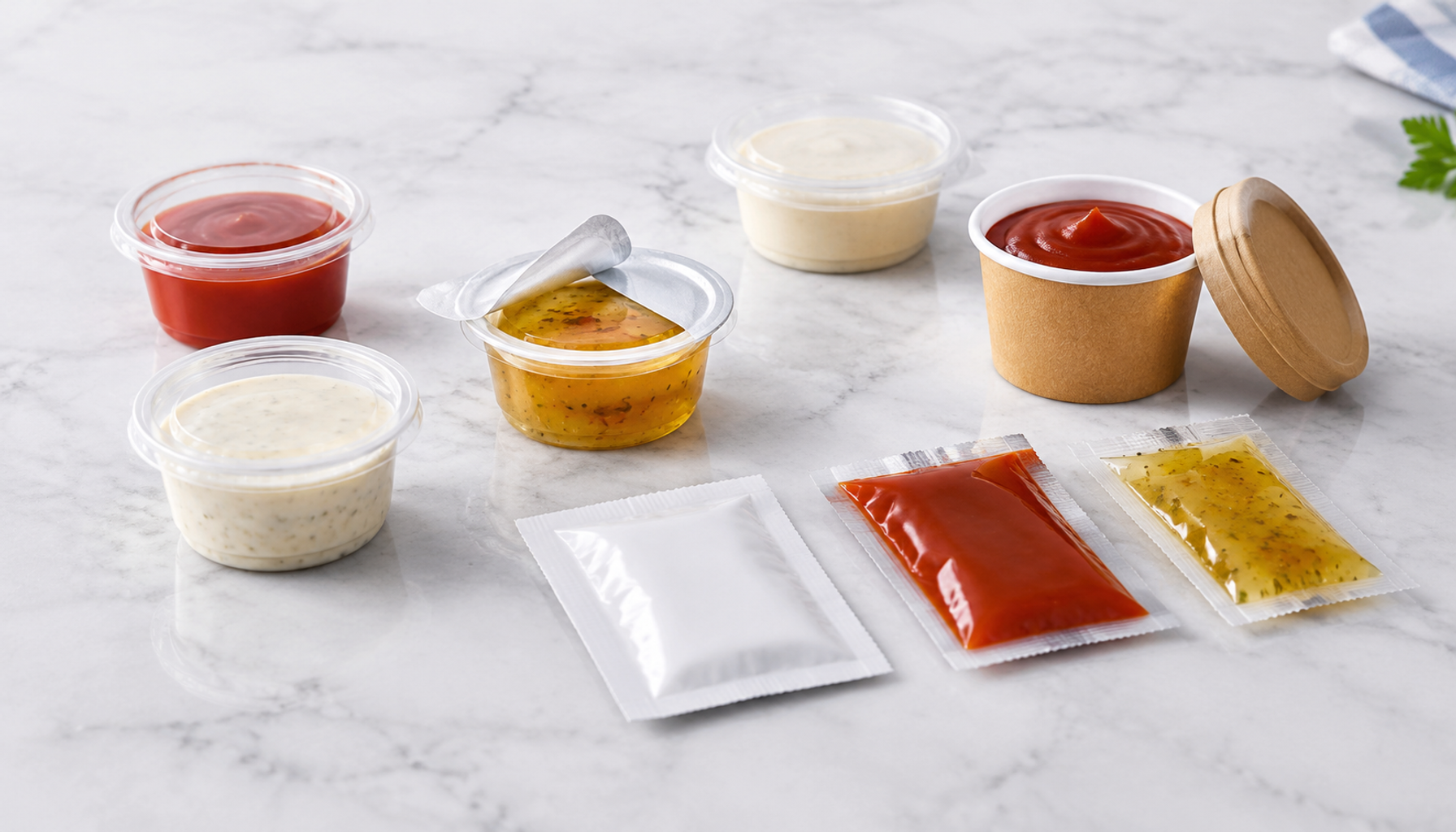
| Small component pot | Separate sauces or garnishes | Fill volume, closure, identification | No missing or displaced components |
| Food wrap or liner | Separate or protect suitable food items | Format, material, grease barrier, permitted use | Correct placement and condition |
| Label | Identify food, batch, and destination | Size, stock, adhesive, print fields, placement | Readable data and adhesion |
| Outer carton or reusable crate | Group packs by route or outlet | Internal dimensions, load limit, pack count, identification | Correct count and sound load |
Assign each approved assembly a revision-controlled pack code. Record permitted substitutions explicitly; an alternative container may require new lids, labels, and carton layouts.
Standardize labels for production and outlet receiving
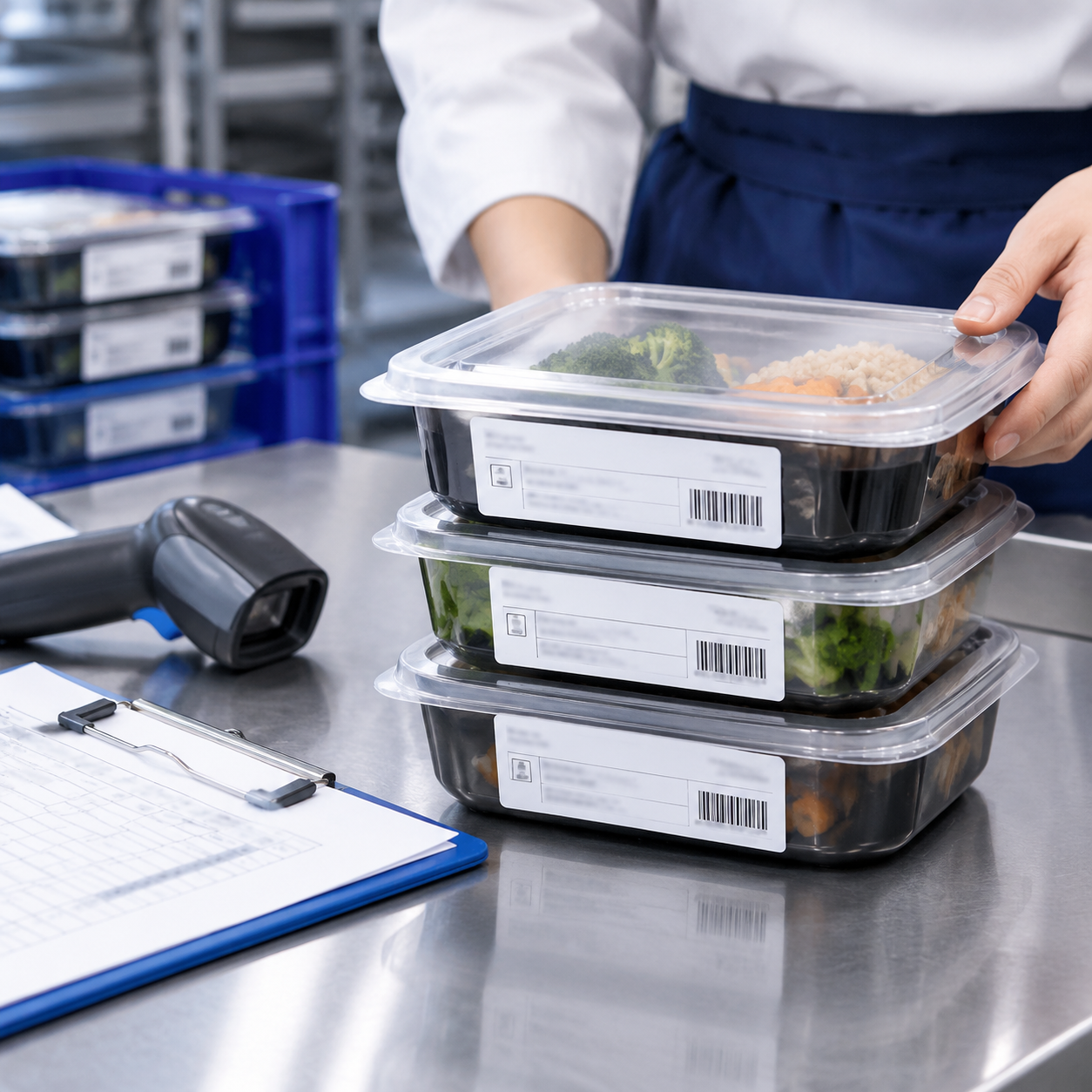
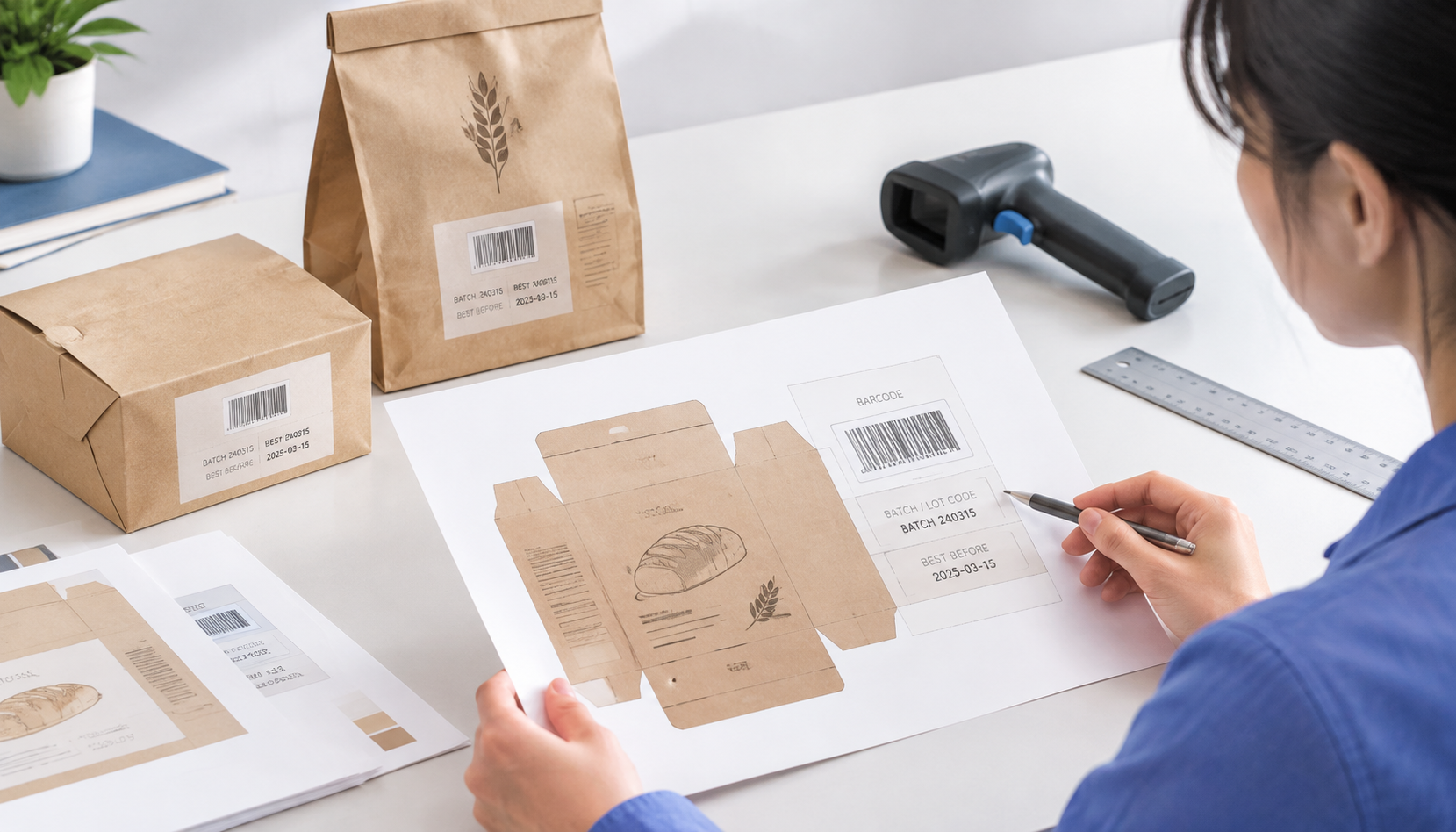
Use a shared label template with variable operational fields so outlets can identify food and act on instructions consistently. Separate permanent branding from information generated for each production batch.
- Identity: Product name, item code, quantity, and outlet or route.
- Traceability: Food batch identifier and links in records to packaging lots.
- Handling: Validated storage, use-by, and preparation instructions.
- Food information: Ingredients and allergen information where required for the supply model and destination market.
Do not derive food shelf life from the container specification. Date marking must follow the validated food process. Have the applicable label requirements reviewed for the destination and whether packs are internal transfers, business-to-business supplies, or consumer-facing products.
Approve label adhesion on the actual surface after condensation, cold storage, and handling. Keep labels away from closure interfaces unless they form an approved seal. Check barcode scanning at receiving, while retaining readable text for manual identification.
Specify delivery packs as complete assemblies
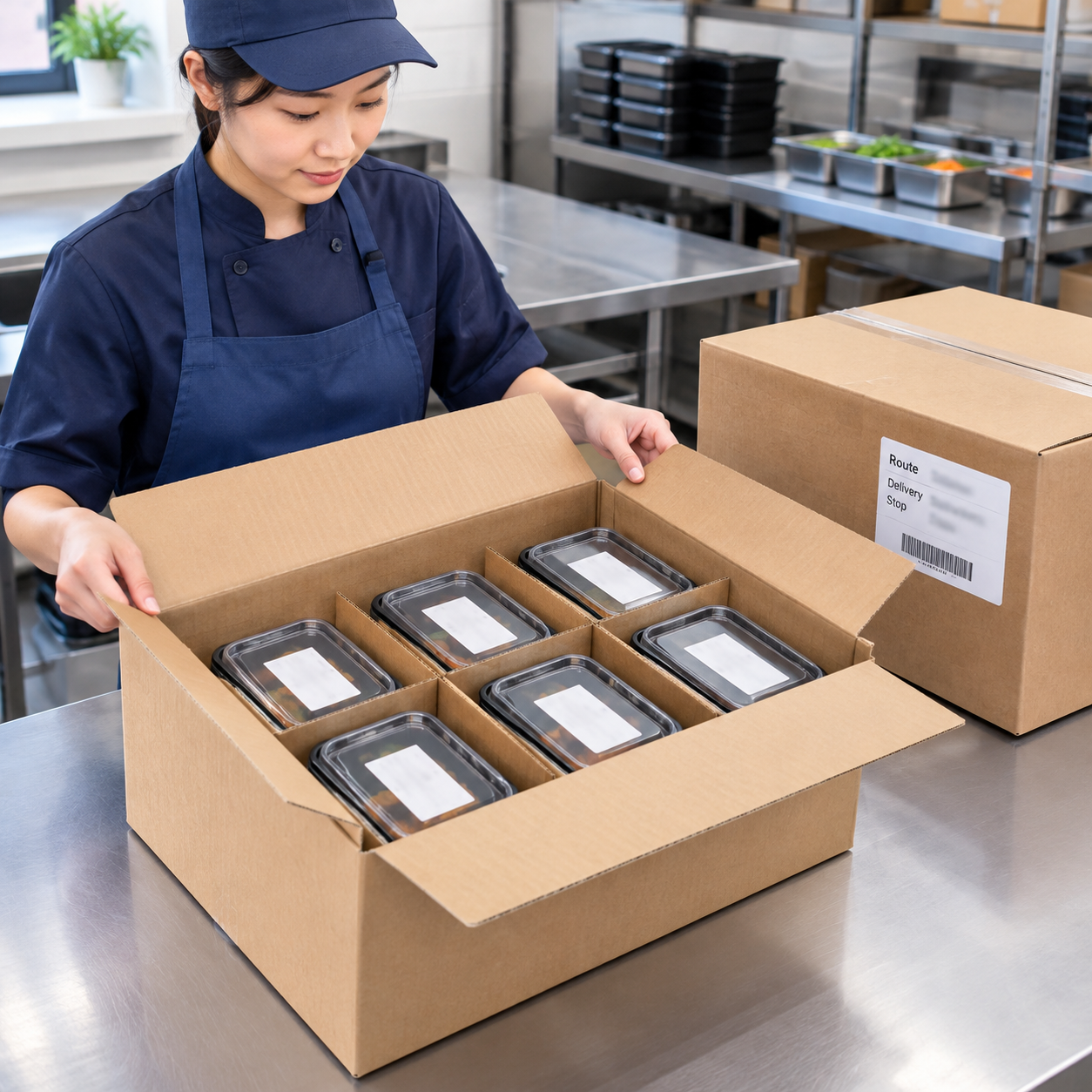
Delivery pack standardization should define what goes inside each outer pack, how it is arranged, and how the outlet checks it. Container approval alone does not demonstrate that a loaded carton or crate will travel successfully.
Document pack count, orientation, divider placement, filled weight, stacking pattern, and route identification. Avoid placing heavy trays over vulnerable lids. Keep foods with incompatible temperature requirements in separately controlled arrangements.
Check the pack against vehicle space, handling equipment, and outlet shelving. Insulated packaging may support temperature control, but its performance must be validated with the route and food load. At receiving, record count, closure condition, relevant temperature checks under the food-safety plan, and discrepancies before unpacking.
Validate food packaging for central kitchens before rollout
Approve food packaging for central kitchens through a documented trial using representative food, operators, equipment, and routes. Set acceptance criteria before testing so decisions are consistent.
- Review documentation: Match food-contact evidence to the exact material, intended conditions, and destination market.
- Run filling trials: Check portion accuracy, separation from nested stacks, closure effort, and line handling.
- Apply the food process: Assess the actual cooling, storage, freezing, or reheating sequence where relevant.
- Simulate distribution: Inspect leakage, shifting, compression, label condition, and closure after representative movement.
- Trial outlet receiving: Confirm identification, scanning, unpacking, storage fit, and preparation instructions.
- Approve a reference: Retain samples, drawings, artwork, and the accepted pack configuration.
A supplier material change, new lid, revised coating, or altered delivery layout should trigger a documented review and appropriate revalidation.
Control MOQ, production, storage, and replenishment
Aggregate demand by approved specification, while tracking containers, lids, labels, and outer packs separately. One missing component can interrupt dispatch even when container stock appears sufficient.
MOQ, price, sampling requirements, and production lead time depend on the exact specification, printing, tooling, quantity, and destination. Consult the food packaging MOQ guide before splitting demand across custom variants. Shared base packaging with variable labels may consolidate purchasing, subject to operational and legal suitability.
Request quotations against identical pack definitions, including accessories, carton quantities, tooling, freight terms, and inspection requirements. The supplier quote comparison checklist helps expose differences in scope. Schedule artwork approval, samples, production, inspection, and shipment as separate milestones.
Set reorder points from consumption during confirmed replenishment lead time plus a justified buffer. Store packaging clean, dry, protected from contamination, and within supplier-specified conditions. Preserve lot identification and rotate stock appropriately. Check export cartons, pallet dimensions, transit protection, and warehouse capacity before ordering larger quantities.
Frequently asked questions
These answers address common purchasing decisions for central kitchen packaging.
Conclusion: standardize the system, then approve the pack
Effective food packaging for central kitchens connects container specifications, label information, delivery assemblies, and replenishment rules. Approve a manageable range against real food processes and outlet requirements, then control revisions across purchasing and operations. Material performance and food-contact compliance depend on the exact specification and destination market.
FAQ
How many container sizes should a central kitchen standardize?
Use the smallest practical range that covers portion sizes, food characteristics, and handling routes. Determine the number through menu and process mapping, then trial it. Excessive consolidation can cause overfilling, unused capacity, or unsuitable closures.
Can different containers use the same lid?
Yes, if the supplier specifies compatibility and trials confirm every pairing. Match rim geometry, tolerances, material, and intended use. Visual similarity or matching nominal capacity is insufficient evidence of a secure fit.
Should central kitchens use printed containers or variable labels?
Printed containers can carry stable branding, while variable labels identify food, batch, dates, and destination. A combined system may suit shared packaging across outlets. Compare printing MOQ, change frequency, label durability, and applicable information requirements.
Can one pack support chilling, transport, and reheating?
Potentially, but approve the exact container and closure for the complete sequence. Obtain relevant supplier documentation and conduct representative process trials. Do not assume a material name proves suitability for every temperature or heating appliance.
What should buyers send when requesting central kitchen packaging samples?
Provide food type, portion volume, dimensions, filling and storage conditions, delivery route, outlet handling, material preference, lid requirements, printing, quantities, and destination market. Include the intended outer-pack layout so samples can be assessed as an assembly.
Need the Right Packaging for Your Food Product?
Tell us your product and packaging type, food application, dimensions or capacity, preferred material and coating, quantity, printing requirements, lid or accessory needs, and destination market. Include central kitchen handling conditions and outlet requirements. Guangzhou YBJ Paper & Plastic Co., operating since 1998, supports design, samples, production, quality control, and export service. Our team will review your specifications and artwork, recommend a suitable structure, and prepare sampling and quotation options.