


Table of Contents
- Start With One Standardized Packaging Specification
- Compare Material, Structure, and Food-Contact Requirements
- Check Dimensions, Capacity, Fit, and Performance
- Review Printing, Artwork, Tooling, and Sampling
- Separate Unit Price From Total Landed Cost
- Evaluate MOQ, Production, Quality Control, and Logistics
- Use a Supplier Quote Review Checklist
- Conclusion: Make the Quote Comparable Before You Choose
To compare food packaging supplier quotes accurately, standardize the specification first, then review material, dimensions, printing, compliance, tooling, MOQ, quality controls, delivery terms, and total landed cost. The lowest unit price is not always the lowest-cost supply option.
Start With One Standardized Packaging Specification

To compare food packaging supplier quotes, send every supplier the same written specification and require each quotation to follow the same commercial basis. A quote for a different material, size, coating, packing quantity, or delivery term is not a true price comparison.
An RFQ, or request for quotation, is a document that defines the product and commercial conditions a supplier must price. For food packaging, the RFQ should describe the complete finished item rather than only naming a product such as a paper bowl, plastic cup, bag, or takeaway box.
Include these fields in the RFQ
- Packaging type and food application, such as hot meals, bakery products, beverages, frozen desserts, or dry goods.
- Internal and external dimensions, capacity, shape, and tolerance requirements.
- Material, thickness or basis weight, structure, coating, liner, and accessory requirements.
- Printing method, number of colors, artwork format, print area, and finish.
- Required quantity per order, forecast quantity, and number of SKUs.
- Sample requirements, inspection standard, packaging method, and destination port or address.
- Requested Incoterm, currency, quotation validity, payment conditions, and whether tooling is included.
Ask suppliers to identify assumptions, exclusions, and optional charges. This makes later negotiation clearer and reduces the risk that a low initial quote becomes more expensive after technical details are confirmed.
Compare Material, Structure, and Food-Contact Requirements

Material is often the first reason two food packaging quotes differ. “Paper packaging” may refer to different paper grades, weights, fiber structures, coatings, or barrier systems. “Plastic packaging” may refer to different resins and forming processes. Compare the stated construction, not only the product name.
Material questions to ask
- What is the exact substrate or resin, and is the material virgin, recycled, biobased, or a blend?
- What paper basis weight, plastic thickness, or multilayer structure is proposed?
- What coating or liner is used, and is it required for grease, moisture, oxygen, heat, or seal performance?
- Is the package recyclable, compostable, biodegradable, or plastic-free under a specific market definition? These terms are not interchangeable and should not be treated as equivalent.
- Which food-contact documentation is available for the proposed material and destination market?
Food-contact compliance depends on the exact material, additives, inks, adhesives, coatings, intended food type, contact conditions, and destination regulations. Do not accept a general statement such as “food grade” as a substitute for documentation relevant to your application. Request the applicable declarations, test documents, or supplier compliance information and confirm who is responsible for final market review.
If grease or oil is involved, compare the barrier construction and validation method rather than assuming that a heavier paper grade alone will provide sufficient protection. See the guide to grease resistance in food packaging for practical questions about coatings, liners, and testing.
Check Dimensions, Capacity, Fit, and Performance

A supplier may quote the correct nominal capacity but a different shape, wall thickness, rim diameter, base dimension, or usable volume. For that reason, compare the dimensional drawing and sample against the actual food and filling process.
Technical checks for the RFQ
- Confirm whether dimensions are internal, external, or measured at a specific point.
- Define capacity as nominal, overflow, or usable capacity, and state the required fill level.
- Check lid, sleeve, carrier, insert, closure, and stacking compatibility.
- Confirm fit with filling equipment, sealing equipment, dispensers, cup holders, cartons, and pallets.
- Specify tolerances for critical dimensions, sealing areas, print registration, and assembly.
- Describe performance needs, including leak control, grease resistance, rigidity, odor, appearance, and handling.
Performance claims should be linked to a test method or an agreed practical trial. For example, a leak check should identify the product, fill level, orientation, time, and temperature conditions used for evaluation. A fit check should use the intended lid and, where relevant, the actual filling or packing line.
Thermal requirements must also be specific. State whether the package will hold hot food, chilled food, frozen products, or be used in a microwave, oven, or freezer. Do not assume that a material is suitable for a thermal application without confirmation for the exact finished package. The takeout packaging thermal safety guide provides a useful framework for these questions.
Review Printing, Artwork, Tooling, and Sampling
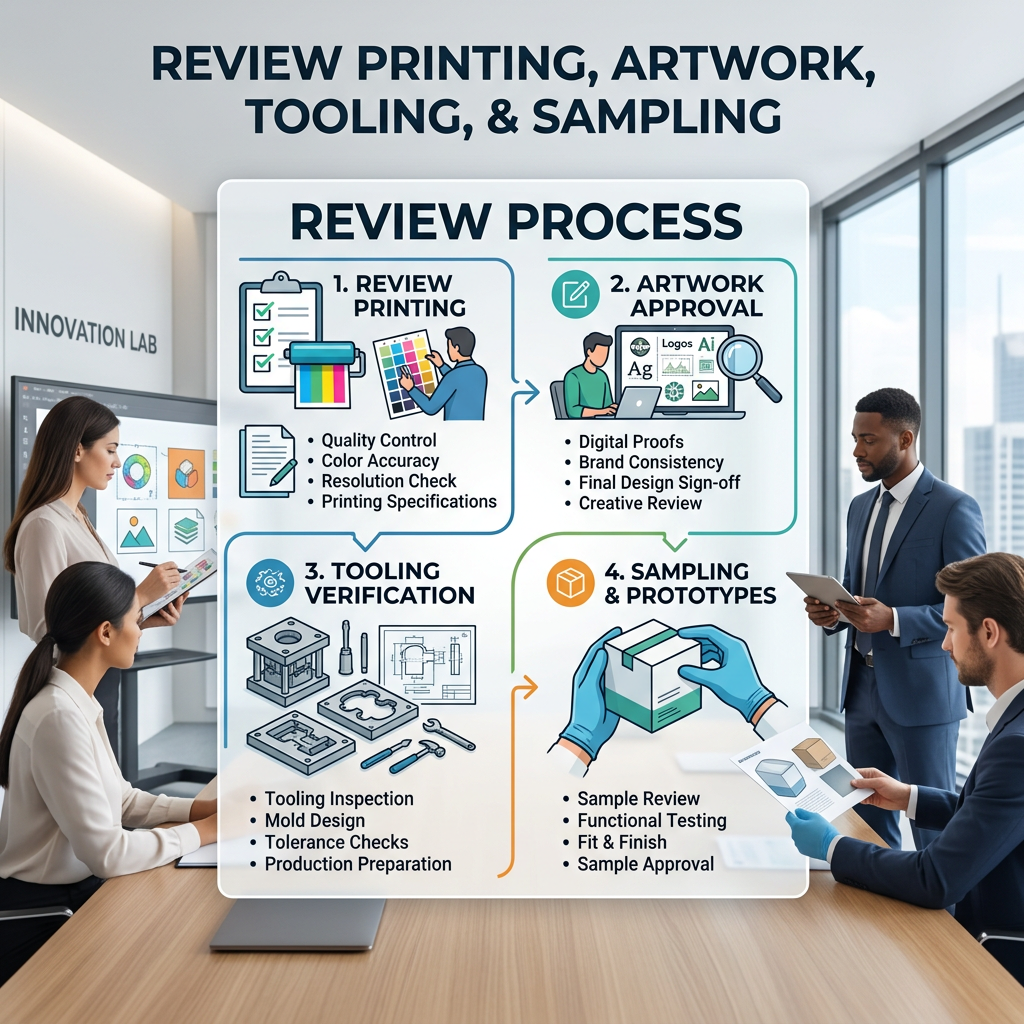
Custom printing can change both the price and the production risk. A quote should state the printing process, color basis, print coverage, finish, registration expectations, and whether prepress or plate charges are included.
Printing and tooling questions
- Is printing flexographic, offset, rotogravure, digital, or another process?
- Are colors specified by a reference system, approved proof, or supplied artwork?
- Are plates, cylinders, dies, molds, cutting tools, or setup charges required?
- Who owns the tooling, where is it stored, and what happens if the order is paused?
- Are artwork adaptation, color proofing, and structural sample charges included?
- Does the quotation cover one design or multiple designs and SKUs?
Request a pre-production sample or proof where appearance, fit, or performance is important. A digital proof may show artwork placement but may not reproduce the final substrate, ink behavior, coating, structure, or forming result. A production sample is more useful for checking the complete finished package, although the sample method and cost depend on the product.
Agree in writing on the approval point: no mass production should begin until the buyer has approved the relevant artwork, structure, dimensions, and sample requirements. Also ask whether changes after approval can affect tooling, MOQ, price, or production timing.
Separate Unit Price From Total Landed Cost

The quoted unit price is only one part of the buying decision. To compare food packaging supplier quotes fairly, convert each offer to the same commercial basis and calculate the expected total landed cost for the required quantity.
Cost items to normalize
- Product price per piece, set, carton, kilogram, or another unit. Confirm the quoted unit.
- Tooling, plates, molds, samples, artwork, setup, and testing charges.
- Inner packing, master cartons, palletization, labeling, and export packing.
- Freight, insurance, customs duties, taxes, brokerage, destination handling, and local delivery.
- Payment fees, currency conversion, bank charges, and any minimum-order surcharge.
- Expected waste, overage, damage, or inventory exposure where these are relevant to the project.
Incoterms allocate responsibilities and costs between buyer and seller, but they do not by themselves make two quotations comparable. An EXW offer and a DDP offer include different services and risk allocations. Request the named place, Incoterm version if stated, shipping method, packing details, and assumptions behind any freight estimate.
Ask suppliers to quote the same quantity breaks, such as the initial order, expected repeat order, and annual forecast. A lower price at a larger quantity may be attractive only if the buyer can store and consume that volume without creating obsolete inventory. Packaging logistics, shipping, storage, and forecasting should be reviewed together; the packaging lead times and logistics guide can help structure this review.
Evaluate MOQ, Production, Quality Control, and Logistics
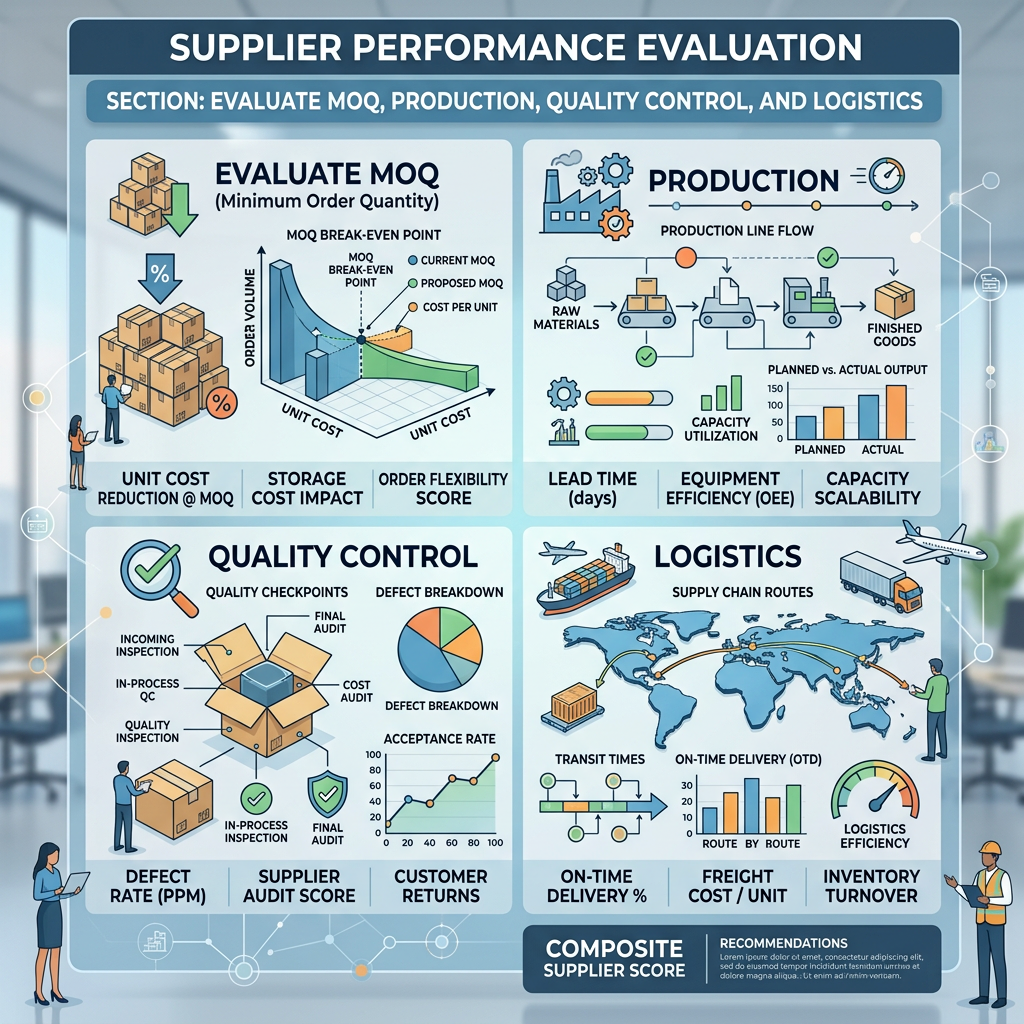
Commercial terms can determine whether a quotation is workable even when the technical specification is correct. MOQ means minimum order quantity: the smallest quantity a supplier agrees to produce or sell under stated conditions. MOQ may vary by material, size, print design, color, tooling, or production run.
Questions for supplier qualification
- What is the MOQ per SKU, design, size, color, and order?
- Can different SKUs be combined to meet a material or production MOQ?
- What are the estimated sample, production, and shipping stages?
- When does the production schedule begin: after deposit, artwork approval, sample approval, or another milestone?
- What inspection process is used for dimensions, print, glue, seams, odor, fit, and appearance?
- How are nonconforming goods documented, contained, replaced, or credited?
- What are the carton dimensions, gross weight, pallet details, and loading assumptions?
- How should the goods be stored to protect them from moisture, heat, odor, contamination, or deformation?
Lead time, MOQ, price, available tests, and quality controls depend on the exact specification and production schedule. Require written confirmation rather than comparing informal estimates. Also distinguish production lead time from transit time and customs clearance; they are separate parts of the supply chain.
A quality plan should define the approved reference sample, inspection stage, sampling approach if agreed, acceptance criteria, and responsibility for inspection. The food packaging quality control checklist covers practical checks for print, glue, seams, odor, and fit.
Use a Supplier Quote Review Checklist

Use the following checklist before ranking suppliers. Mark each item as confirmed, unclear, excluded, or requiring a sample or document. This prevents a low price from receiving a high score simply because important costs or requirements were omitted.
- Product identity: Is the packaging type, application, SKU, and accessory set clearly stated?
- Construction: Are the material, thickness or basis weight, coating, liner, and structure specified?
- Dimensions: Are capacity, measurements, tolerances, and fit requirements confirmed?
- Performance: Are leak, grease, rigidity, odor, thermal, sealing, or stacking requirements testable?
- Compliance: Has the supplier identified documentation relevant to the food, use conditions, and destination market?
- Printing: Are the process, colors, coverage, proof, finish, and print tolerances stated?
- Tooling: Are dies, molds, plates, setup, ownership, storage, and replacement terms clear?
- Samples: Is the sample type, approval process, cost, and timing defined?
- Commercial basis: Are quantity, price unit, currency, validity, payment, Incoterm, and named place comparable?
- Supply capability: Are MOQ, production schedule, quality controls, packing, storage, and shipping information documented?
- Exceptions: Has the supplier listed exclusions, assumptions, alternatives, and possible surcharges?
After the first review, send the same clarification questions to every shortlisted supplier. Then compare the revised quotations, approved samples, and supporting documents as one procurement package. If one supplier proposes a substitute material or construction, evaluate it as a separate option rather than mixing it into the original comparison.
Conclusion: Make the Quote Comparable Before You Choose
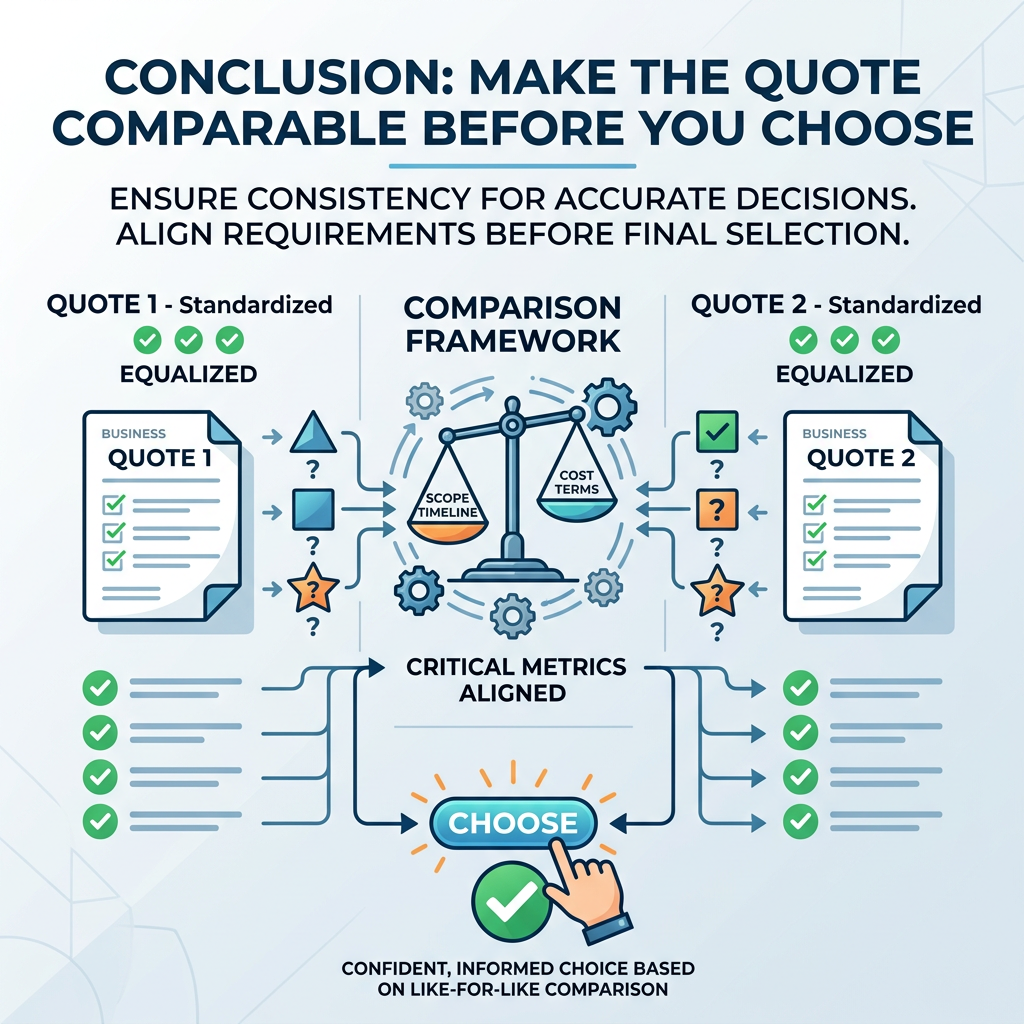
The best way to compare food packaging supplier quotes is to compare complete, equivalent supply proposals—not isolated unit prices. Standardize the RFQ, confirm material and food-contact requirements, validate dimensions and performance, separate tooling and logistics costs, and review MOQ, quality controls, samples, storage, and shipping before making a decision.
Material performance, food-contact compliance, MOQ, price, production timing, and available documentation depend on the exact packaging specification and destination market. A transparent supplier should identify assumptions and help the buyer confirm what is included. This creates a clearer basis for approval, repeat orders, and long-term supply planning.