


Table of Contents
- Introduction
- Corrugated Pizza Boxes: Structure and Performance
- Paperboard Pizza Boxes: Compact and Printable
- Ventilation: Why It Matters and How to Specify It
- Custom Sizes: Getting the Right Fit for Your Pizza
- Key Specification Checklist for Buyers
- Storage, Shipping, and Handling Considerations
- Pizza Box Buying Guide: Final Recommendations
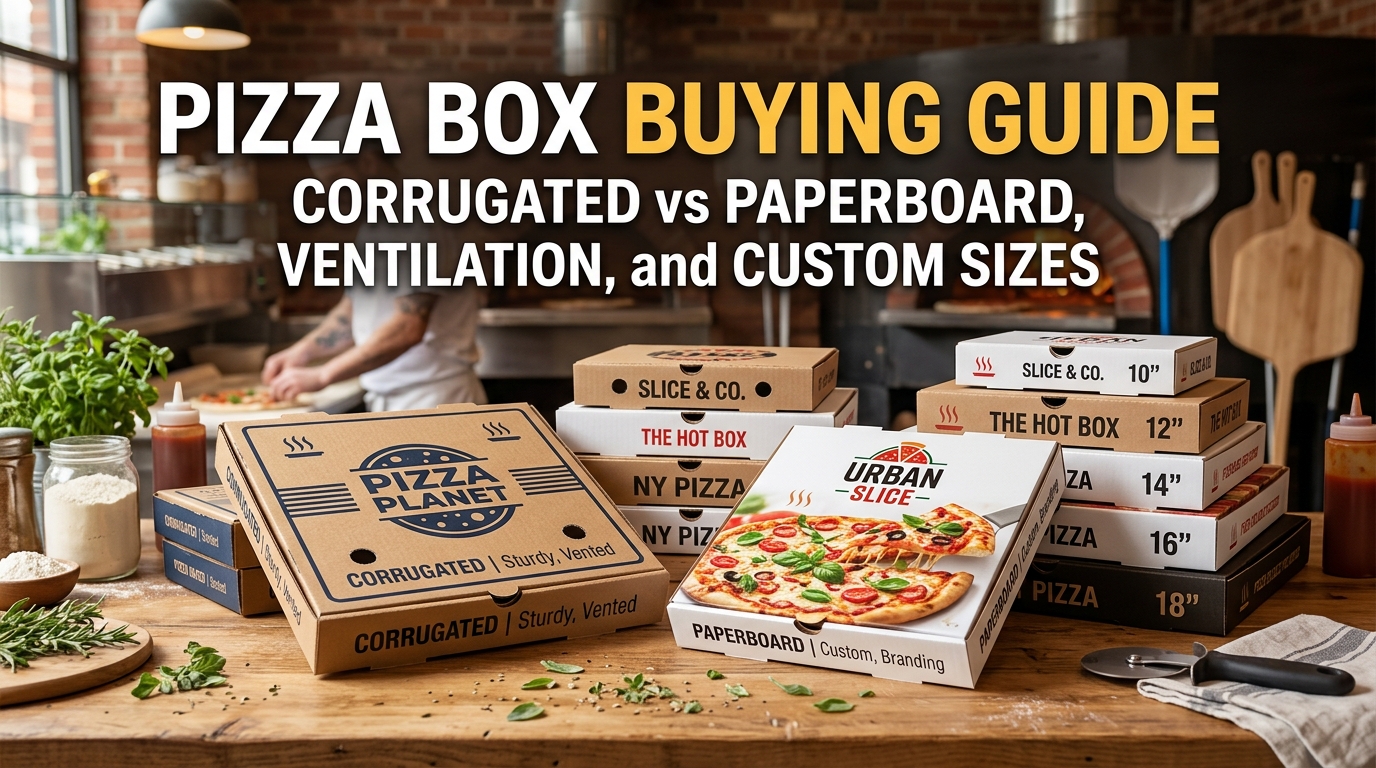
This pizza box buying guide helps foodservice buyers and distributors choose between corrugated and paperboard construction, specify effective ventilation, and order custom sizes that protect product quality and brand image.
Introduction
This pizza box buying guide is written for foodservice operators, distributors, and brand owners who need to make a confident decision between corrugated and paperboard pizza boxes, specify the right ventilation for crisp crusts, and order custom sizes that reduce waste and protect margins. The right box does more than hold a pizza—it manages moisture, maintains temperature, supports stacking, and carries your brand. The wrong box leads to soggy crusts, crushed toppings, damaged boxes, and unhappy customers.
In this guide, we define the two primary materials, explain how ventilation affects product quality, and outline a practical process for specifying custom dimensions. We also cover key considerations for storage, shipping, and quality control. For a broader overview of pizza packaging options, see our pizza boxes category page.
Corrugated Pizza Boxes: Structure and Performance

Corrugated board consists of a fluted or wavy medium glued between one or two flat linerboards. This structure creates air pockets that provide excellent cushioning, thermal insulation, and stacking strength. For pizza boxes, corrugated is the preferred choice for larger sizes (14 inches and above), deep-dish or thick-crust pizzas, and delivery operations that stack multiple boxes.
Key advantages of corrugated pizza boxes:
- Superior crush resistance and structural integrity under stacked loads.
- Better thermal retention due to the insulating air gaps in the flutes.
- Ideal for heavy or saucy pizzas that generate high moisture.
- Available in various flute profiles—E-flute (thin, good for printing) and B-flute (thicker, more rigid) are common for pizza packaging.
Trade-offs: Corrugated boxes are bulkier than paperboard, require more storage space, and are generally more expensive per unit. The corrugated surface is less smooth than solid board, which can affect fine print detail, though modern preprint and litho-lamination techniques can overcome this limitation.
When specifying corrugated pizza boxes, confirm the flute type, board combination (e.g., single-wall, double-wall), and whether the box is die-cut or slotted. These variables directly impact cost, performance, and shipping efficiency.
Paperboard Pizza Boxes: Compact and Printable

Paperboard, also called solid board or boxboard, is a single-ply material made from bleached or unbleached wood pulp. Common grades for pizza boxes include solid bleached sulfate (SBS), coated unbleached kraft (CUK), and recycled board. Paperboard is thinner and lighter than corrugated, making it popular for smaller pizzas, slices, and takeout-only operations where high-quality printing is a priority.
Key advantages of paperboard pizza boxes:
- Excellent print surface for high-resolution graphics, vivid colors, and brand messaging.
- Lightweight and compact when folded flat, reducing storage and freight costs.
- Lower per-unit material cost for smaller sizes (up to about 14 inches).
- Smooth, wipeable surface is easy to handle and can accept barrier coatings.
Trade-offs: Paperboard provides less insulation and lower stacking strength than corrugated. For very large or heavy pizzas, paperboard may buckle or absorb moisture more quickly. However, thicker calipers (e.g., 18–24 pt) and moisture-resistant coatings can mitigate these issues.
For a deeper dive into paperboard pizza box specifications, see our pizza paper box buyer’s guide.
Ventilation: Why It Matters and How to Specify It

Ventilation in a pizza box is not an afterthought—it is a critical control point for product quality. A hot pizza releases steam, and if that steam is trapped, it condenses on the inside of the lid and drips back onto the crust, making it soggy. Properly placed ventilation holes or slots allow moisture to escape while retaining enough heat to keep the pizza warm during delivery.
Types of ventilation commonly used:
- Die-cut holes: Small circular openings, usually 3–6 per box, strategically placed on the lid or side panels.
- Slots or louvers: Elongated openings that provide more airflow without weakening the structure excessively.
- Perforated patterns: Pre-scored areas that can be punched open by the operator only when needed.
- Ventilation with filters: Some high-end boxes include a breathable membrane that lets steam out while keeping grease in.
When specifying ventilation, consider the pizza type, delivery time, and ambient conditions. Thin-crust pizzas benefit from more ventilation to stay crisp, while deep-dish or heavily topped pizzas may need less to avoid drying out. Work with your packaging supplier to test different hole sizes and placements—typically on the top panel corners or along the side edges—to find the right balance.
Custom ventilation patterns can also be part of your brand identity. For guidance on combining functional ventilation with custom printing, see our custom pizza paper box wholesale guide.
Custom Sizes: Getting the Right Fit for Your Pizza

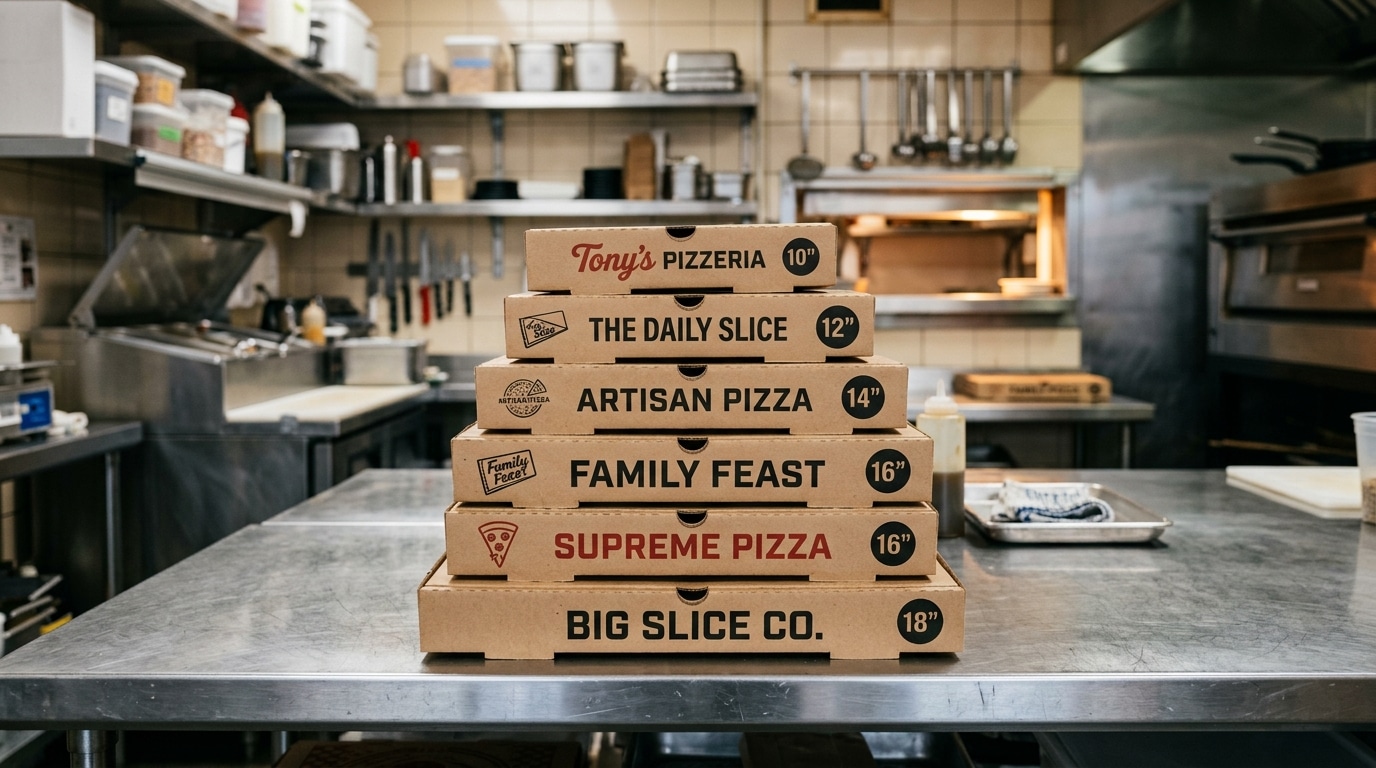
Off-the-shelf pizza boxes come in standard diameters—commonly 7″, 9″, 10″, 12″, 14″, 16″, and 18″—but your product may not fit neatly into one of these. A box that is too large wastes material, costs more per unit, and allows the pizza to slide around during transport. A box that is too small crushes the crust and can cause toppings to stick to the lid.
Custom sizing becomes necessary when you offer:
- Non-round pizzas (rectangular, Sicilian, artisan oval).
- Deep-dish or thick-crust pizzas that require extra height.
- Pizzas with extra toppings or protruding ingredients.
- Combo meals that include sides or dips inside the box.
To specify a custom pizza box, provide your supplier with the following measurements:
- Inside length and width: For round pizzas, the diameter plus at least 1/2 inch clearance on each side.
- Inside depth: Height of the pizza plus enough headspace to prevent lid contact.
- Wall thickness and flute direction: For corrugated, the flute direction should run parallel to the longest dimension for maximum stacking strength.
- Lid style: Tuck-top, lock-corner, or clamshell—each affects ease of assembly and structural integrity.
Always request a sample for fit testing before placing a production order. For more guidance on matching package size to portion and cost, read how to choose the right packaging size.
Key Specification Checklist for Buyers
Before you request a quote or place an order, use this checklist to document your requirements clearly. It reduces back-and-forth with suppliers and ensures you receive boxes that meet your operational and brand standards.
- Material type: Corrugated (single-wall, double-wall) or paperboard (SBS, CUK, recycled).
- Flute profile (if corrugated): E-flute, B-flute, or other.
- Board caliper or basis weight: For paperboard, specify points (pt) or grams per square meter (gsm).
- Box style: RSC (regular slotted container), die-cut folding carton, clamshell, or custom design.
- Inside dimensions: Length, width, and depth in inches or millimeters.
- Ventilation: Number, size, shape, and placement of holes or slots.
- Printing: Number of colors, print method (flexo, offset, digital), and artwork specifications.
- Coatings or barriers: Grease-resistant, moisture-resistant, or water-based coatings.
- Food safety compliance: Confirm FDA or EU food-contact requirements for the destination market.
- Packing and shipping: Flat vs pre-glued, bundle quantity, pallet configuration.
- Minimum order quantity (MOQ): Ask about MOQ for custom printing and custom sizes.
- Lead time: Confirm production and shipping timelines, including sample approval.
Remember that material performance, food-contact compliance, MOQ, price, and lead time all depend on the exact specification and destination market. Always request a written specification sheet and a physical sample before committing.
Storage, Shipping, and Handling Considerations
Pizza boxes
Pizza Box Buying Guide: Final Recommendations
Choosing the right pizza box requires balancing material, ventilation, size, and brand requirements. Use the checklist above to communicate your needs clearly with suppliers. Test samples under real delivery conditions before committing to a full order.