


Table of Contents
- Start with a Chain-Wide Packaging Framework
- Map Menu Applications and Location Requirements
- Compare Packaging Standardization Models
- Build a Product Specification Matrix
- Control Artwork and Regional Variants
- Approve Samples Through Store Trials and Quality Checks
- Align MOQ, Cost, Inventory, and Shipping
- Roll Out Packaging with Clear Responsibilities
- Conclusion: Specify Once, Control Every Location
Build a controlled packaging program across restaurant locations with shared product specifications, approved regional variants, practical store trials, clear quality standards, and coordinated inventory planning.
How to Specify Custom Food Packaging for Restaurant Chains
Specify custom food packaging for restaurant chains through a shared product specification, a controlled list of regional exceptions, and sample approval under real store conditions. Connect every approved item to its menu application, compatible accessories, artwork version, quality criteria, and replenishment plan. This gives purchasing teams a consistent basis for ordering while allowing justified differences between locations.
Packaging standardization means using common specifications wherever food performance, operations, and market requirements allow. A SKU, or stock keeping unit, identifies a separately managed inventory item. A master specification is the controlled record defining that item’s construction, dimensions, printing, packing, and acceptance requirements.
The objective is to reduce unnecessary variation without forcing unsuitable packaging onto different menus. Assign one specification owner and identify who approves food performance, branding, compliance, and purchasing changes. For multi-location packaging procurement, material performance, food-contact compliance, MOQ, price, and lead time depend on the exact specification and destination market.
Map Menu Applications and Location Requirements
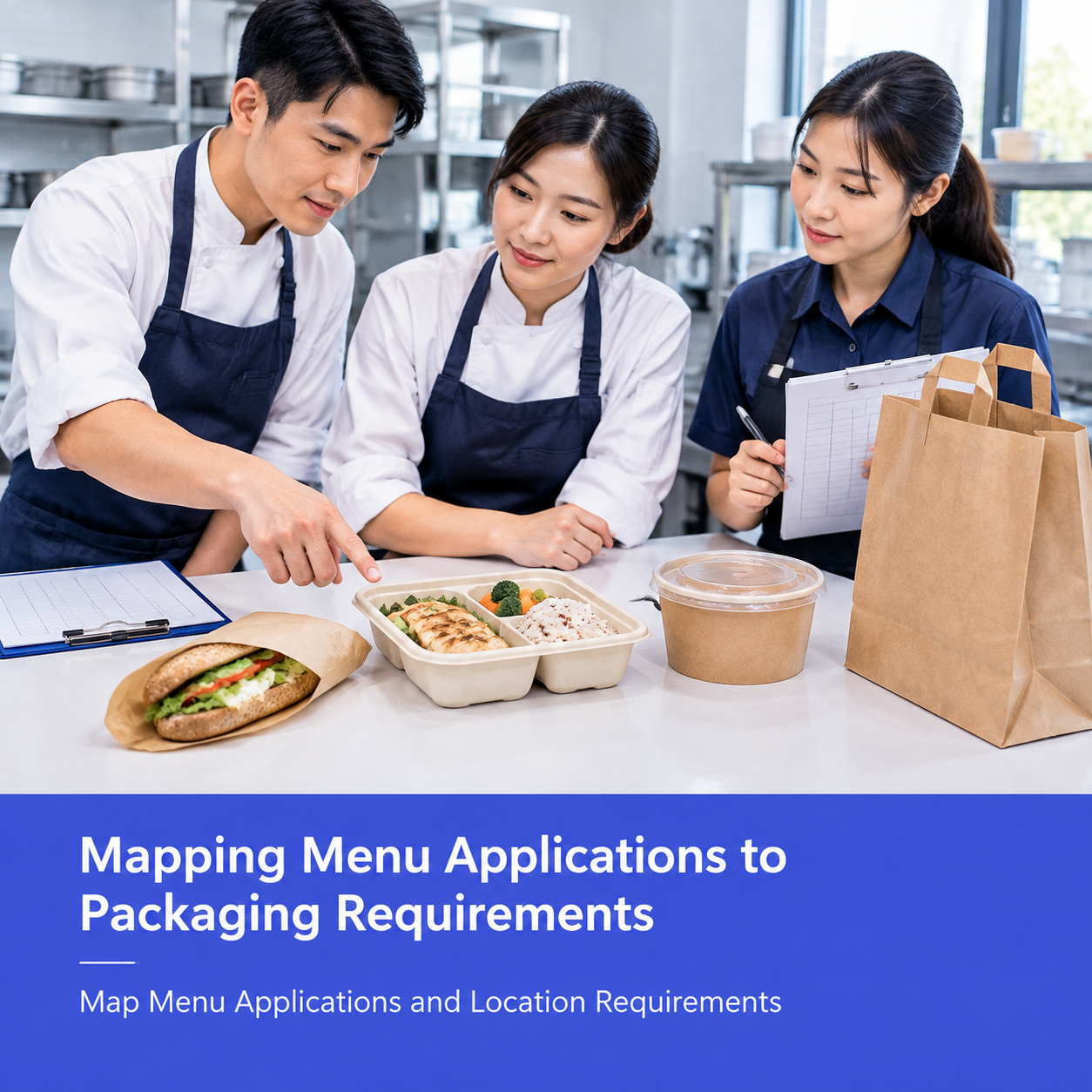
Group locations by their packaging requirements before choosing shared products. Stores with similar menus may still differ in delivery time, assembly workflow, storage space, or local rules.
- Record the food application: portion size, serving temperature, grease, moisture, sauces, and expected holding conditions.
- Map the service channel: dine-in leftovers, takeaway, delivery, catering, or chilled display.
- Check the store workflow: filling, closing, labeling, stacking, bagging, and customer handling.
- Identify regional requirements: food-contact documentation, required language, disposal labeling, and restrictions affecting materials.
- List exceptions: record the reason and approving person for each local variant.
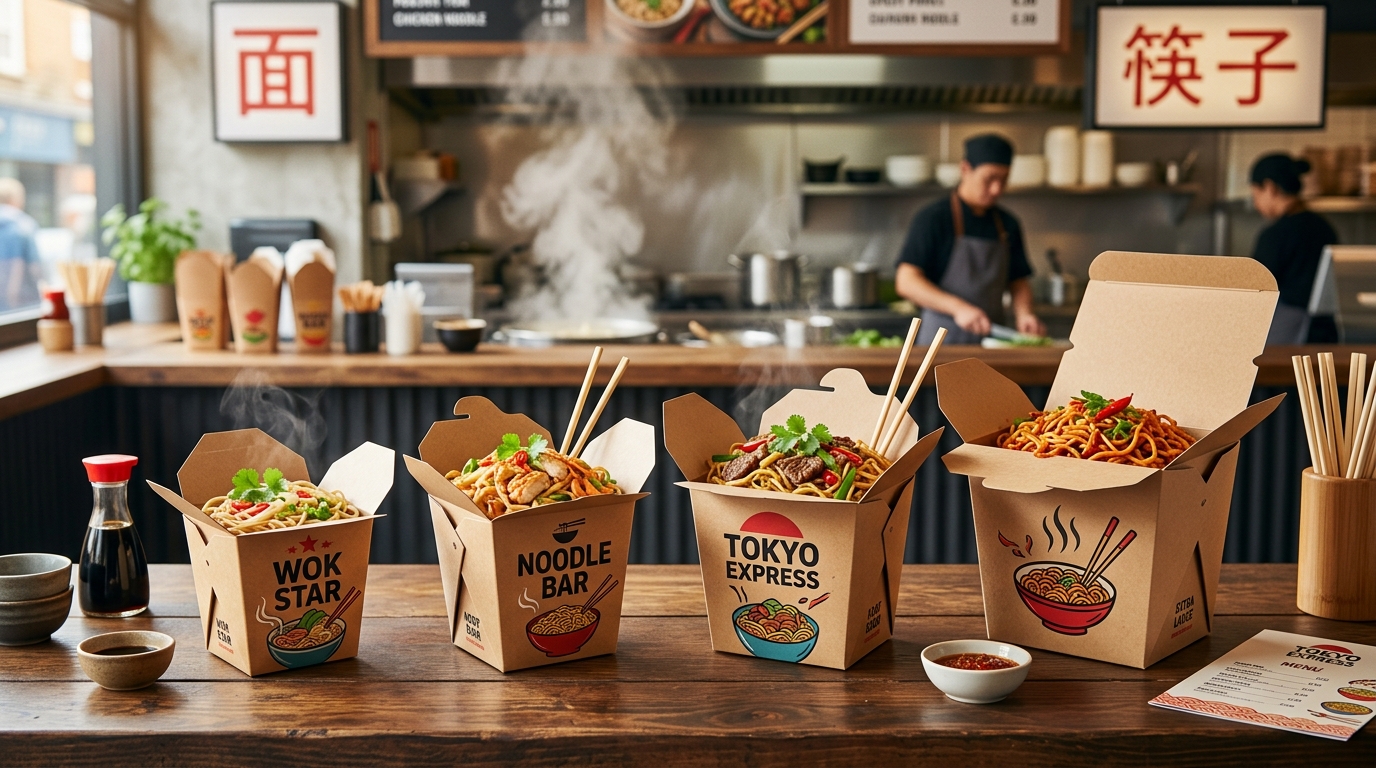
For example, two outlets may share a meal container while using different outer bags because their typical order sizes differ. A chilled display application may need a separate specification from a hot delivery meal. The meal prep and grab-and-go packaging guide provides related checks for compartments, labels, and stackability.
Keep demand data at SKU and location level. Total chain volume alone can hide slow-moving variants and accessories that run out before the main container.
Compare Packaging Standardization Models
Choose the smallest packaging range that satisfies validated food, workflow, and market requirements. Custom food packaging for restaurant chains usually benefits from a shared core range with documented exceptions.
| Model | Suitable situation | Procurement benefit | Trade-off to manage |
|---|---|---|---|
| One chain-wide range | Similar menus, portions, and market requirements | Consolidated demand and simpler replenishment | One format may perform poorly for an outlying application |
| Shared core with regional variants | Common menu with selected legal or operational differences | Consolidation with controlled flexibility | Variants require separate approval and inventory tracking |
| Store-specific range | Substantially different concepts or food applications | Closer alignment with individual operations | More artwork, smaller order lots, and greater stock complexity |
Consolidate only after checking usable capacity, closure compatibility, and food quality. A larger universal box can increase empty space, carton volume, and movement during delivery. A smaller format can cause overfilling or contamination of the closure area. Review packaging SKU management periodically so temporary exceptions do not become permanent without justification.
Build a Product Specification Matrix
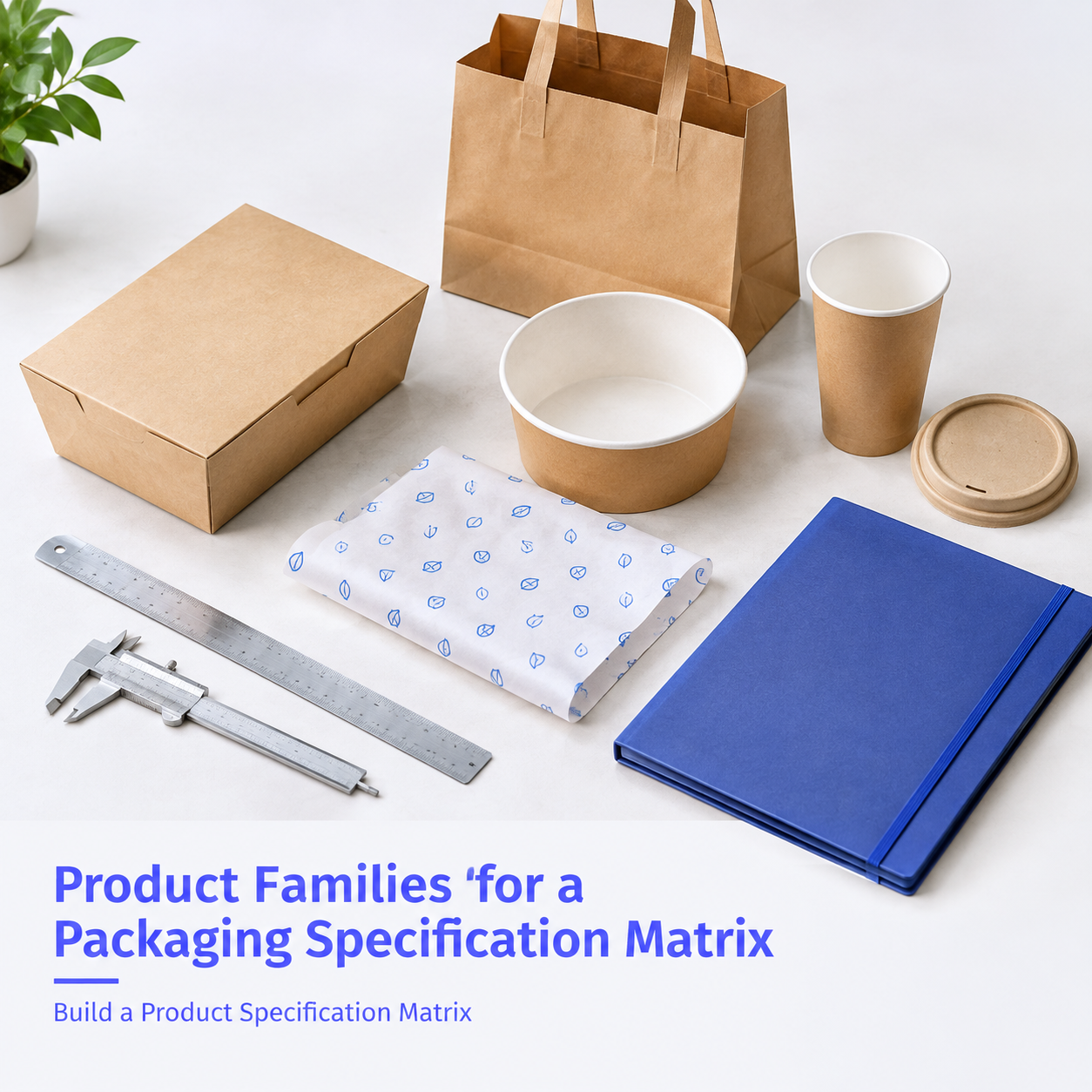
Give each packaging family measurable requirements and an approved application. The table below is a specification planning tool; it does not establish product availability or performance ratings.
| Product family | Fields to control | Store validation |
|---|---|---|
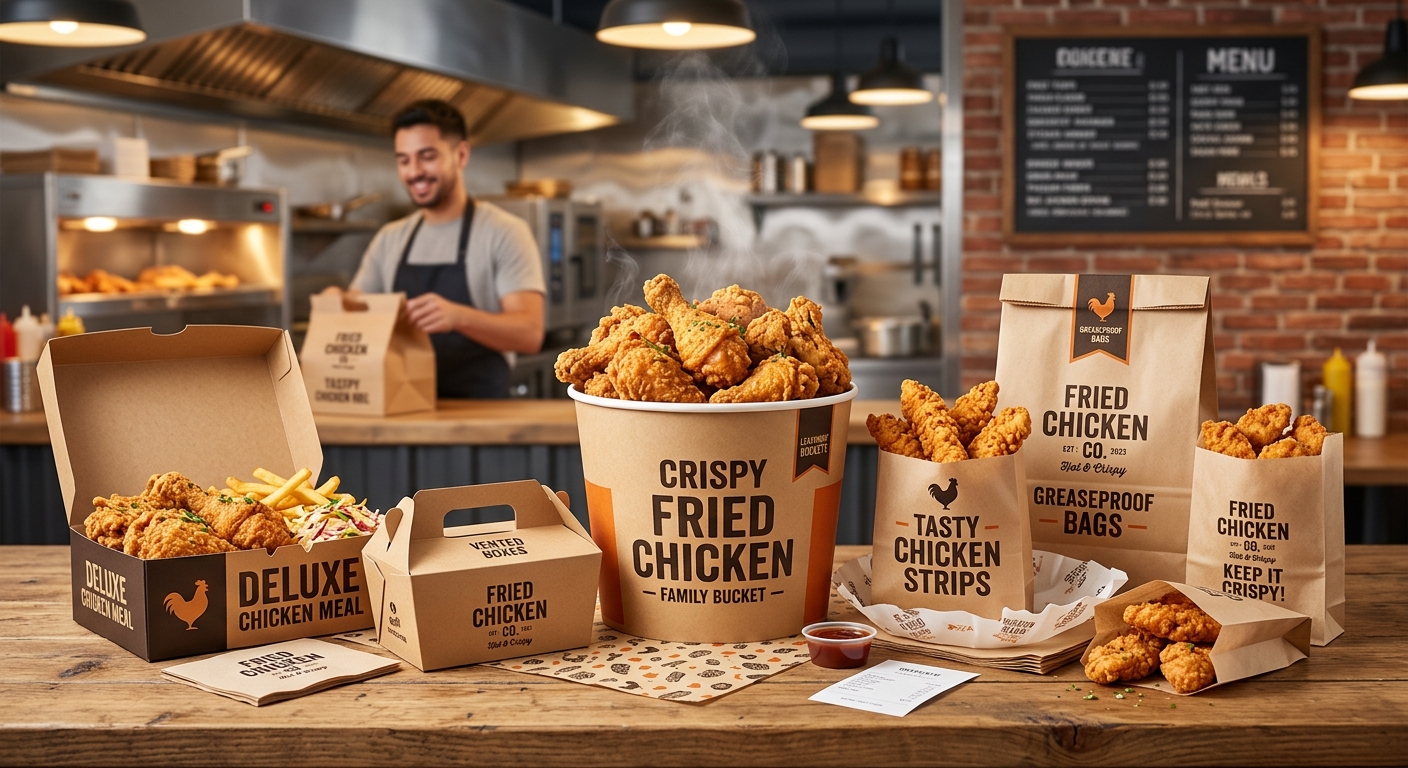
| Meal boxes and bowls | Internal dimensions, usable capacity, material, coating, compartments, closure | Portion fit, grease and moisture exposure, stacking, transport |
| Cups and lids | Capacity, rim geometry, material, matching lid code, sleeve fit | Filling, lid attachment, handling, delivery stability |
| Bags and outer carriers | Usable dimensions, material, handle or closure, print area | Loaded fit, carrying, sealing, order identification |
| Wraps and liners | Sheet dimensions, material, barrier treatment, print placement | Food contact, grease transfer, wrapping workflow |
| Catering trays | Dimensions, material, lid interface, packing configuration | Loaded handling, stacking, serving workflow |
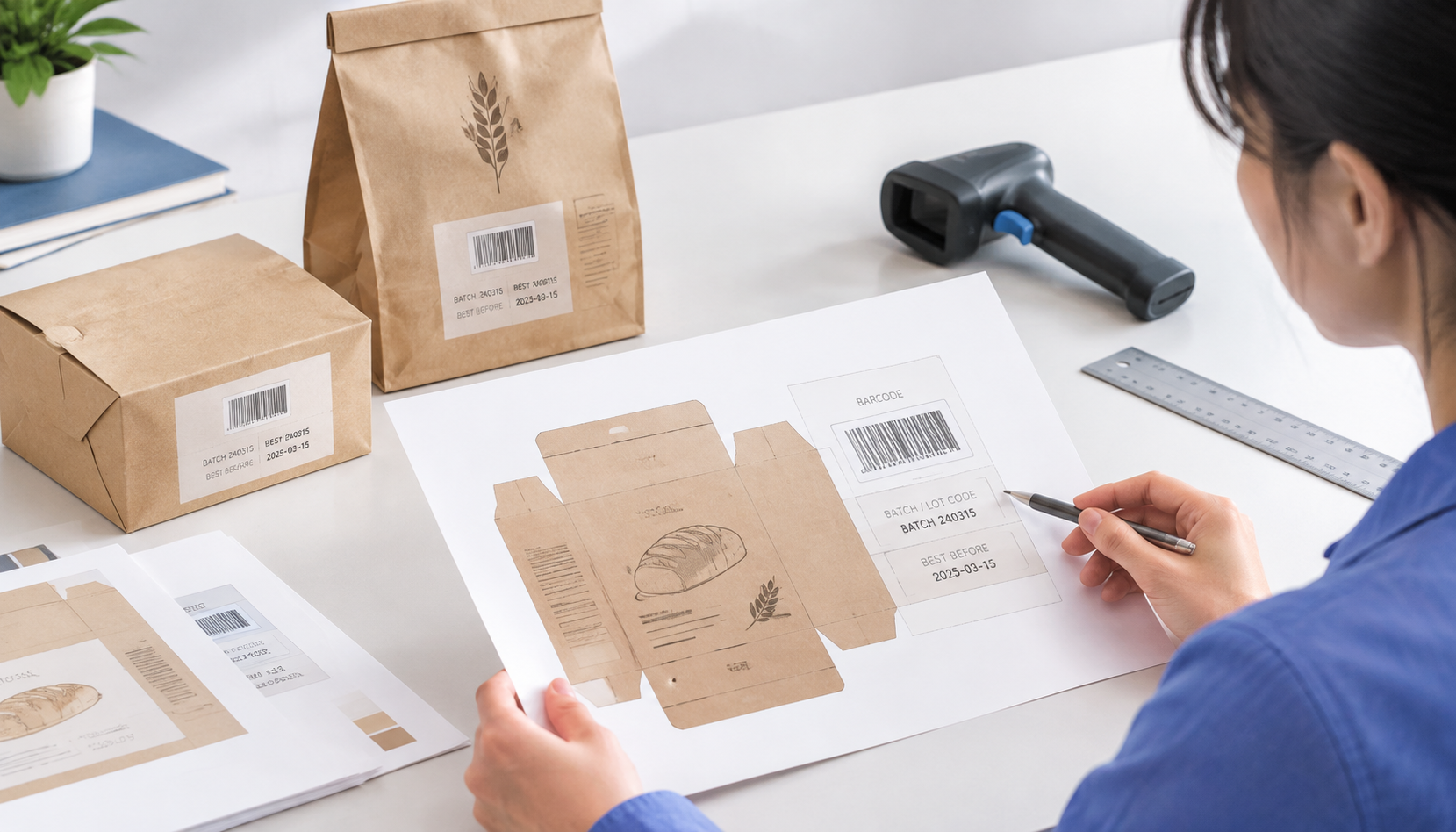
Add drawing references, dimensional tolerances, units per sleeve and carton, carton dimensions, and traceability requirements to each master specification. State whether dimensions are internal or external and whether capacity describes brimful volume or the intended serving fill.
For beverage programs, the plastic cup materials and sizing guide supports material and size discussions. Do not assume that equal stated capacity means lids are interchangeable.
Minimum approval record: SKU code; approved locations; food application; drawing revision; material and coating; accessory codes; artwork revision; acceptance criteria; destination market; carton configuration.
Control Artwork and Regional Variants
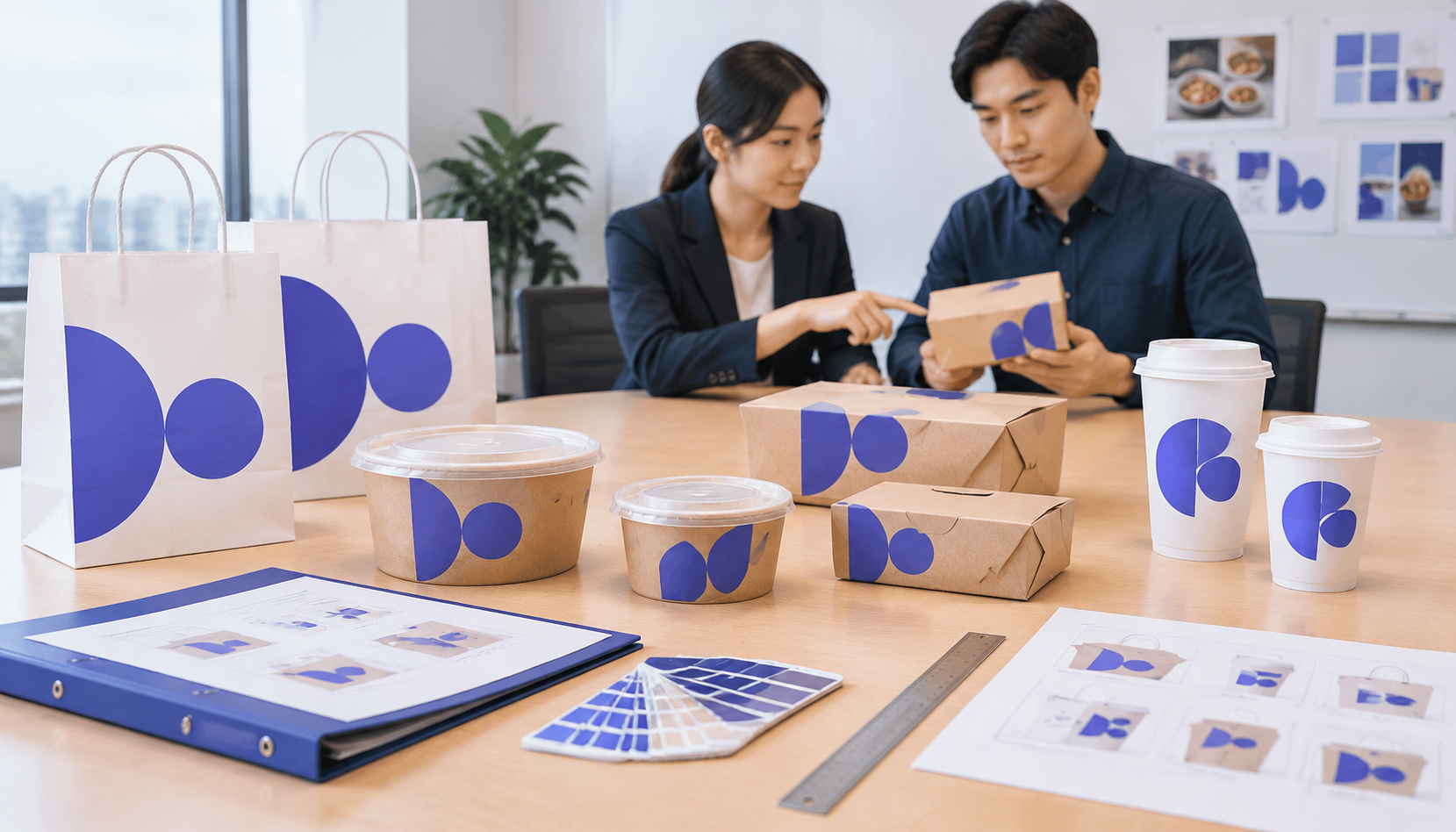
Manage branded takeaway packaging through an approved artwork library linked to SKU revisions. Every production order should identify the exact artwork file and specification version.
Define logo placement, approved color references, print areas, mandatory text, and any region-specific language. Agree how color will be evaluated on the actual substrate: paper color, coatings, and printing processes can affect appearance. A screen preview alone cannot establish the finished result.
A useful change record states what changed, why, who approved it, which locations are affected, and when the new version becomes orderable. Specify whether existing stock will be consumed, transferred, or withdrawn. Suppliers and distributors should receive the same effective revision.
For custom food packaging for restaurant chains, treat environmental wording as controlled artwork. Recyclable means compatible with an applicable collection and recycling route. Compostable requires evidence for defined composting conditions; biodegradable describes breakdown under specified conditions and does not establish compostability. Plastic-free claims require verification of all components, including coatings and adhesives. Approve claims for the exact construction and destination market.
Approve Samples Through Store Trials and Quality Checks
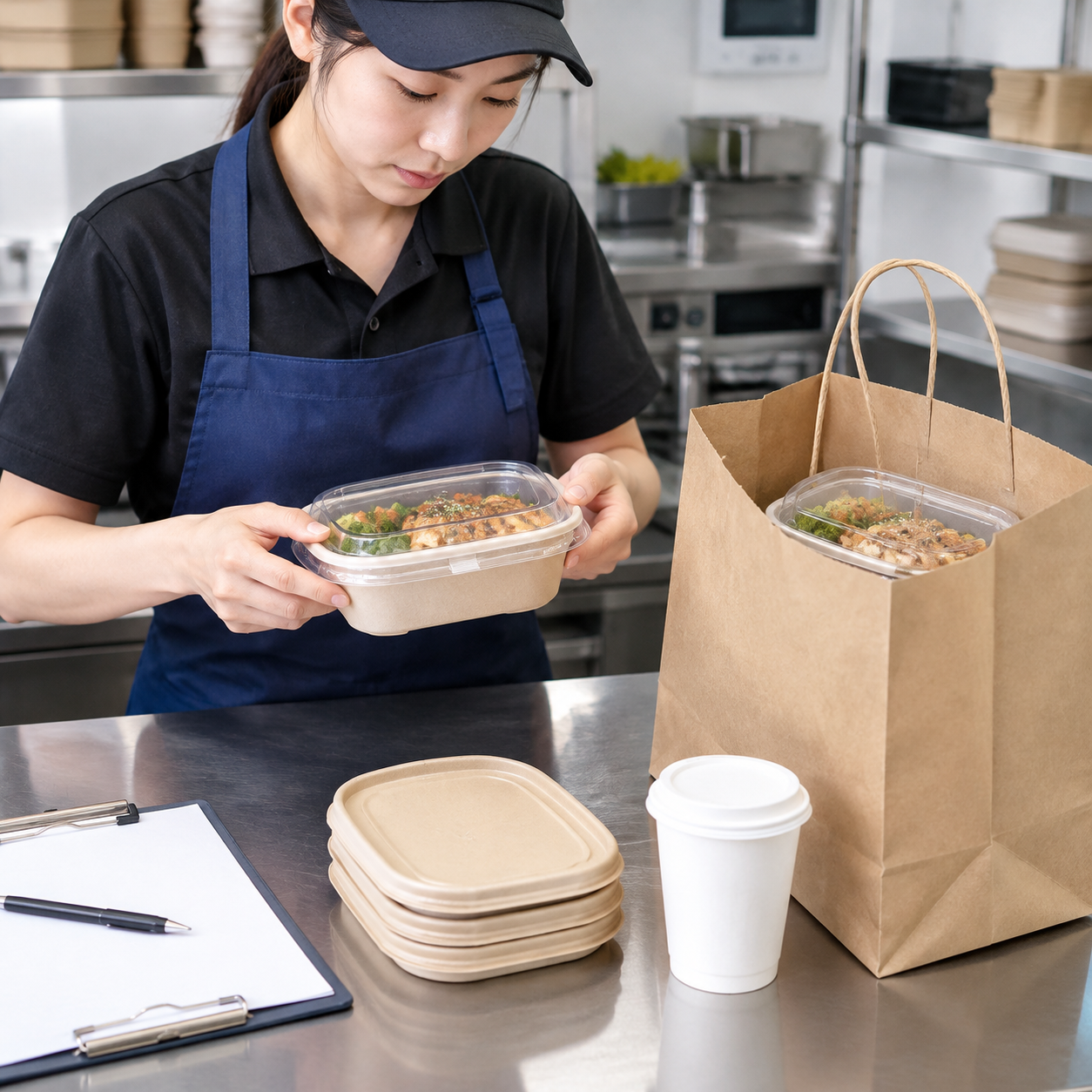
Approve packaging through representative store trials and agreed inspection criteria before a chain-wide release. Packaging sample approval should cover both the physical item and its intended operation.
- Confirm sample status: identify whether it is a structural prototype, printed proof, or production-representative sample, and record any differences.
- Test complete combinations: use the intended container, lid, sleeve, label, and outer bag together.
- Reproduce service conditions: check representative portions, grease, moisture, holding time, handling, and delivery movement.
- Observe staff use: assess opening, filling, closing, separating nested items, and fitting storage shelves.
- Record acceptance: retain approved references, test conditions, results, limitations, and sign-offs.
Agree measurable checks for dimensions, closure fit, print registration, agreed color references, cleanliness, carton counts, and application-specific leakage. Define defects and the inspection sampling plan before production; do not rely on an undefined instruction to supply “good quality.”
The tamper-evident delivery bag buyer’s guide adds relevant closure and use-case considerations. Tamper evidence indicates interference; it does not guarantee that interference is impossible.
Request food-contact documentation applicable to the finished construction and intended market. Keep compliance review separate from operational trials: successful delivery testing does not prove regulatory suitability.
Align MOQ, Cost, Inventory, and Shipping
Compare the delivered cost and inventory commitment of the complete packaging program. A low unit price can lose its advantage when regional variants create excess stock or urgent replenishment.
Ask whether MOQ applies per structure, size, material, artwork, or production run. Shared construction does not automatically allow different printed versions to share one MOQ. Distinguish a factory production order from smaller releases held by an agreed warehouse or distributor.
- Commercial scope: item prices, tooling or print setup, samples, packing, freight terms, and applicable import costs.
- Schedule: artwork approval, sampling, production, inspection, export transit, customs, and onward delivery.
- Inventory: demand by location, seasonal changes, replenishment variability, minimum dispatch units, and accessory consumption.
- Storage: supplier-specified conditions, clean protected cartons, batch identification, and stock rotation.
Set reorder points using expected demand during the full replenishment period plus an agreed buffer. For custom food packaging for restaurant chains, include regional stock separately and align lid availability with container stock.
Confirm carton labels, pallet configuration, receiving requirements, and who holds reserve inventory. Packaging that nests efficiently may reduce storage volume, but verify actual carton measurements rather than estimating from individual item size. Confirm lead time against the approved specification and current production plan.
Roll Out Packaging with Clear Responsibilities
Release new packaging in controlled stages, with clear instructions for stores and distributors. Start with representative locations, review results, and expand after resolving observed problems.
Give each store an item list showing the approved SKU, compatible accessories, applicable menu items, ordering code, and changeover date. Include handling guidance and a process for reporting failures with batch details and photographs. Assign responsibility for approving substitutions; an emergency replacement still needs application and market checks.
Key takeaways for custom food packaging for restaurant chains:
- Standardize validated applications and document necessary exceptions.
- Link specifications, artwork, accessories, and approvals through revision control.
- Test complete orders under representative store and delivery conditions.
- Plan inventory by location and variant, not just total chain demand.
- Track complaints by SKU and batch so corrective action reaches affected stores.
Review early rollout performance before the next production order. Changes to material, coating, dimensions, or suppliers should trigger proportionate revalidation and formal approval.
Conclusion: Specify Once, Control Every Location
Successful custom food packaging for restaurant chains connects menu needs with controlled specifications, approved samples, realistic inventory plans, and consistent store instructions. Use a shared core range where validated, retain justified regional variants, and make every change traceable. This creates a clearer basis for supplier quotations, repeat production, and dependable replenishment across locations.
FAQ
Should every restaurant location use the same packaging?
Use shared packaging where food applications, portions, workflows, and market requirements align. Approve separate variants when testing or local requirements justify them. Record each exception and review whether it remains necessary.
Can several artwork versions share one minimum order quantity?
Possibly, but this requires supplier confirmation. MOQ may apply separately to each size, structure, material, or artwork. Ask for a quotation that identifies production minimums and any agreed warehouse release quantities.
What samples should a chain approve before production?
Approve structure and accessory fit, printed appearance, and food performance under representative store conditions. Identify whether samples represent the intended production process and document any differences. Retain approved references and acceptance records.
How can a chain keep packaging colors consistent?
Use controlled artwork revisions, agreed color references, and approved printed samples on the intended substrate. Define evaluation conditions and acceptable variation with the supplier. Paper, coatings, and printing methods can affect the finished appearance.
What information is needed to quote custom food packaging for restaurant chains?
Provide packaging type, food application, dimensions or capacity, material and coating, quantities by SKU, artwork, compatible lids or accessories, destination markets, and delivery arrangement. Include forecasts and regional variants so sampling, MOQ, price, and lead time can be assessed against the actual program.
Need the Right Packaging for Your Food Product?
Tell us your product or packaging type, food application, dimensions or capacity, preferred material and coating, quantity by SKU, printing requirements, compatible lid or accessory, and destination market. Include your location count, regional variants, and artwork for review. Guangzhou YBJ Paper & Plastic Co., operating since 1998, supports design, samples, production, quality control, and export service. Our team will recommend a suitable structure and prepare sampling and quotation options for your restaurant packaging program.