

Table of Contents
- Define Fixed and Variable Packaging Data
- Food Packaging Artwork Barcode Batch Code Checklist
- Compare Methods for Applying Variable Data
- Match the Coding Panel to the Packaging Format
- Approve Artwork and Validate Production Codes
- Specify MOQ, Sampling, Storage, and Shipping
- Frequently Asked Questions
- Conclusion and Key Takeaways
Plan barcode locations, batch-code fields, and best-before panels before approving packaging artwork. This buyer’s guide explains data ownership, coding surfaces, verification, production trials, and supplier checks.
Define Fixed and Variable Packaging Data
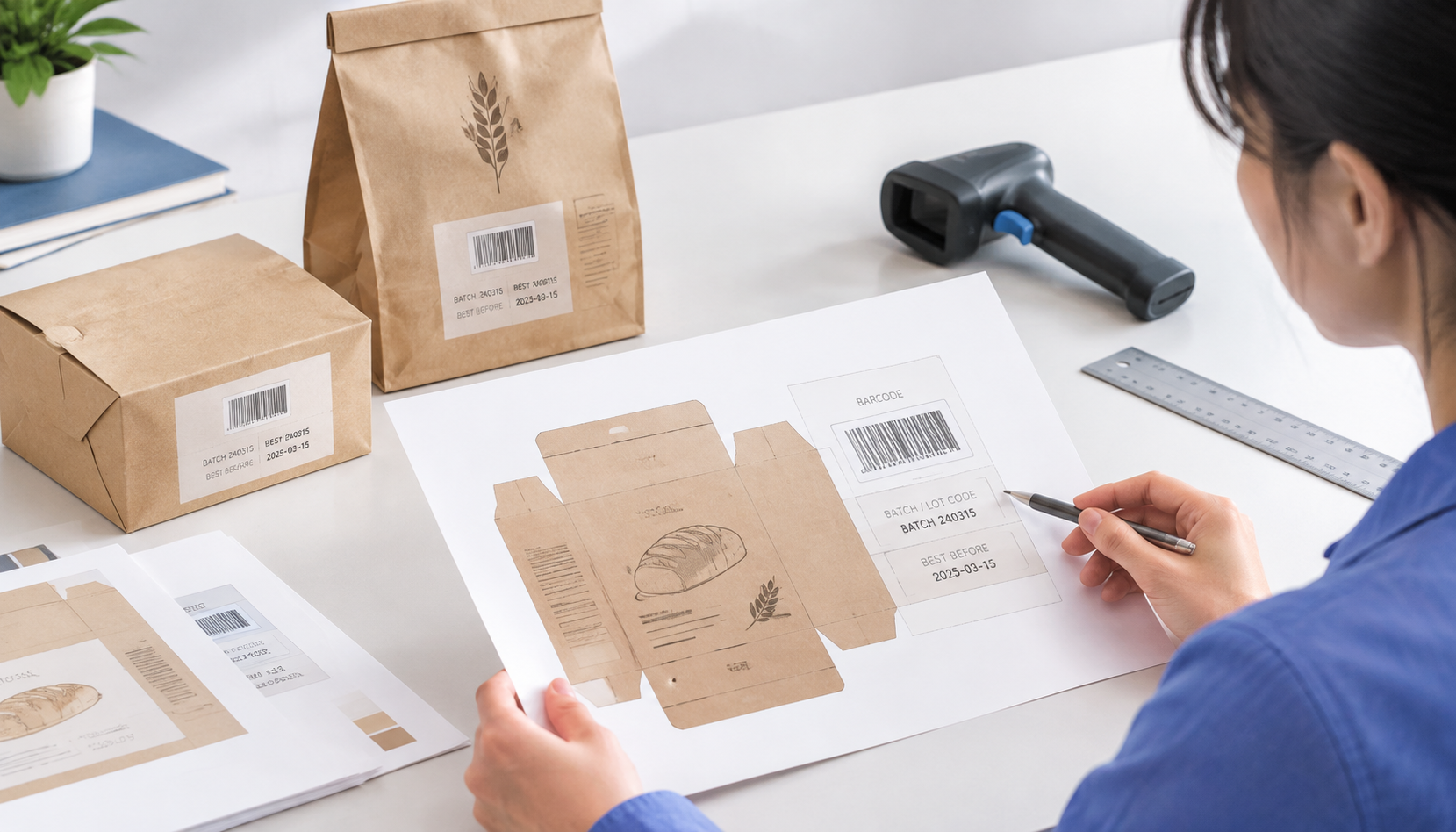
A food packaging artwork barcode batch code specification should reserve readable, accessible areas for product identification and production information before the design is approved. Set the barcode type and dimensions, protect its clear margins, and agree who applies batch codes and date marks. Validate the finished packaging on the intended coding and scanning equipment.
Fixed data stays the same across an approved packaging version, such as branding or a product-specific retail barcode. Variable data changes between production runs or individual packs, such as a lot number, best-before date, or serial identifier. A coding panel is the designated surface where this changing information will be applied.
A barcode is a machine-readable symbol containing encoded data. It is not automatically variable: a retail product barcode may be preprinted, while a suitable logistics or two-dimensional symbol may encode changing information. The receiving retailer, distributor, or traceability system determines which format and data structure are acceptable.
A batch code identifies a defined production lot. A best-before date generally communicates quality duration under stated storage conditions; a use-by date serves a different purpose in many markets. Confirm the required wording, format, and placement with the food business responsible for labeling. Packaging artwork does not establish shelf life.
Food Packaging Artwork Barcode Batch Code Checklist
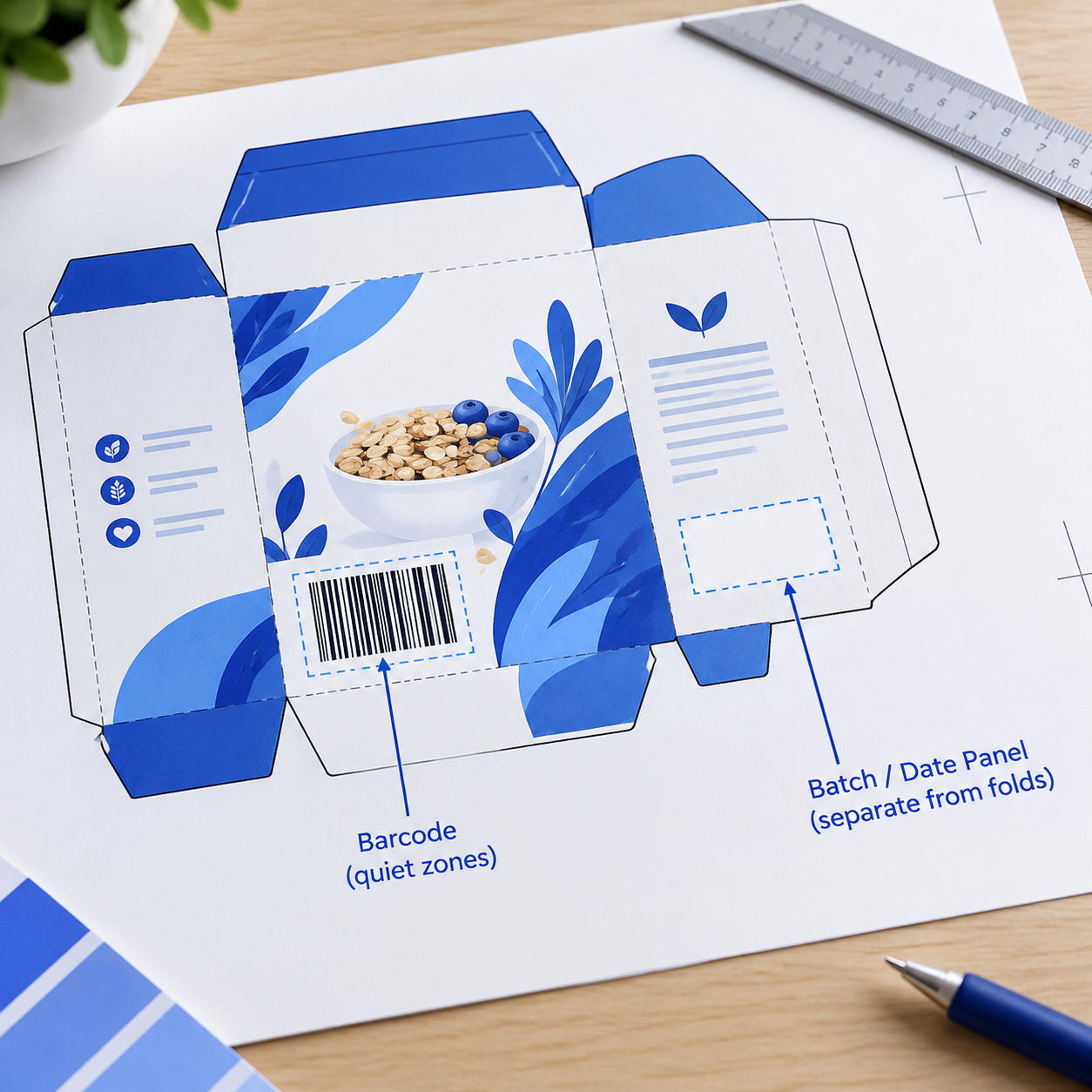
Approve the data specification alongside the dieline, because the finished shape determines whether codes remain visible and readable.
- Assign data ownership. Name the person approving product identifiers, lot-number logic, date calculations, and market-specific labeling.
- Specify the symbol. Record the barcode format, encoded data, required dimensions, and verification criteria. For GS1 identifiers, use correctly assigned numbers and the applicable GS1 requirements.
- Protect quiet zones. These are clear margins around the symbol. Keep text, borders, graphics, and cutting or folding effects outside the required area.
- Define contrast. Dark bars or modules on a light, opaque background are a practical starting point. Confirm suitability with verification, especially on colored, clear, or metallic materials.
- Locate the coding panel. Keep it away from seams, folds, sealing jaws, tear features, and areas obscured by lids or labels.
- Allow for real data. Reserve space for the longest approved lot code and date string, including prefixes, separators, and additional lines.
- Separate instructions from printable content. Mark variable fields on a nonprinting technical layer and identify any fixed wording that must appear.
Record panel dimensions and position in millimeters from defined dieline references. Agree allowable positional variation with the supplier and filling-line operator rather than choosing a universal allowance.
For file preparation, use the separate custom food packaging artwork requirements guide. Barcode scaling, quiet zones, and coding-panel suitability need their own approval beyond general artwork checks.
Compare Methods for Applying Variable Data

Select the coding method against the actual substrate, production sequence, and operating conditions. No method works equally well on every paper coating or plastic surface.
| Method | Typical role | Artwork or surface requirement | Main validation point |
|---|---|---|---|
| Fixed packaging print | Branding, fixed barcode, date-field headings | Approved symbol size and clear background | Print gain, contrast, and performance after converting |
| Continuous or thermal inkjet | Batch codes and dates on a production line | Accessible panel and compatible ink/substrate combination | Drying, adhesion, line speed, and condensation resistance |
| Thermal transfer overprinting | Variable text and symbols on compatible flexible packaging | Suitable ribbon, film, and supported printing area | Transfer quality, abrasion resistance, and machine compatibility |
| Laser marking | Permanent marks on suitable materials | Material or coating with a validated laser response | Contrast and absence of unacceptable barrier or structural damage |
| Printed label | Variable data on an applied label | Space for label placement without hiding required information | Adhesion, wrinkles, placement, and scanning after storage |
A coating-free window may help one ink system but reduce resistance to grease or moisture. Treat it as a change to the packaging specification. Laser marking also needs material-specific trials; do not assume any kraft board or plastic film will produce a readable mark.
Confirm coding responsibility explicitly. The packaging supplier may provide fixed print and a reserved panel, while the food packer applies dates and lots after filling. If variable printing is requested from the supplier, confirm capability and workflow before ordering.
Match the Coding Panel to the Packaging Format
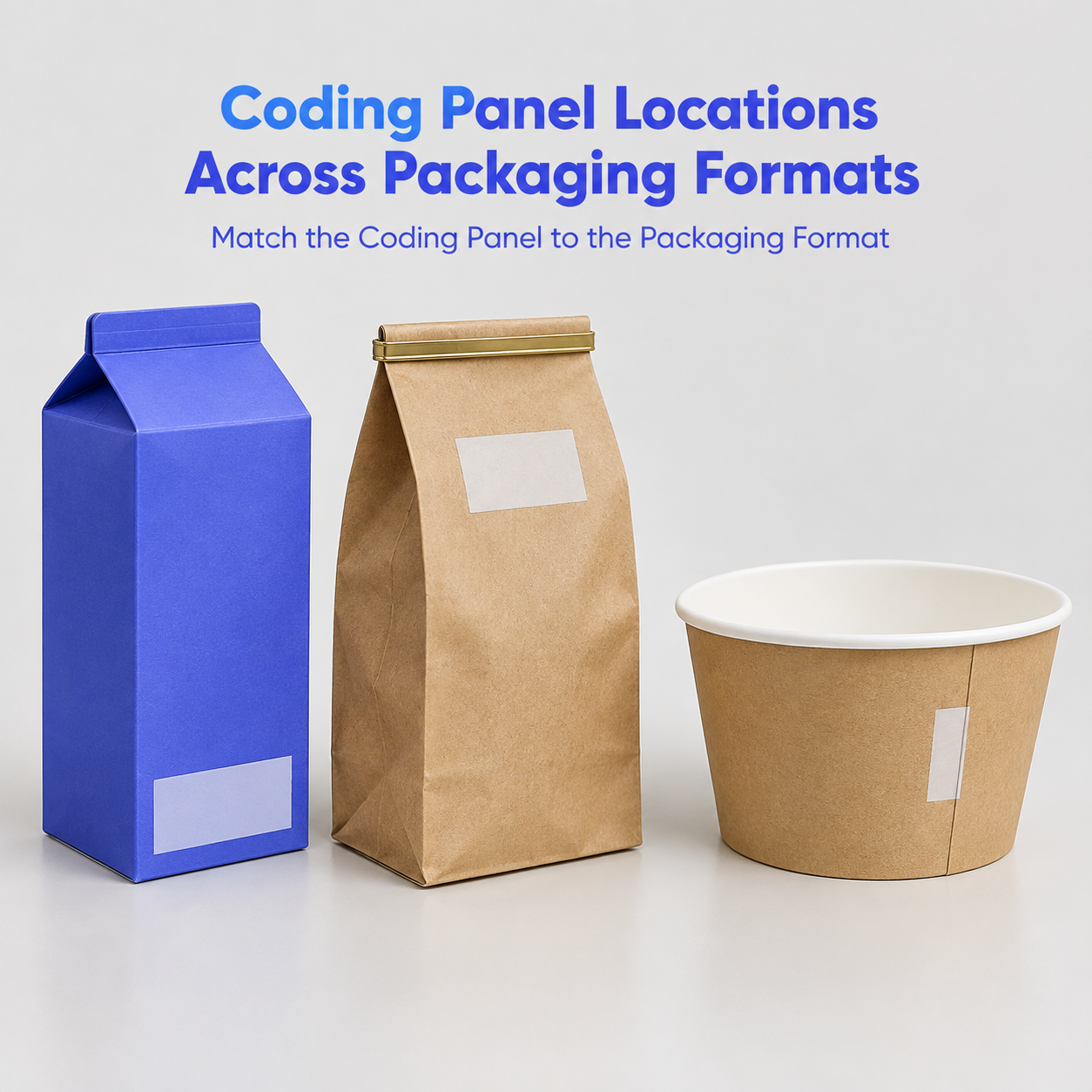
The best location is a surface that stays accessible, stable, and visible throughout filling, closing, transport, and sale. These format-level checks guide sampling; they do not establish a product’s coding capability.
| Packaging format | Panel planning | Sample check |
|---|---|---|
| Paperboard food box | Use a flat panel clear of creases, glue flaps, and closures | Inspect and scan after erection and filling |
| Bakery or tin tie paper bag | Avoid gussets, closure folds, windows, and ties | Check visibility and distortion after closing |
| Paper cup or bowl | Account for curvature, taper, and the side seam | Validate scanner access and coding-head positioning |
| Plastic container or lid | Avoid ribs, embossing, and unstable reflective areas | Test ink adhesion and readability under intended conditions |
| Foil container with a separate lid | Evaluate a suitable lid panel or label location | Check glare, handling, and lid attachment |
For resealable bags, review the structure considerations in the tin tie paper bag buyer’s guide before finalizing the coding location.
If a code appears on a removable lid, confirm that its location satisfies the applicable labeling and traceability requirements. Keep barcode backgrounds sufficiently opaque where the contents could otherwise alter contrast.
Approve Artwork and Validate Production Codes
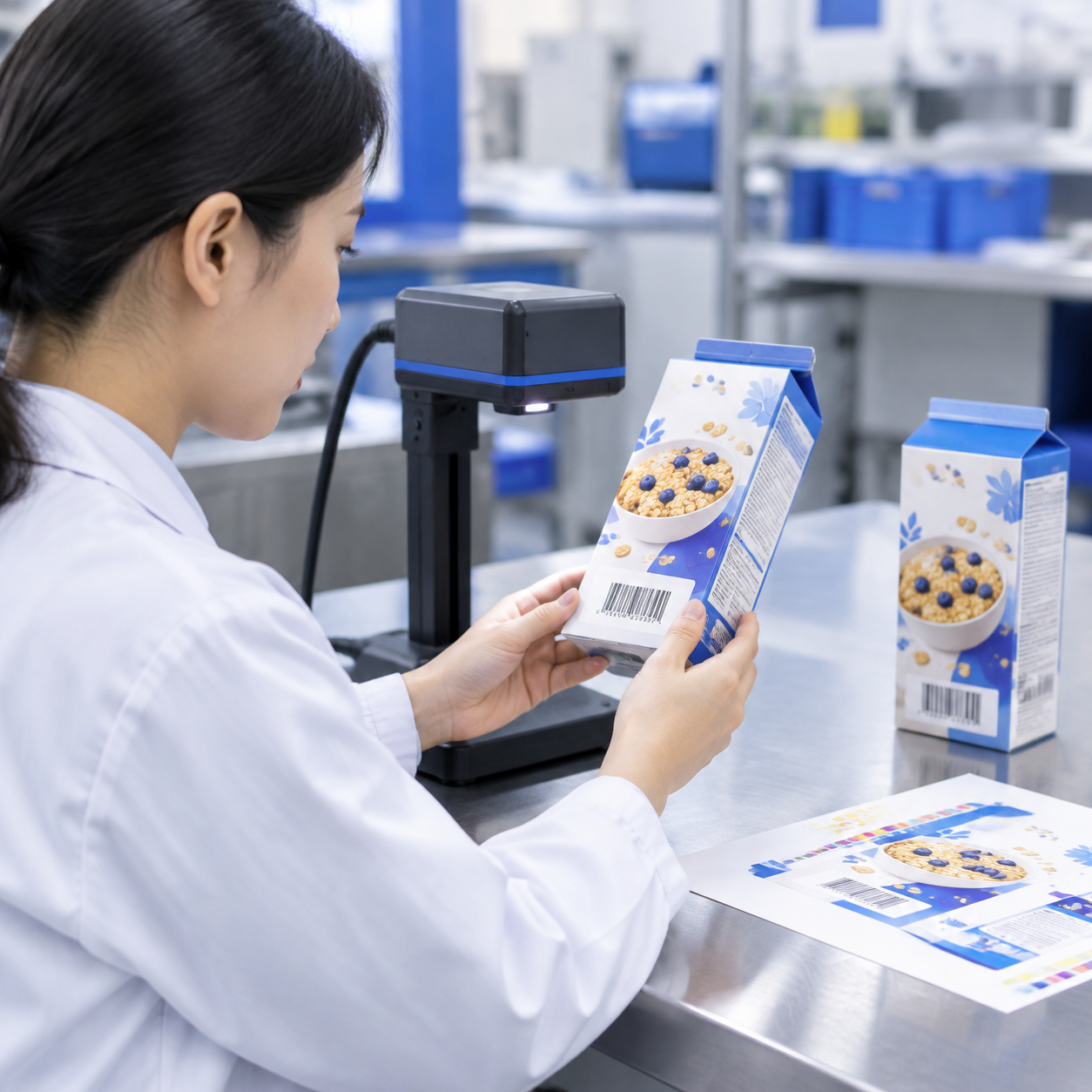
A successful phone scan is a useful spot check, but it does not replace barcode verification against the agreed standard and acceptance criteria.
- Check the source data. Compare encoded content with the approved identifier and human-readable text. Confirm date format, lot rules, and any field separators.
- Review artwork at final size. Prevent unintended stretching, cropping, or resampling of barcode graphics. Confirm panel location on the approved dieline.
- Inspect a representative physical sample. Use the intended substrate, coating, and print process. A desktop proof cannot establish production scan quality or coding adhesion.
- Run a coding trial. Use realistic line speed, pack orientation, code length, and environmental conditions. Check startup, changeovers, and interruptions.
- Verify finished packs. Evaluate appropriate barcode quality measures and readable text after forming, filling, closing, and representative handling.
- Approve release controls. Define inspection frequency, retained samples, rejection handling, and authorization for data changes.
For chilled applications, include relevant condensation exposure. For oily products, assess realistic surface contamination and handling. Agree test methods and acceptance limits in advance; a vague instruction to make the code “rub resistant” is difficult to enforce.
Combine these checks with the food packaging quality control checklist. Correct data and physical print quality require separate inspection: a clear code can still contain the wrong date.
Specify MOQ, Sampling, Storage, and Shipping
Request a quotation for the complete packaging and coding specification. MOQ, price, sampling arrangements, and lead time depend on material, dimensions, coating, artwork versions, quantities, and production workflow.
Identify whether each SKU needs different fixed artwork or shares a common design with variable information added later. A shared design can reduce version complexity, but mandatory product information and operational controls may limit that approach. See how food packaging MOQ is calculated when planning order quantities.
Supplier brief: include the packaging format, food application, dimensions or capacity, material and coating, print colors, barcode file, coding method, panel position, longest data string, quantities per version, and destination market. Identify accessories and the party responsible for applying variable information.
Store empty packaging under supplier-recommended conditions and protect coding surfaces from dust, moisture, abrasion, and deformation. Specify carton identification that distinguishes artwork revisions and SKUs. During shipping trials, check whether stacking, rubbing, or labels obscure the code.
Food-contact compliance and material performance depend on the exact construction and destination market. Confirm inks, coatings, labels, and coding treatments for the intended use, including possible transfer when packs are stacked or nested. Guangzhou YBJ Paper & Plastic Co., operating since 1998, supports design, sampling, production, quality control, and export coordination; confirm the project-specific coding scope during artwork review.
Frequently Asked Questions
These answers address common decisions about barcode artwork, batch identification, and date panels. Final requirements depend on the receiving system, packaging specification, and destination market.
Conclusion and Key Takeaways
A reliable food packaging artwork barcode batch code specification connects approved data, a suitable coding surface, and verified production output. Resolve these requirements before committing to printed stock.
- Separate fixed artwork from changing batch and date information.
- Protect barcode dimensions, quiet zones, contrast, and panel access.
- Validate representative finished packs on the intended equipment.
- Agree data ownership, inspection criteria, and version control.
FAQ
Can the barcode, batch code, and best-before date all be preprinted?
A fixed product barcode can be preprinted. Batch codes and dates can be preprinted only when the correct values are known and the packaging is controlled for the intended production lot. Otherwise, reserve a panel and apply changing data during packing.
How large should a barcode and its quiet zones be?
Dimensions depend on the barcode format, encoded data, printing process, and receiving system. Use the applicable symbol specification and customer requirements. Do not shrink a barcode simply to fit spare space; adjust the layout and verify the finished result.
Can a batch code be printed directly on coated paper or plastic?
It may be possible with a compatible coding system, but adhesion and drying depend on the exact coating or plastic surface. Trial the intended ink or ribbon on production-representative material and assess rubbing, condensation, and handling where relevant.
Does a QR code replace a retail barcode or date mark?
Not automatically. A general QR code may link to a website without satisfying retail identification or labeling requirements. Confirm the accepted symbol, data structure, and scanner capability with the receiving customer, and retain required human-readable information.
Who approves the best-before date and batch-code rules?
The responsible food business should approve shelf-life information, lot logic, date wording, and destination-market requirements. The packaging supplier implements the approved artwork and agreed coding scope; it should not invent dates or determine shelf life from the packaging design.
Need the Right Packaging for Your Food Product?
Tell us your product and packaging type, food application, dimensions or capacity, material, coating, quantity, printing requirements, lid or accessories, and destination market. Share your artwork, barcode specification, and intended batch/date coding method for review. Our team will recommend a suitable structure and prepare sampling and quotation options.