

Table of Contents
- What Food Packaging MOQ Means
- Why Food Packaging Suppliers Set MOQs
- How Food Packaging MOQ Is Calculated
- Specifications That Can Change MOQ
- Standard vs. Custom Packaging MOQ
- How to Reduce MOQ and Inventory Risk
- Sampling, Production, Storage, and Shipping Checks
- How to Request an Accurate MOQ Quote
- Conclusion
Food packaging MOQ is the minimum quantity a supplier can produce efficiently for one exact packaging specification. This buyer guide explains the manufacturing factors behind MOQ and how to manage it when sourcing custom food packaging.
What Food Packaging MOQ Means
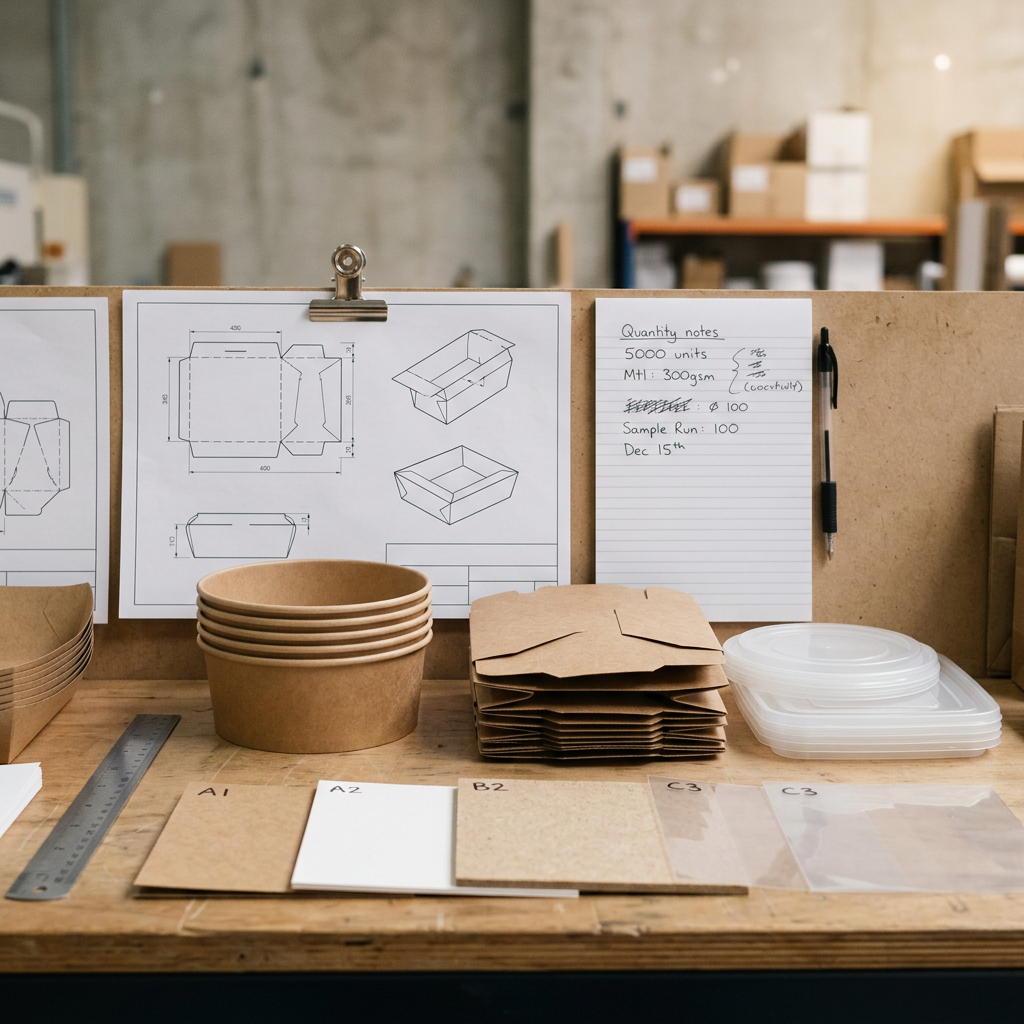
Food packaging MOQ means the minimum order quantity a manufacturer requires to make one defined packaging item under commercially workable production conditions. For a buyer, it is not simply the smallest number of cups, boxes, bowls, bags, or lids that a factory is willing to sell. It reflects the minimum volume needed to set up materials, equipment, printing, labor, inspection, and packing for a specific specification.
An MOQ applies to an exact stock keeping unit (SKU). Changing the size, paper grade, plastic resin, coating, color, print design, lid, handle, window, compartment layout, or packing method can create a different SKU and a different MOQ. For example, two paper food boxes with the same shape may not share an MOQ if one is plain kraft paper and the other has custom full-color printing and a functional barrier coating.
MOQ should also be distinguished from a production batch. A production batch is the quantity run together through a manufacturing process. The MOQ may be based on that batch size, but it may also be influenced by material suppliers’ minimums, printing setup, tooling requirements, or standard carton packing quantities.
Why Food Packaging Suppliers Set MOQs
MOQs exist because custom food packaging has fixed work before the first finished unit is produced. A factory may need to confirm artwork, prepare print files, order or allocate material, make or install tooling, adjust machine settings, run initial pieces for approval, inspect output, and pack finished goods. These activities consume time and materials whether the order is small or large.
For paper packaging, the practical minimum may be tied to printing-sheet utilization, die-cutting layout, folding and gluing setup, and the quantity of paperboard or coated paper available for the job. For plastic food packaging, it can depend on resin availability, molding or thermoforming tooling, color matching, sealing requirements, and the production run needed to keep equipment operating consistently.
MOQ therefore helps balance manufacturing efficiency with repeatable quality. It should not be treated as an arbitrary surcharge. A very low quantity can be possible in some cases, particularly for existing unprinted items or limited digital-print projects, but the unit cost may increase because fixed preparation costs are divided across fewer pieces.
For buyers planning meal kits, retail-ready meals, or delivery packaging, the item specification should be settled before MOQ discussions. Decisions on portions, fill level, stackability, compartments, and labels can change the package format. Review these operational requirements alongside the guidance in packaging for meal prep and grab-and-go food before finalizing a custom SKU.
How Food Packaging MOQ Is Calculated
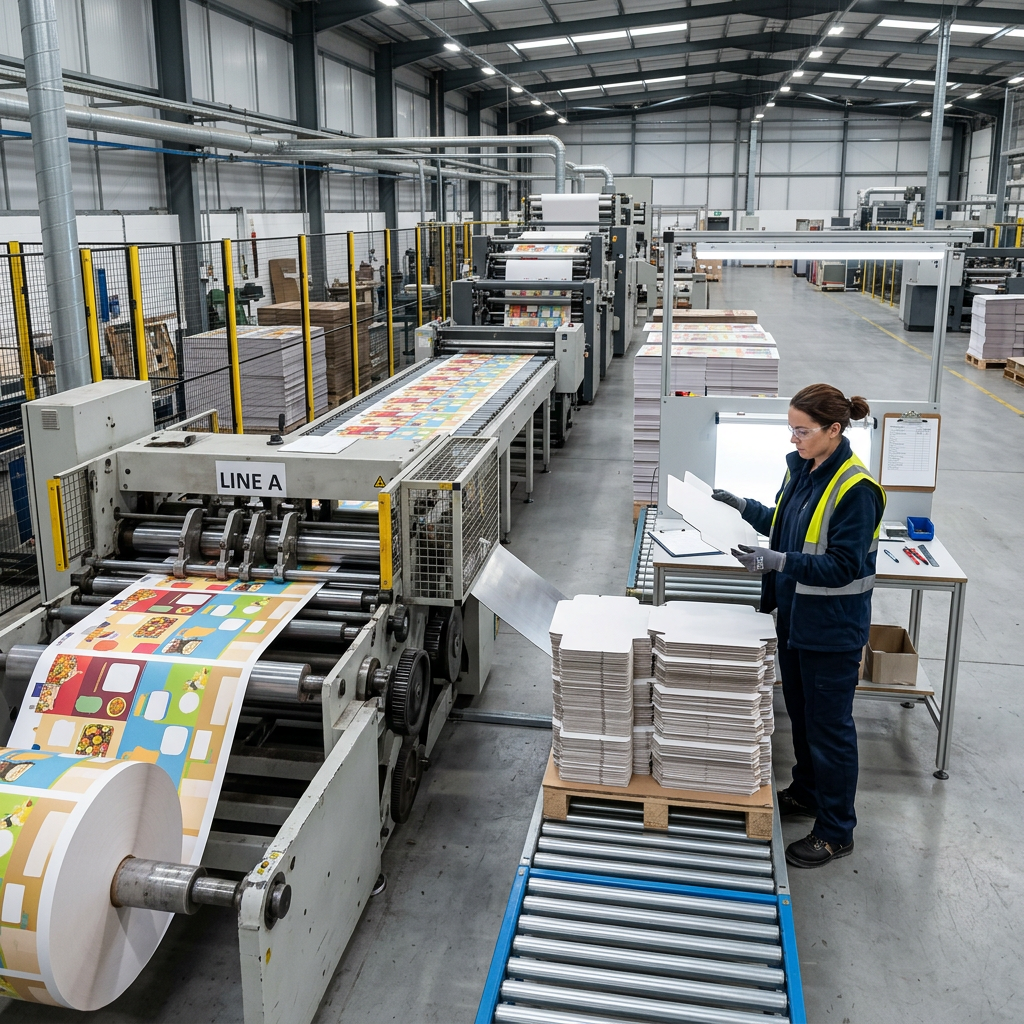
A supplier normally calculates food packaging MOQ by reviewing the complete item specification rather than applying one universal minimum. The process commonly starts with five questions: Is the item an existing model or a new design? Is it plain or custom printed? Which material and barrier treatment are required? Is new tooling needed? How will finished goods be packed and shipped?
1. Existing product or new structure
An existing cup, bowl, box, tray, bag, or lid generally has fewer setup requirements than a new structure. If the factory already has the matching mold or cutting die, the buyer may avoid a separate development stage. A new shape, special size, custom window, unusual compartment configuration, or proprietary closure can require development and tooling evaluation.
2. Material purchasing and conversion
Paper, paperboard, plastic film, plastic sheet, resin, inks, adhesives, and coatings may each have supplier minimums or efficient run sizes. The factory must also consider trim loss, setup waste, and process yield. This is why a requested finished quantity does not always equal the material quantity needed to start the job.
3. Printing method and artwork complexity
Custom printing creates setup work. Print colors, coverage area, artwork placement, varnish, metallic effects, and registration tolerance can affect the process selected and the amount of setup needed. Artwork must be supplied in a production-ready format and approved before mass production. A design revision after approval may require a new assessment of cost, timing, and minimum quantity.
4. Forming, converting, and assembly
After printing or material preparation, packaging may be die cut, formed, heat sealed, glued, rim rolled, or assembled with handles, inserts, lids, or liners. Each operation has an efficient run range. Packaging that requires several components must also be evaluated as an assembled system, not only as individual parts.
5. Packing configuration
Finished packaging is often packed in inner sleeves, bags, or bundles and then into export cartons. A requested quantity that does not align with the packing configuration can require partial cartons or special packing instructions. That may be acceptable, but it should be agreed in writing because it affects counting, warehousing, and shipment planning.
Specifications That Can Change MOQ
Buyers should provide a specification sheet early because small changes can alter the food packaging MOQ. The following details are especially important:
- Product format: cup, bowl, tray, clamshell, carton, paper bag, sleeve, liner, or other item.
- Dimensions or capacity: length, width, height, diameter, volume, fill line, and tolerance where relevant.
- Material construction: paper grade, paperboard thickness, plastic type, single-layer or multi-layer construction, and required coating or lamination.
- Food application: dry, oily, saucy, hot, chilled, frozen, bakery, fried food, or other use condition.
- Print requirement: plain, one-color, multiple colors, inside print, outside print, coverage area, and artwork status.
- Accessories: compatible lid, insert, liner, handle, sleeve, sealing film, or tamper-evident label.
- Functional requirements: grease resistance, moisture resistance, leak control, venting, stackability, visibility, or tamper evidence.
- Destination market: the country or region where the package will be used and distributed.
Food-contact compliance is not a generic statement that can be assumed from a product name. Applicable requirements depend on the exact material construction, intended food contact, use conditions, and destination market. Buyers should state the market and intended application during inquiry so the supplier can review the relevant documentation and production controls.
Material language also needs precision. Recyclable means a package may be accepted in an available recycling stream; acceptance depends on local collection and processing systems. Compostable refers to a package designed to break down under defined composting conditions and requires evidence for the exact product and market claim. Biodegradable is not interchangeable with compostable. Plastic-free means no plastic is present in the stated product construction, not merely that the package uses paper. Read the detailed distinctions in this guide to recyclable, compostable, and biobased packaging claims.
Standard vs. Custom Packaging MOQ
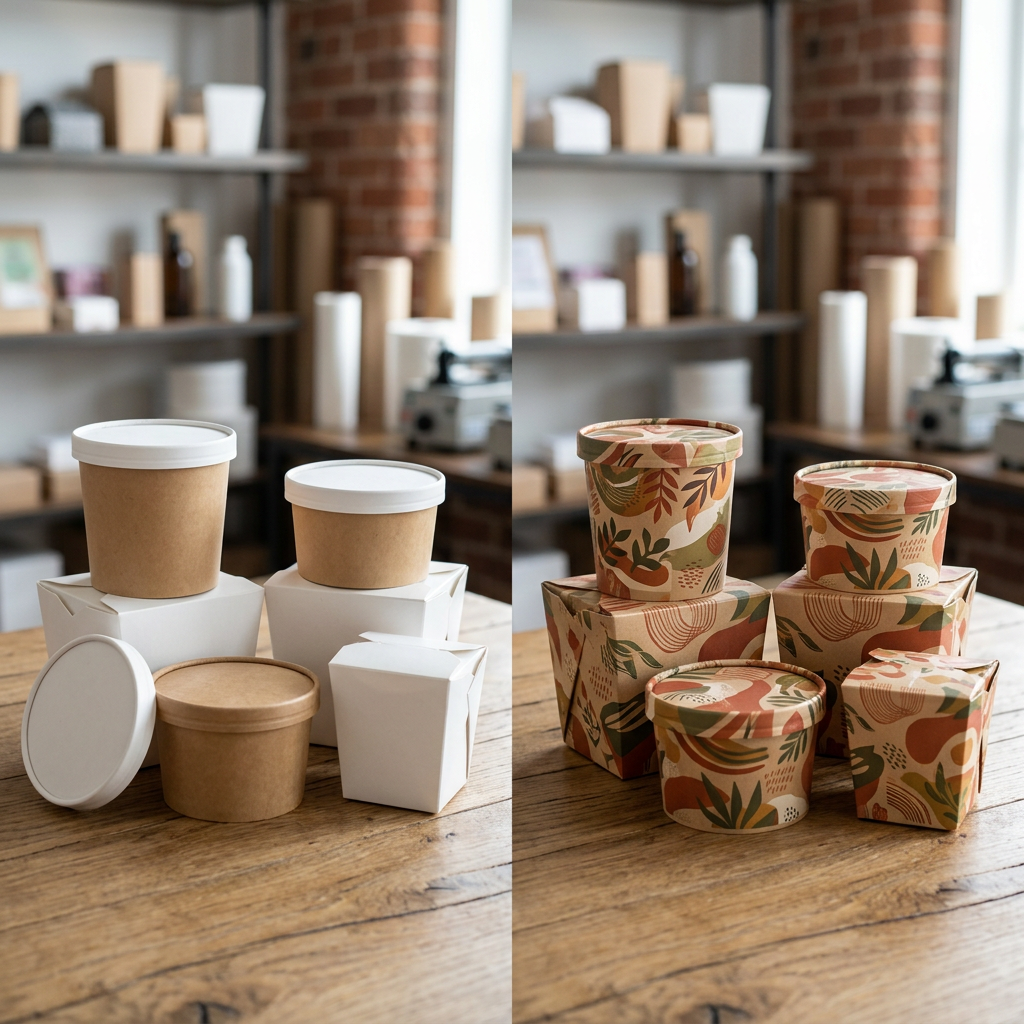
The most effective way to understand MOQ is to separate standard stock-style packaging from custom packaging.
Standard or existing-format packaging
Standard packaging uses an established shape and existing production method. It may be available plain, with limited customization, or with a compatible standard lid or accessory. Since no new structure is required, it can be a practical starting point for market testing, seasonal programs, or buyers with limited storage space. Availability, material options, carton quantities, and MOQ still need confirmation for each item.
Custom printed existing-format packaging
This option retains an existing size and structure but adds the buyer’s artwork. It avoids structural development but still involves print setup, color control, material allocation, and production planning. It is often suitable when branding is important but the food application does not require a unique form.
Fully custom packaging
Fully custom packaging can include a new dieline, size, shape, molded component, construction, or coordinated multi-part system. It provides the greatest design flexibility but may require more engineering review, sampling, tooling, approvals, and a larger production commitment. It should be selected when functional performance or brand presentation cannot be achieved with an established format.
Size selection should be confirmed before custom artwork or tooling is approved. Packaging that is oversized can increase material use, freight volume, and portion inconsistency, while undersized packaging can compromise closure or presentation. Use the practical checks in the packaging size and portion-control guide when defining dimensions and capacity.
How to Reduce MOQ and Inventory Risk
MOQ management is not only about asking for a smaller number. It is about reducing the risk of buying the wrong packaging specification or holding more inventory than operations can use before a design, menu, or regulation changes.
- Start with an existing structure. If a standard size works, customize printing before investing in a completely new format.
- Limit variations at launch. Consolidate sizes, print designs, and accessory combinations where operationally possible. Multiple artwork versions usually split volume across separate SKUs.
- Use one coordinated design system. Shared colors and common layout rules can simplify artwork management, although every printing process must still be evaluated separately.
- Forecast consumption by SKU. Estimate weekly or monthly usage, service locations, storage capacity, promotional periods, and safety stock. Do not base the order only on a total annual forecast if products will be consumed at different rates.
- Confirm compatibility. Check that bowls match lids, trays fit sealing equipment, and bags accommodate the packed food item. A low-MOQ main component is not useful if a required accessory has a different supply constraint.
- Plan repeat orders. Ask how repeat ordering works once approved artwork, tooling, and specification records are on file. Retained files do not automatically mean the original MOQ, price, or production schedule will remain unchanged.
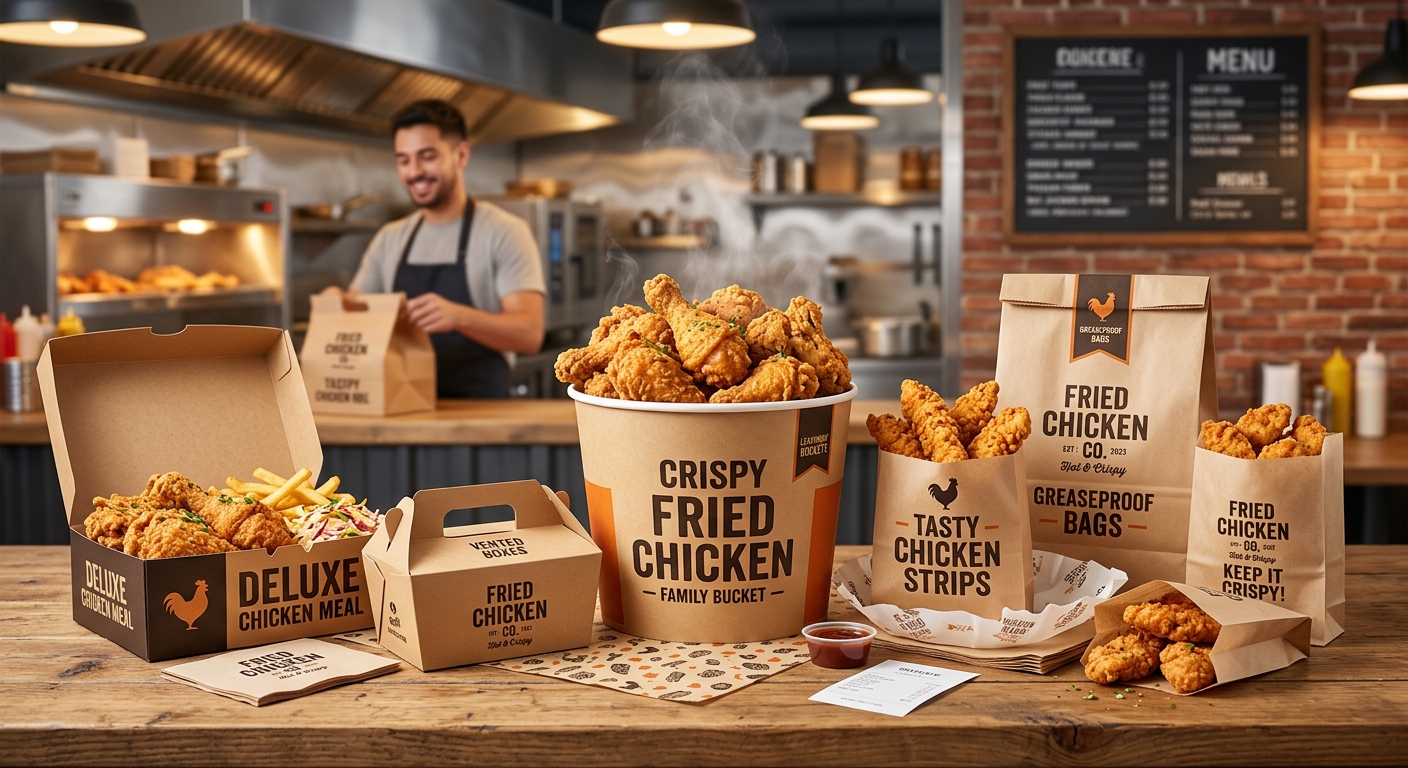
Application testing should be part of the decision. Fried foods, for example, may require a balance between heat retention, grease management, and venting. If this is your application, consult guidance on packaging fried foods for venting and grease control before committing to a large custom quantity.
Sampling, Production, Storage, and Shipping Checks
MOQ should be reviewed together with the complete procurement process, not in isolation. A lower initial quantity may not reduce total sourcing risk if it leaves insufficient time for sample approval, testing, production, export packing, or delivery to the destination market.
Sampling and approval
Ask what type of sample is available: an existing reference sample, a blank structural sample, a printed proof, a pre-production sample, or another agreed sample type. Each serves a different purpose. A blank sample can confirm fit and basic construction, but it may not confirm final print appearance. A pre-production sample can be used to review the agreed specification before the main run where applicable. Confirm what is being approved, how approval is recorded, and whether any changes affect the order.
Functional testing
Test with the actual food, filling process, transport route, and expected holding period. Check filling volume, closure engagement, leakage, grease migration, condensation, stacking, compression, label adhesion, and opening experience. Where a package will be heated, chilled, frozen, or used with a particular process, disclose that condition before material selection. Do not assume performance from another application or packaging format.
Storage planning
Calculate storage by carton dimensions and pallet configuration, not only by unit count. Printed packaging should be protected from conditions that could affect its appearance or structure. Rotate inventory using a clear stock-control method, and avoid ordering several design versions unless they can be consumed within your planned cycle.
Shipping and delivery planning
Food packaging is often light but volumetric. Freight cost can be driven by the packed volume of cartons rather than product weight alone. Confirm carton dimensions, gross weight, palletization if applicable, shipping marks, loading plan, and whether accessories are packed together or separately. Destination market, shipping method, quantity, inspection requirements, and documentation needs all influence the final procurement plan. MOQ, price, compliance documentation, and lead time depend on the confirmed specification and destination market.
How to Request an Accurate MOQ Quote
A request for “your MOQ” without a product specification can only receive a general answer. To obtain a useful MOQ assessment and quotation, provide the following information in one inquiry:
- Product type and intended food application
- Dimensions, capacity, and required quantity per SKU
- Preferred material and any required coating or barrier performance
- Whether the item should be plain or custom printed
- Artwork files, color references, and print locations if available
- Required lid, insert, liner, sealing film, handle, or other accessory
- Expected order frequency and estimated annual volume, if known
- Destination market and delivery location
- Requested sample type and required testing process
- Target packing method, storage limits, or shipping preferences
Ask the supplier to state whether the MOQ is per design, per size, per colorway, per material, or per complete item set. Also ask whether tooling, sampling, artwork preparation, special packing, or testing is quoted separately. Clear answers prevent a common sourcing error: comparing two MOQ figures that cover different product specifications or different levels of customization.
For delivery programs, consider whether the package needs a tamper-evident feature such as a seal, label, or closure solution. This can affect materials, assembly steps, and the number of components to be ordered. See the tamper-evident takeout packaging guide for selection considerations.
Conclusion: Evaluate Food Packaging MOQ as a Production Decision
Food packaging MOQ is calculated from the actual work required to make one approved packaging SKU: material supply, print setup, tooling or existing equipment, converting operations, quality checks, packing, and shipment planning. The best MOQ is not always the lowest figure. It is the quantity that supports reliable manufacturing, appropriate packaging performance, manageable inventory, and a realistic total procurement plan.
For custom printed food packaging, define the food application and final specification first, approve samples against real use conditions, and compare quotations on a like-for-like basis. Material performance, food-contact compliance, MOQ, price, production timing, and shipping requirements must be confirmed for the exact product specification and destination market.