

Table of Contents
- Food Packaging for Sauces and Condiments: Start with the Recipe
- Choose a Format Around Serving and Filling
- Compare Materials and Barrier Requirements
- Specify Portions, Capacity, and Headspace
- Control Leaks Through the Complete Closure System
- Validate Samples with Actual Sauces
- Align MOQ, Printing, Production, and Shipping
- Key Takeaways for Packaging Buyers
- Conclusion: Approve the Packaging as a System
Specify sauce and condiment packaging around the actual recipe, serving portion, filling conditions, and delivery journey. Compare portion cups, sealed tubs, sachets, and material options, then verify lid fit, leakage, food-contact suitability, and purchasing requirements.
Food Packaging for Sauces and Condiments: Start with the Recipe
The right food packaging for sauces and condiments matches the recipe, serving portion, filling temperature, closure, and delivery conditions. Start by identifying whether the product is thin, oily, acidic, thick, or particulate; then select a container-and-closure system and test it with the actual food. Material choice alone cannot establish leak resistance or shelf life.
A watery dressing can escape through a small closure gap. A thick dip may need a wider opening, while chili oil can expose compatibility problems that a water-only test misses. A refrigerated takeaway portion and a shelf-stable retail sauce require different packaging and process validation.
- Portion packaging
- A pack intended to deliver a defined serving, such as a dipping cup or single-use sachet.
- Barrier
- A material layer that limits passage of moisture, grease, gases, or other substances. The required barrier depends on the product and storage period.
- Closure system
- The container rim, lid or sealing film, and application process that together close the pack.
- Headspace
- The space between the filled product and the closure.
Record the food application, oil content, acidity, particles, fill conditions, storage conditions, and expected time before consumption. Exact material performance and food-contact compliance depend on the complete specification and destination market.
Choose a Format Around Serving and Filling
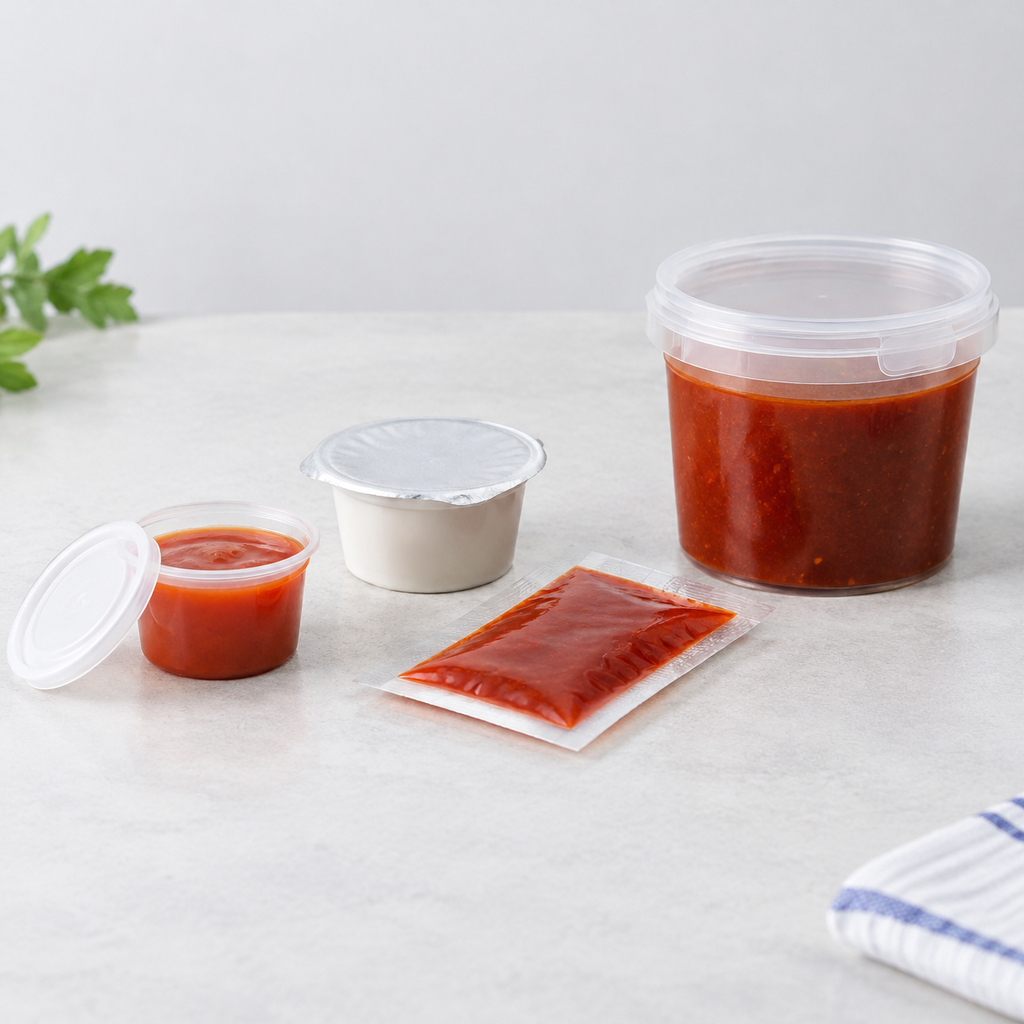
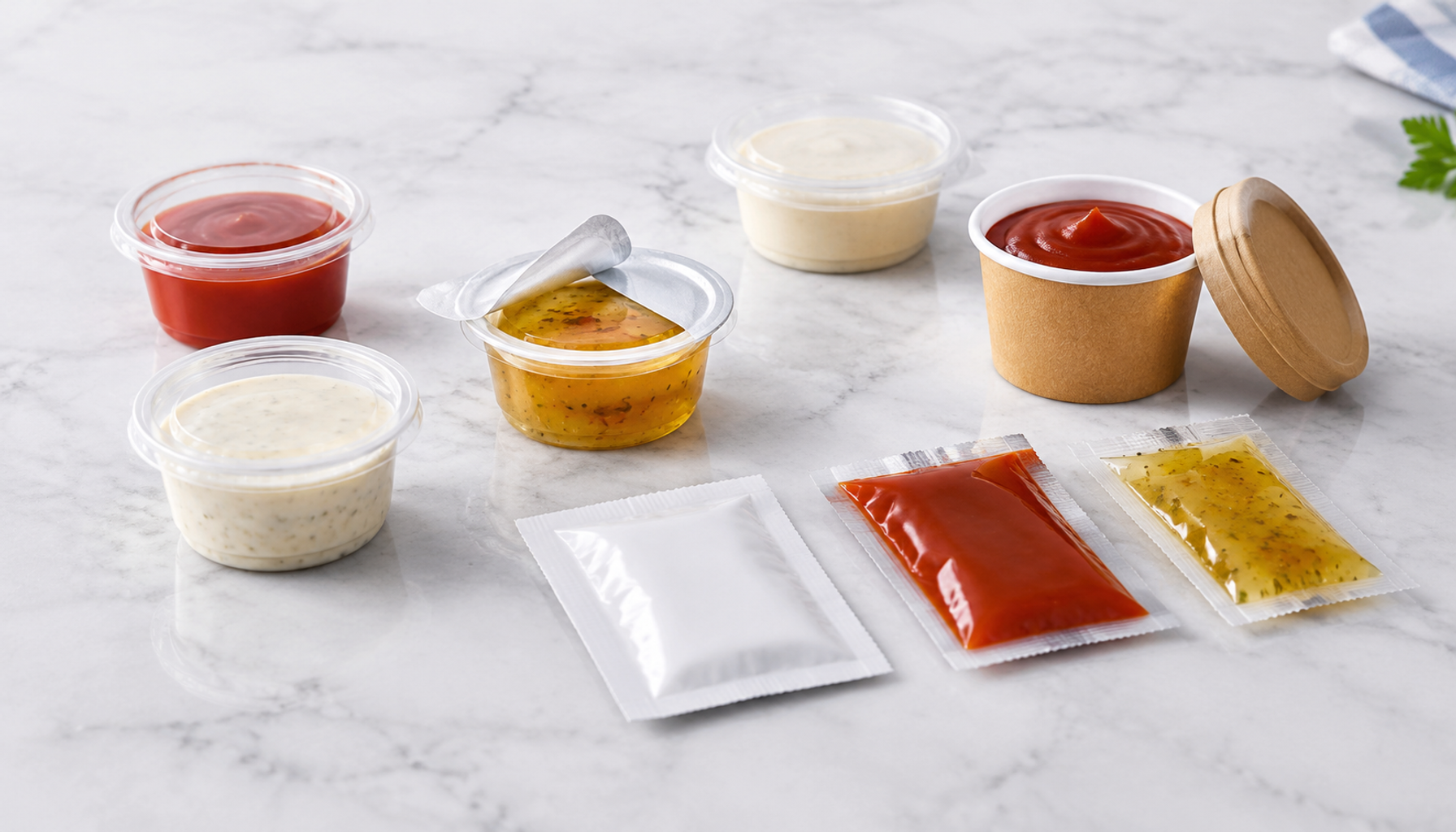
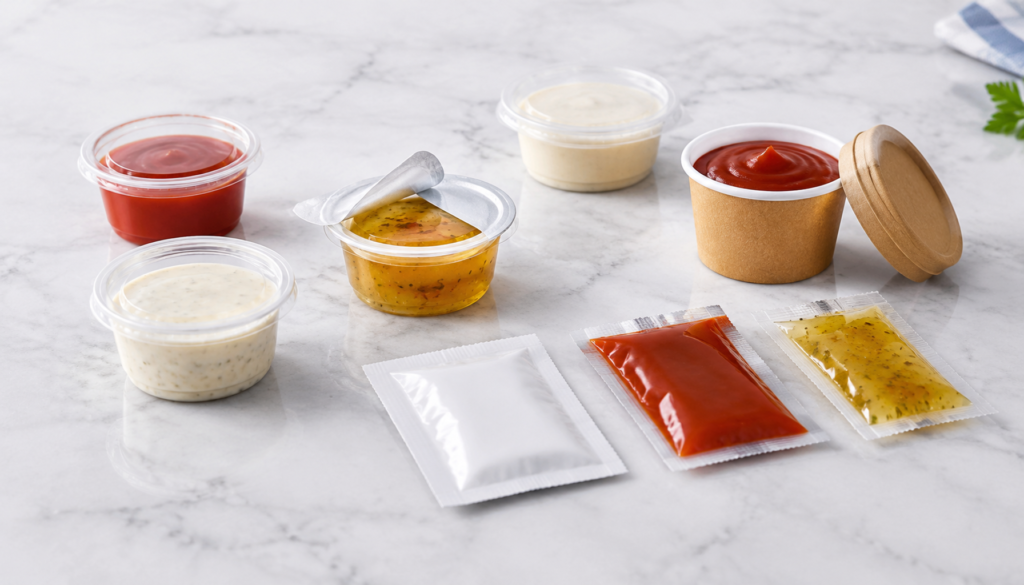
Select the packaging format by how the sauce will be filled, transported, opened, and consumed. The following product-format table describes options to evaluate; availability and customization require supplier confirmation.
| Product format | Typical application | Buying advantage | Specification to verify |
|---|---|---|---|
| Portion cup with snap-on lid | Restaurant dressings, dips, and delivery sauces | Supports manual filling and direct dipping | Rim geometry, lid retention, usable capacity, and packing orientation |
| Cup or tub with heat-sealed film | Pre-portioned dips and controlled filling operations | Provides a continuous seal when the process is validated | Film compatibility, seal window, peelability, and equipment fit |
| Flexible sachet | Single-use ketchup, mustard, or smooth sauces | Compact format with controlled servings | Film barrier, seal integrity, opening feature, and filling-machine compatibility |
| Resealable tub or bottle | Multi-serving sauces and catering supply | Supports repeated dispensing | Closure integrity, opening size, dispensing behavior, and storage instructions |
For restaurant delivery, check whether each portion remains upright beside the meal. For sachets, assess whether particles can pass through the filling nozzle and whether the customer can empty the pack easily. Do not assume that a sealed portion pack makes a sauce shelf-stable; formulation, processing, and storage must also be validated.
Compare Materials and Barrier Requirements
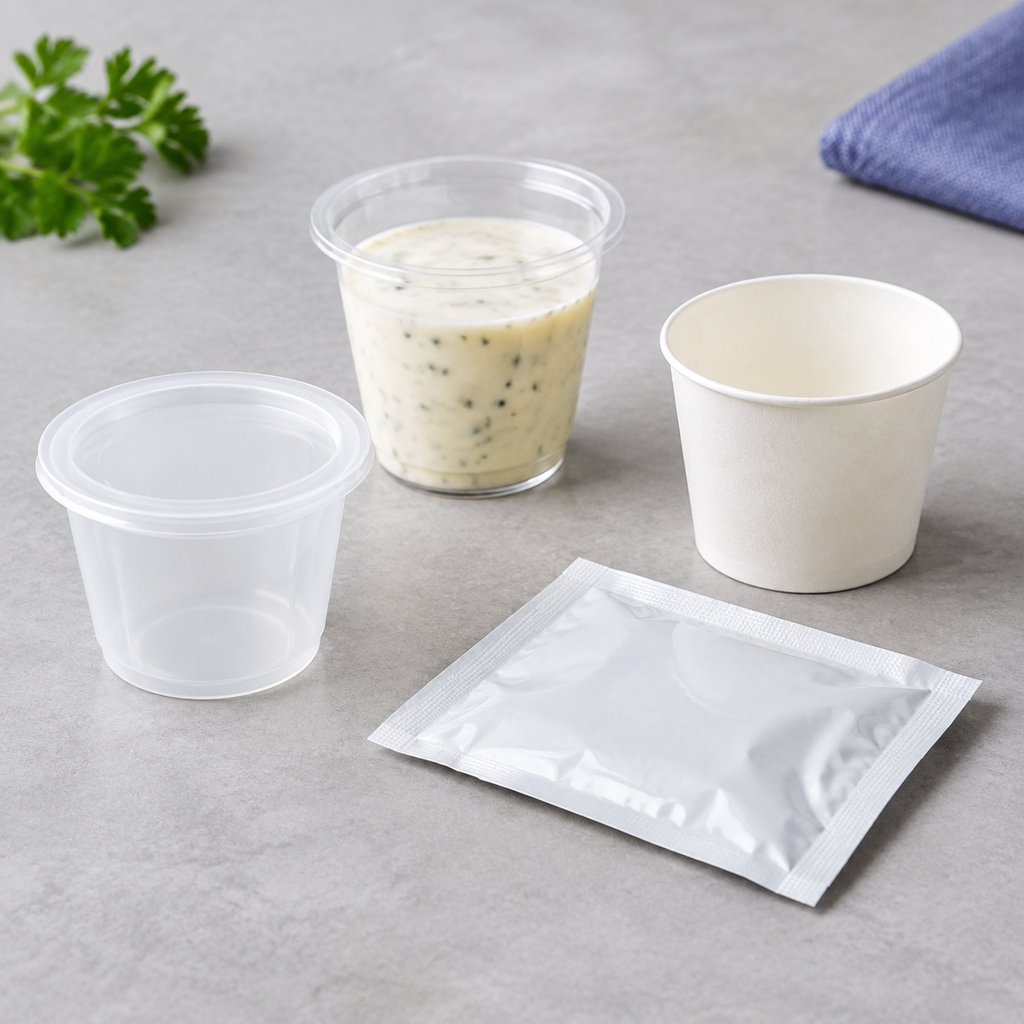
Choose materials according to food compatibility, temperature exposure, barrier needs, and closure construction. Polymer names identify material families, not guaranteed performance for every finished pack.
| Material option | Reason to consider it | Trade-off or limitation | Required checks |
|---|---|---|---|
| PP, or polypropylene | Commonly evaluated for portion cups and tubs, including applications with heat exposure | Actual heat tolerance and rigidity depend on grade and construction | Declared use conditions, deformation, oil compatibility, and lid fit |
| PET, or polyethylene terephthalate | Clear presentation for chilled dressings and dips | Standard clear PET should not be assumed suitable for hot filling | Approved fill temperature, cold-storage behavior, and closure performance |
| Coated paper | Printable exterior for selected cup-style applications | Coating, seams, and exposed edges govern liquid resistance | Barrier continuity, seam leakage, soak duration, and lid compatibility |
| Flexible film structures | Sachets with barriers tailored to the recipe and storage target | Multilayer structures can complicate recycling | Layer structure, migration suitability, sealability, and barrier requirements |
For coated paper, review the paper food packaging coating comparison before specifying the barrier. Uncoated fiber should not be assumed suitable for prolonged contact with free-flowing sauces.
Recyclable means a pack can enter a relevant collection and recycling system under applicable criteria. Compostable requires evidence for specified composting conditions. Biodegradable describes breakdown under defined conditions and does not establish compostability or permission to litter. A paper appearance does not establish a plastic-free composition; check coatings, adhesives, and closures.
Specify Portions, Capacity, and Headspace
Specify the required serving quantity separately from the container’s stated capacity. Brimful capacity measures volume at the rim; usable fill capacity allows space for closing, handling, and the intended process.
If a menu portion is 30 mL, use that as the required fill quantity, not an automatic instruction to buy a cup labeled 30 mL. Confirm how the supplier defines capacity and trial the portion in the proposed pack. Recipes measured by weight need a product-specific relationship between mass and volume.
- State the target fill quantity and acceptable filling variation.
- Confirm whether capacity uses milliliters or fluid ounces; identify the fluid-ounce system when relevant.
- Record top diameter, base diameter, height, and lid clearance.
- Check opening width for dipping, spoon access, or dispensing.
- Assess residual sauce after normal use and portion consistency across staff.
Use the packaging dimensions and capacity guide to standardize measurements. Reduce unnecessary portion sizes only after checking meal requirements and customer use.
Control Leaks Through the Complete Closure System
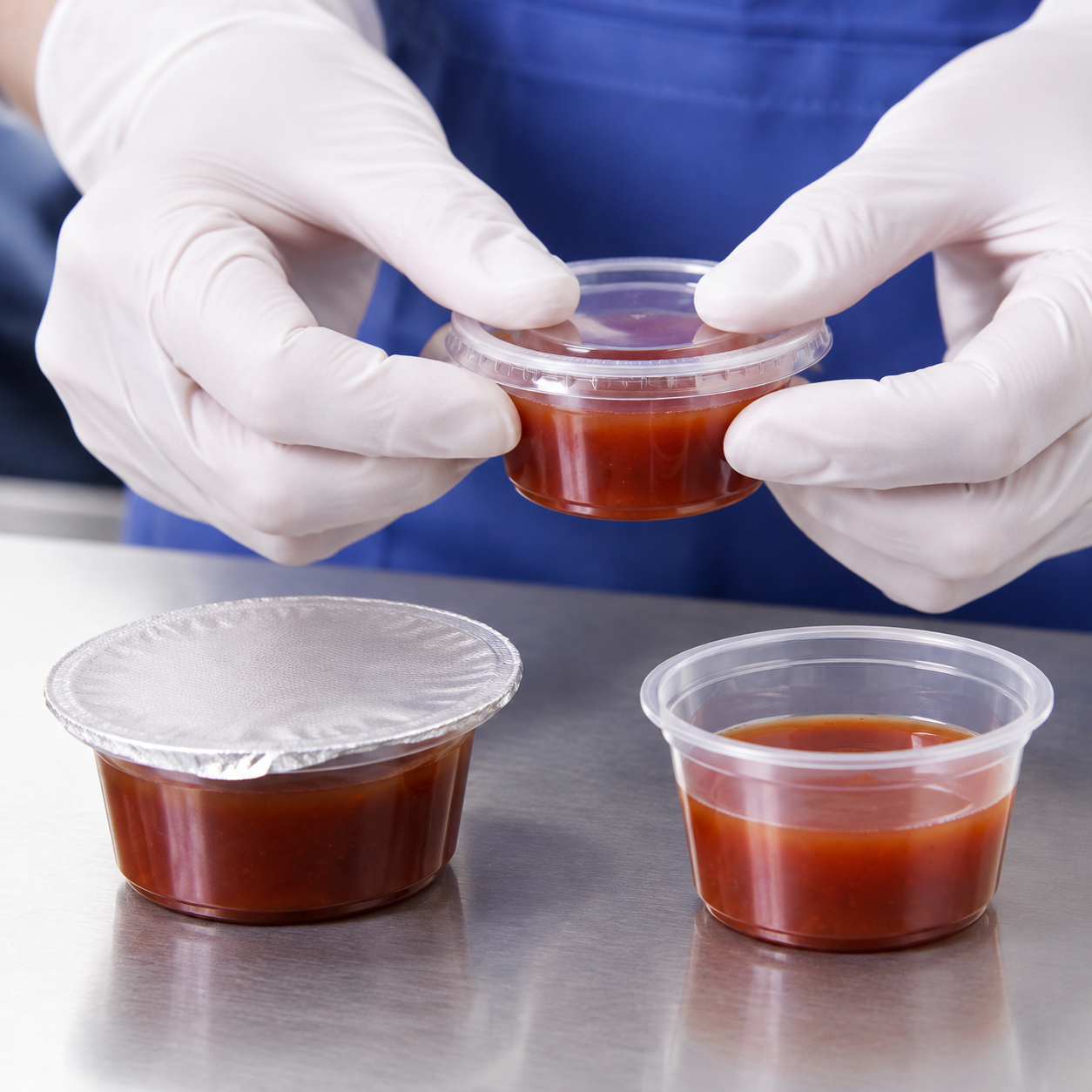
Leak control depends on the container, closure, fill level, and closing process working together. Matching nominal diameters does not prove that a lid and cup are compatible.
For snap-on lids, verify engagement around the full rim and resistance to lifting during handling. Sauce on the rim, a distorted cup, or pressure from surrounding meal boxes can undermine closure performance. Ask the supplier to identify the exact paired cup and lid references.
For heat-sealed packs, confirm that the film’s sealant layer matches the container sealing surface. Temperature, dwell time, pressure, and a clean sealing area affect results. Evaluate seal strength alongside peelability: a difficult opening can cause spills even when the unopened pack survives transport.
Leak resistance and tamper evidence address different needs. A snap-on lid may resist leakage without showing prior opening. A film seal can provide visible opening evidence, but that feature still requires assessment. Define both requirements separately when specifying food packaging for sauces and condiments.
Validate Samples with Actual Sauces
Approve samples using representative recipes and realistic delivery conditions. Water checks can reveal obvious gaps, but they do not replace trials with oily, acidic, viscous, or particulate sauces.
- Confirm documents: Request food-contact documentation applicable to the finished structure, intended food, contact time, temperature, and destination market.
- Fill under operating conditions: Use the intended portion and filling method. Check splashing, rim contamination, and closure application.
- Condition the packs: Reproduce expected storage and temperature transitions within the supplier’s declared use limits.
- Simulate the journey: Assess agreed orientations, vibration, handling impacts, and compression inside the actual delivery pack.
- Inspect and open: Record leakage, lid displacement, deformation, opening effort, and product changes. Compare odor or flavor with a control where appropriate.
Agree sample counts, test conditions, and acceptance criteria before approval. Food packaging for sauces and condiments intended for extended storage also needs appropriate shelf-life and food-safety validation; a successful delivery trial does not establish either.
Align MOQ, Printing, Production, and Shipping
Compare the cost of a complete usable pack, including its closure and delivery requirements. A lower container price can lose its advantage through separate lid costs, filling labor, damaged portions, or inefficient carton packing.
MOQ depends on the exact format, material, tooling, decoration, and production setup. Ask whether cups and lids have separate minimums and whether printed variants can share a common structure. The food packaging MOQ guide explains why minimums vary.
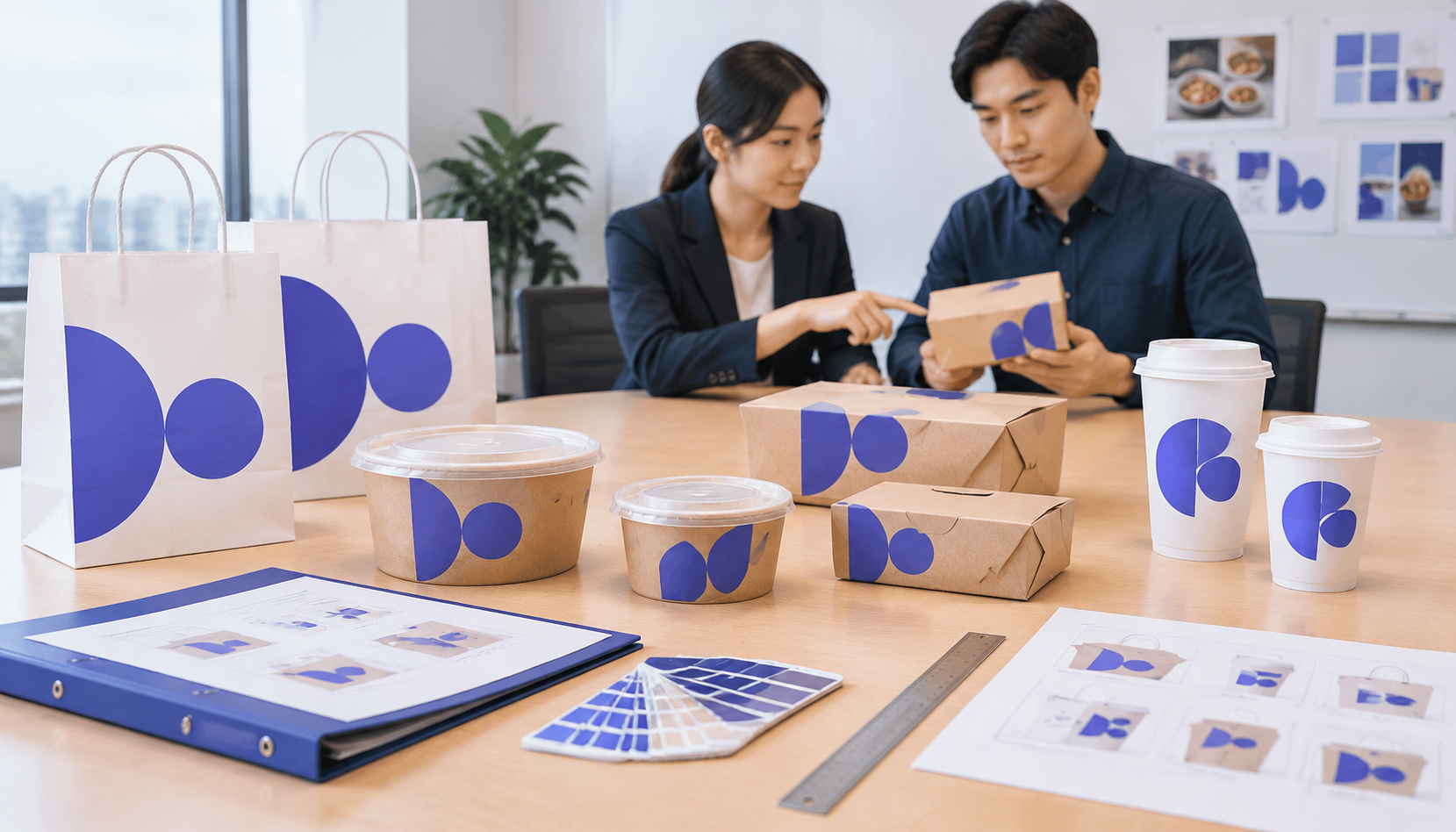
For small packs, prioritize readable artwork and required information. Confirm the print area, color references, ink suitability, and controls against ink transfer during nesting or stacking. Request a decorated sample when printing could affect handling or appearance.
Approve a specification and reference sample before production. Agree inspection points for dimensions, closure fit, appearance, count, and packing. Lead time depends on tooling, artwork approval, materials, scheduling, and shipment arrangements; request confirmation for the actual order.
Store empty packs in clean, dry conditions away from contamination and excessive heat, following supplier guidance. Confirm carton dimensions, nested counts, lid protection, pallet arrangement, and freight assumptions. Use the supplier quote comparison checklist to align quotations on the same scope.
Key Takeaways for Packaging Buyers
- Recipe first: Identify oil, acidity, viscosity, particles, and temperature exposure.
- Portion second: Specify the required fill quantity and usable capacity separately.
- Complete system: Approve the container, closure, and filling process together.
- Evidence before claims: Confirm food-contact suitability, test results, and disposal claims for the exact structure.
- Comparable purchasing: Include lids, tooling, printing, packing, and freight in the commercial comparison.
Conclusion: Approve the Packaging as a System
Reliable food packaging for sauces and condiments combines suitable materials, accurate portions, compatible closures, and validated handling. Approve performance with the actual recipe before committing to volume production. Guangzhou YBJ Paper & Plastic Co., operating since 1998, supports custom food packaging design, samples, production, quality control, and export service. The suitable structure, compliance evidence, MOQ, price, and lead time depend on the specification and destination market.
FAQ
Which material is best for oily sauces and dressings?
No single material is best for every oily sauce. Evaluate the complete cup, coating or film, and closure against the recipe, contact duration, and temperature. Request applicable food-contact documentation and test actual samples for leakage, deformation, and product changes.
Can the same portion cup hold both hot and cold sauces?
Only when the complete pack is documented and validated for both conditions. Check the container, lid, or sealing film together. Material names alone do not establish temperature limits; confirm filling, storage, and any reheating requirements separately.
Should sauce cups use snap-on lids or heat-sealed film?
Snap-on lids can suit manual restaurant filling, while heat-sealed film requires compatible materials and controlled sealing equipment. Compare leakage, opening effort, tamper-evidence needs, and operating cost. Neither closure should be approved without testing the filled pack.
How much headspace should a condiment container have?
There is no universal headspace allowance. Establish it through trials using the target portion, closure geometry, product movement, and filling conditions. Confirm that the sauce stays clear of the sealing area and that the lid does not contact the fill in a way that disrupts closing.
What should buyers send when requesting a sauce packaging quote?
Provide the packaging type, sauce application, dimensions or usable capacity, material and coating preferences, fill and storage conditions, quantity, printing, closure or accessory requirements, and destination market. Include filling-equipment details and acceptance criteria where relevant so sampling and quotations address the same specification.
Need the Right Packaging for Your Food Product?
Tell us your product and packaging type, food application, dimensions or capacity, material and coating preferences, quantity, printing requirements, lid or accessory needs, and destination market. Include heat, grease, moisture, filling conditions, and the intended disposal route. Our team will recommend a suitable structure and prepare sampling and quotation options.