

Table of Contents
- Understanding Bakery Paper Bag Specifications
- Types of Bakery Paper Bags for Wholesale Orders
- Greaseproof Liners: Material Options and Performance
- Window Options for Bakery Paper Bags
- Key Wholesale Specifications to Confirm
- Quality Control and Sampling Checks
- Frequently Asked Questions
A practical buyer’s guide to specifying bakery paper bags for wholesale orders, covering bag types, greaseproof liners, window materials, and the key technical details to confirm before sourcing.
Understanding Bakery Paper Bag Specifications
Bakery paper bags are among the most functional and brand-forward packaging formats for bread, pastries, croissants, cookies, and other baked goods. When sourcing bakery paper bags wholesale specifications, buyers must balance food safety, grease resistance, visibility, print quality, and cost. A bag that works for a dry baguette may fail for a buttery croissant, so specifications must match the exact product application.
This guide breaks down the three core specification areas: bag construction types, greaseproof liner options, and window materials. It also covers the key order details—dimensions, paper weight, printing, MOQ, and compliance—that procurement teams need to confirm before placing a bulk order.
Always verify that the material composition, coating, and any window film meet food-contact regulations in your destination market, such as FDA, EU Framework Regulation (EC) No 1935/2004, or specific national standards. Performance claims like grease resistance and heat tolerance must be validated with the supplier for your exact food type.
Types of Bakery Paper Bags for Wholesale Orders
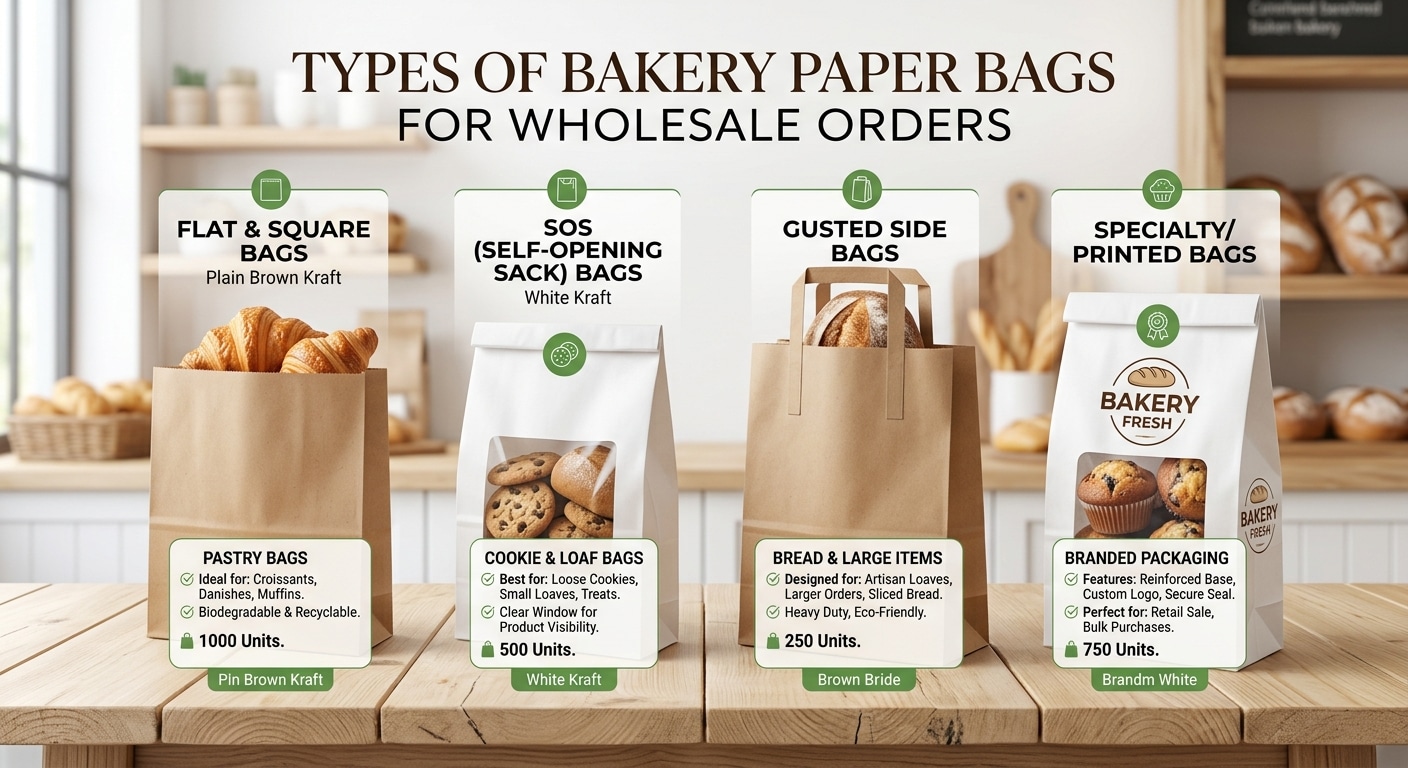
Bakery paper bags come in several structural styles, each suited to specific product shapes and service formats. The following are the most common types specified in wholesale orders:
Flat Bags
Flat bags are the simplest and most economical option. They are ideal for sliced bread, bagels, cookies, and flat pastries. Made from a single sheet of paper folded and glued on the side and bottom, they offer minimal protection against crushing but excellent print area. For more details, see the custom flat paper bag wholesale guide.
Satchel Bags (SOS Bags)
Self-opening satchel (SOS) bags have a gusseted bottom and side folds that allow them to stand upright. They are perfect for bakery counters and self-service displays, accommodating items like muffins, scones, and rolls. The open top can be crimped or folded for quick service.
Gusseted Bags
Side-gusset or bottom-gusset bags provide extra volume and stability for bulky items like artisan loaves, baguettes, or multiple pastries. The gussets expand to fit irregular shapes, reducing product damage during handling.
Tin-Tie Bags
Tin-tie bags feature a flexible metal or plastic tie integrated into the top fold. This allows customers to reseal the bag to maintain freshness. They are commonly used for coffee beans, but also work for bakery items like biscotti or cookies that benefit from an airtight closure.
Die-Cut Handle Bags
Die-cut handle bags offer a convenient carry handle and a premium presentation. They are often used for gift boxes of pastries, large cookie orders, or takeaway assortments. The handle is cut directly into the paper, requiring a heavier paper stock for durability. Review the custom die-cut paper bag wholesale guide for structural considerations.
For a comprehensive overview of custom printing and ordering for bakery-specific bags, refer to the custom bakery bag wholesale guide.
Greaseproof Liners: Material Options and Performance
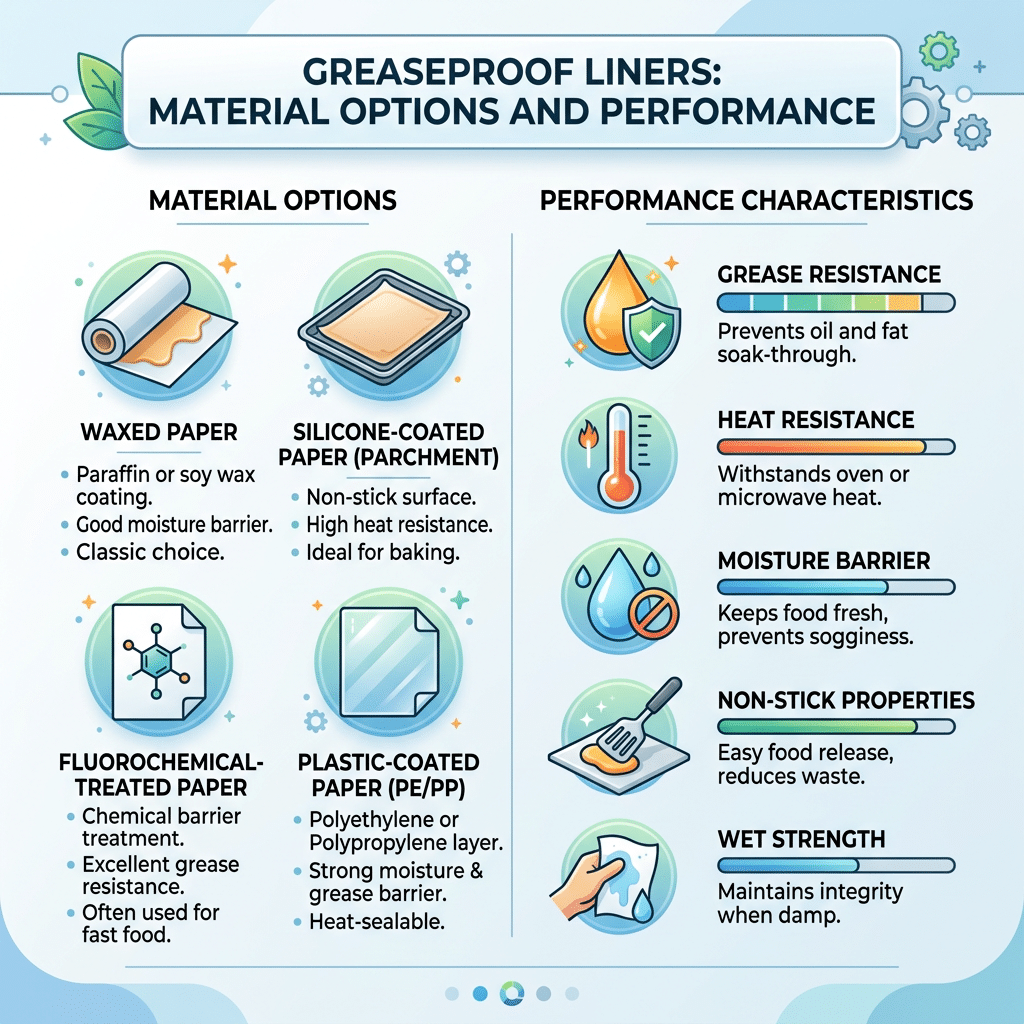
Greaseproof liners are essential for baked goods that contain butter, oil, or other fats. Without a barrier, grease can stain the paper, weaken the bag, and create an unappetizing presentation. The liner can be a separate sheet inserted into the bag or a coating/lamination applied directly to the paper substrate.
Why Greaseproof Liners Matter
Grease resistance is measured by the time it takes for oil to penetrate the paper under standardized test conditions. A higher grease resistance rating means the bag will hold oily pastries longer without leaking. For bakery applications, common tests include the TAPPI T454 or ISO 16532 kit test, where a rating of 6 to 12 indicates increasing resistance. Always confirm the kit test level required for your specific product.
Liner Material Choices
- Polyethylene (PE) Coating: A thin layer of PE on the inside provides a strong moisture and grease barrier. It is cost-effective but not compostable or recyclable in standard paper streams. Confirm whether the PE is food-grade and meets migration limits.
- PLA (Polylactic Acid) Coating: A bio-based plastic coating that offers grease resistance and is industrially compostable under specific conditions. PLA-lined bags are often marketed as eco-friendly, but check whether your local composting infrastructure accepts them.
- Greaseproof Paper Liner (Separate Sheet): A separate sheet of greaseproof parchment or glassine can be inserted manually or automatically. This allows the outer bag to be plain paper while providing a removable barrier. The liner GSM typically ranges from 30 to 50 gsm.
- Water-Based Greaseproof Coating: Some suppliers offer water-based barrier coatings that are repulpable and can enhance recyclability. These coatings may be suitable for low to medium grease loads.
For a deeper dive into bag formats and usage, see the greaseproof paper bags buyer’s guide. For guidance on selecting the right paper weight and barrier, review the greaseproof paper GSM guide.
Window Options for Bakery Paper Bags
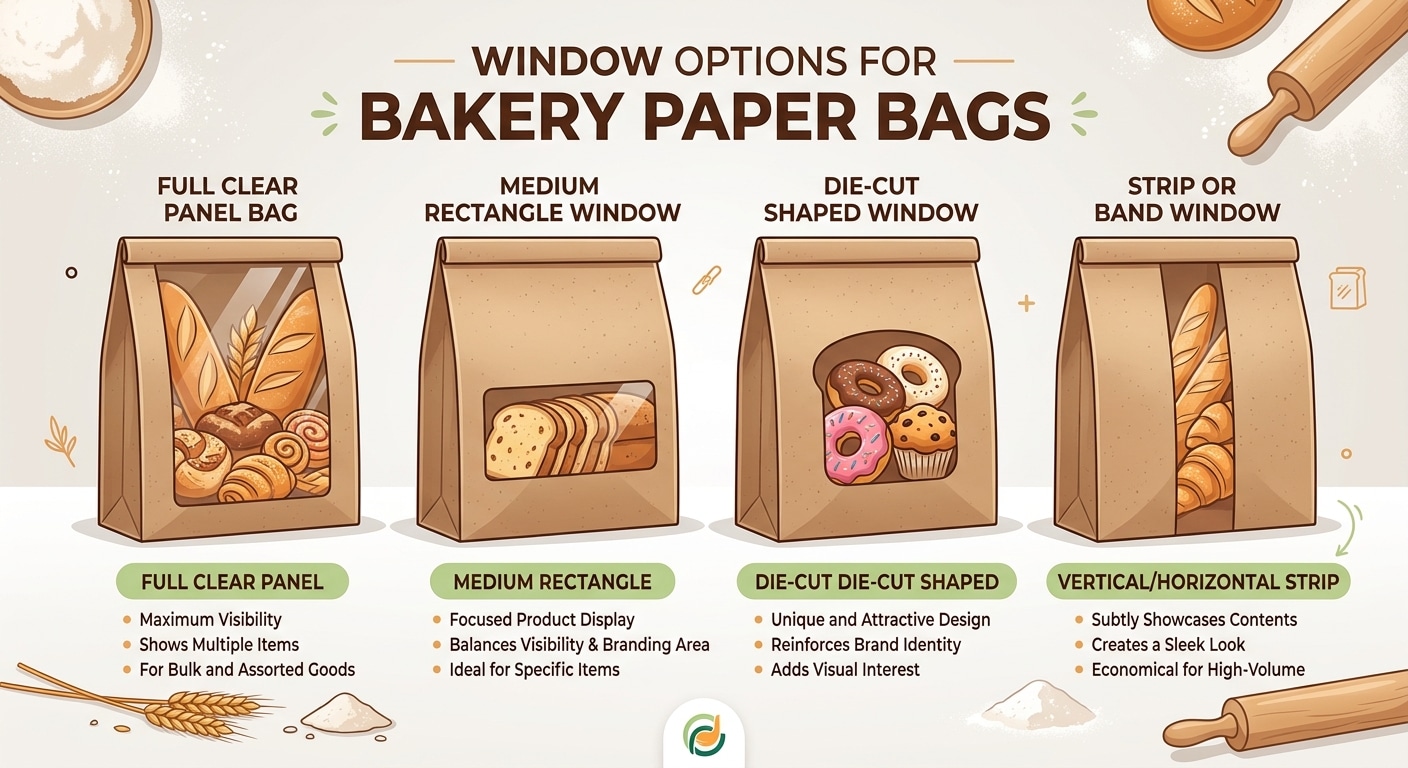
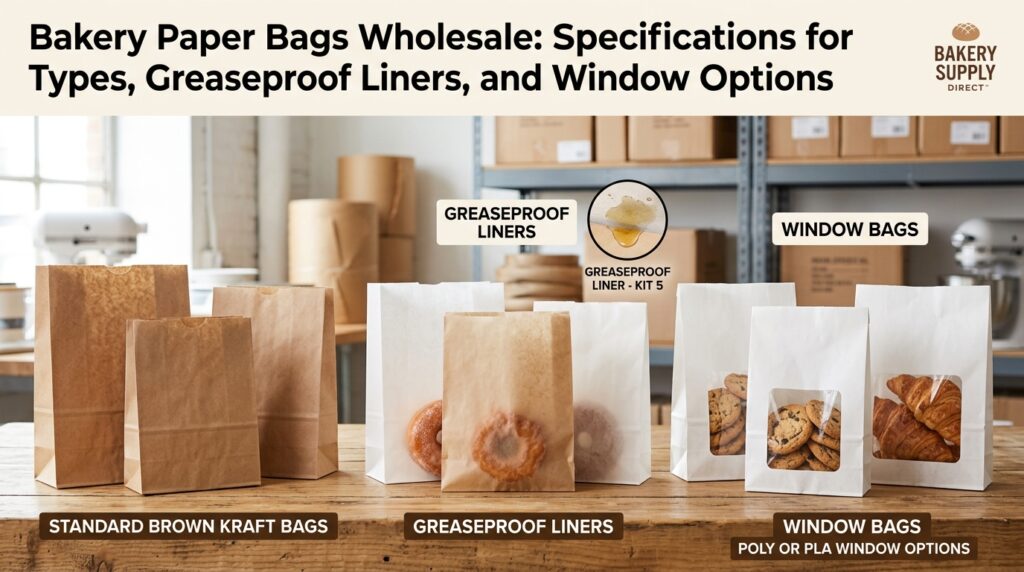
A transparent window in a bakery paper bag allows customers to see the product inside, which can increase impulse purchases and reduce the need to open bags. Window bags are specified by the film material, thickness, shape, and placement.
Window Film Materials
- Biaxially Oriented Polypropylene (BOPP): A common, cost-effective film with good clarity and moisture resistance. BOPP is not biodegradable and may hinder repulpability.
- Polyethylene Terephthalate (PET): Provides excellent clarity and stiffness, often used for premium bakery packaging. PET is recyclable in some streams but check local guidelines.
- Polylactic Acid (PLA): A compostable film made from plant starch. PLA windows can make the entire bag suitable for industrial composting if the paper and adhesives are also compostable. However, PLA has lower heat resistance than PET and may not be suitable for hot-filled items.
- Cellulose Film: A biodegradable, compostable film derived from wood pulp. It offers good clarity but may be more expensive and less moisture-resistant than plastic films.
Window Shapes and Placement
Windows can be die-cut into the front panel, side panel, or even the bottom of the bag. Common shapes include rectangles, ovals, and custom die-cut silhouettes matching your brand or product shape. The window is typically heat-sealed or glued to the inside of the bag using a food-safe adhesive.
For a dedicated guide on window bag specifications, see the window paper bag buyer’s guide. For custom window bag printing and sourcing considerations, review the custom window paper bag wholesale guide.
Key Wholesale Specifications to Confirm
When requesting a quote for bakery paper bags, always specify the following details. Inconsistent or missing specifications lead to sampling delays and performance mismatches.
Dimensions and Capacity
Provide the internal dimensions of the bag: width, gusset (if any), and height. Also indicate the target product dimensions and weight. For example, a standard croissant bag might be 150 mm × 80 mm × 300 mm with a 50 mm gusset. Capacity is often expressed in grams or number of items.
Paper Stock and GSM
The paper weight affects strength, print quality, and cost. Common bakery bag paper weights range from 30 gsm (lightweight, for single pastries) to 80 gsm (heavy-duty, for multiple items). Kraft paper is the most common base material, but bleached white paper offers a cleaner look for colorful printing. Confirm whether virgin or recycled fiber is required and if the paper needs to be FSC-certified. For more on kraft paper options, see the kraft paper bag buyer’s guide.
Printing and Branding
Specify the printing method (flexographic, rotogravure, or digital), number of colors, and whether the design includes bleed or requires precise registration. For small runs, digital printing may be more cost-effective. For large volumes, flexographic printing is standard. Also confirm if the inside of the bag needs printing, especially if a liner is not used.
MOQ and Packaging
MOQs vary widely by bag type, material, and printing complexity. Simple flat bags may have an MOQ of 10,000 units, while custom window bags with multi-color printing may require 30,000 or more. Confirm packaging format: bags are typically bundled in poly bags or shrink-wrapped and packed in export cartons. Specify carton dimensions and maximum pallet height for efficient shipping.
Compliance and Food Safety
Request documentation that the bags comply with food contact regulations for your market. For the EU, request a Declaration of Compliance (DoC) under Regulation (EC) No 1935/2004 and, if applicable, the Plastics Regulation (EU) No 10/2011 for plastic liners or windows. For the US, confirm FDA 21 CFR compliance for the specific material. Also ask for migration test reports if the product is high-fat or high-moisture.
Quality Control and Sampling Checks
Before mass production, always request pre-production samples. A physical sample allows you to verify dimensions, paper thickness, grease resistance, window clarity, and print quality. For bulk orders, specify an acceptable quality limit (AQL) for inspection, such as AQL 2.5 for major defects and 4.0 for minor defects.
Key checks during inbound quality control (IQC) include:
- Dimension conformity: Measure width, gusset, and height within tolerance (±2 mm typical).
- Paper weight verification: Use a GSM cutter and scale to confirm paper weight.
- Grease resistance spot test: Apply a standardized oil drop test to check for penetration within a specified time.
- Window seal integrity: Check that the window film is securely attached and free of wrinkles or adhesive bleed.
- Print registration and color: Compare against the approved proof using a Pantone guide or spectrophotometer.
- Food contact safety: Review compliance certificates and confirm no odor or off-taste is imparted to the product.
Work with your supplier to define a sampling plan (e.g., ISO 2859-1) and communicate rejection criteria upfront to avoid disputes.
Frequently Asked Questions
Below are answers to common questions from buyers sourcing bakery paper bags.
FAQ
What is the minimum order quantity (MOQ) for custom bakery paper bags?
MOQs depend on the bag type, material, and printing complexity. Simple flat kraft bags may have an MOQ of 10,000 units, while custom window bags with multi-color printing can start at 30,000 units or more. Always confirm the MOQ with your supplier for your exact specification.
How do I choose between PE, PLA, and greaseproof paper liners for bakery bags?
PE liners offer the strongest grease and moisture barrier at a low cost but are not compostable. PLA liners provide grease resistance and are industrially compostable, but require specific composting conditions. Separate greaseproof paper liners are plastic-free and can be removed before disposal, but may not be as effective for very oily products. Select based on product grease load, sustainability goals, and destination market regulations.
Can bakery paper bags with windows be recycled or composted?
This depends on the window film. BOPP and PET windows typically make the bag non-recyclable in standard paper streams. PLA or cellulose film windows can enable industrial composting if the entire bag structure (paper, adhesive, inks) is compostable. Always verify with your supplier and check local waste management guidelines.
What paper weight is best for bakery bags?
For lightweight items like a single croissant, 30-40 gsm kraft paper is sufficient. For heavier or multiple items, 50-80 gsm provides more strength and durability. The right weight also depends on bag size and whether a liner or window is added.
How do I ensure the bags are food-safe for my market?
Request a Declaration of Compliance (DoC) from the supplier that the bags meet EU Regulation (EC) No 1935/2004 for EU markets, or FDA 21 CFR compliance for the US. Also ask for migration test reports for fatty or moist foods. If plastic liners or windows are used, confirm compliance with the specific plastic regulations, such as EU No 10/2011.
Ready to Source Bakery Paper Bags?
To receive an accurate quotation and technical recommendation, please provide the following details:
- Product type (bread, croissant, cookies, etc.)
- Food application (retail, takeaway, wholesale)
- Dimensions or capacity required
- Paper material and GSM preference
- Coating or liner requirement (greaseproof, moisture barrier)
- Quantity and target MOQ