


Table of Contents
- What a Supplier Audit Should Establish
- Food Packaging Supplier Audit Checklist: Evidence Summary
- Choose the Right Audit Method
- Verify Manufacturer Identity, Materials, and Compliance
- Match Audit Checks to Each Packaging Product
- Check Sample Approval and Production Controls
- Review Inspection, Traceability, and Corrective Action
- Assess MOQ, Capacity, Storage, and Export Readiness
- Turn Audit Findings into an Approval Decision
- Supplier Audit FAQs
- Conclusion: Approve the Process Behind the Product
Evaluate a food packaging manufacturer through verifiable evidence: material traceability, sample approval, production controls, inspection records, export preparation, and corrective action. This framework helps restaurant chains and importers make documented supplier approval decisions.
What a Supplier Audit Should Establish
A food packaging supplier audit checklist should establish whether a manufacturer can repeatedly deliver your approved specification, maintain material traceability, support destination-market compliance, and resolve defects. Restaurant chains and importers should evaluate records, production practices, and representative samples together before approving a supplier.
Definition: A supplier audit is a structured review of a supplier’s capabilities and controls. A product inspection checks a particular batch; an audit evaluates the system responsible for producing that batch.
The approval scope should identify the manufacturing site, packaging families, intended food uses, and any outsourced processes. One satisfactory paper cup order does not establish capability for every container, coating, or printing process.
Keep this food packaging supplier audit checklist separate from routine incoming inspection. Its purpose is to identify weaknesses before orders scale across restaurant locations or distributor inventories.
Food Packaging Supplier Audit Checklist: Evidence Summary
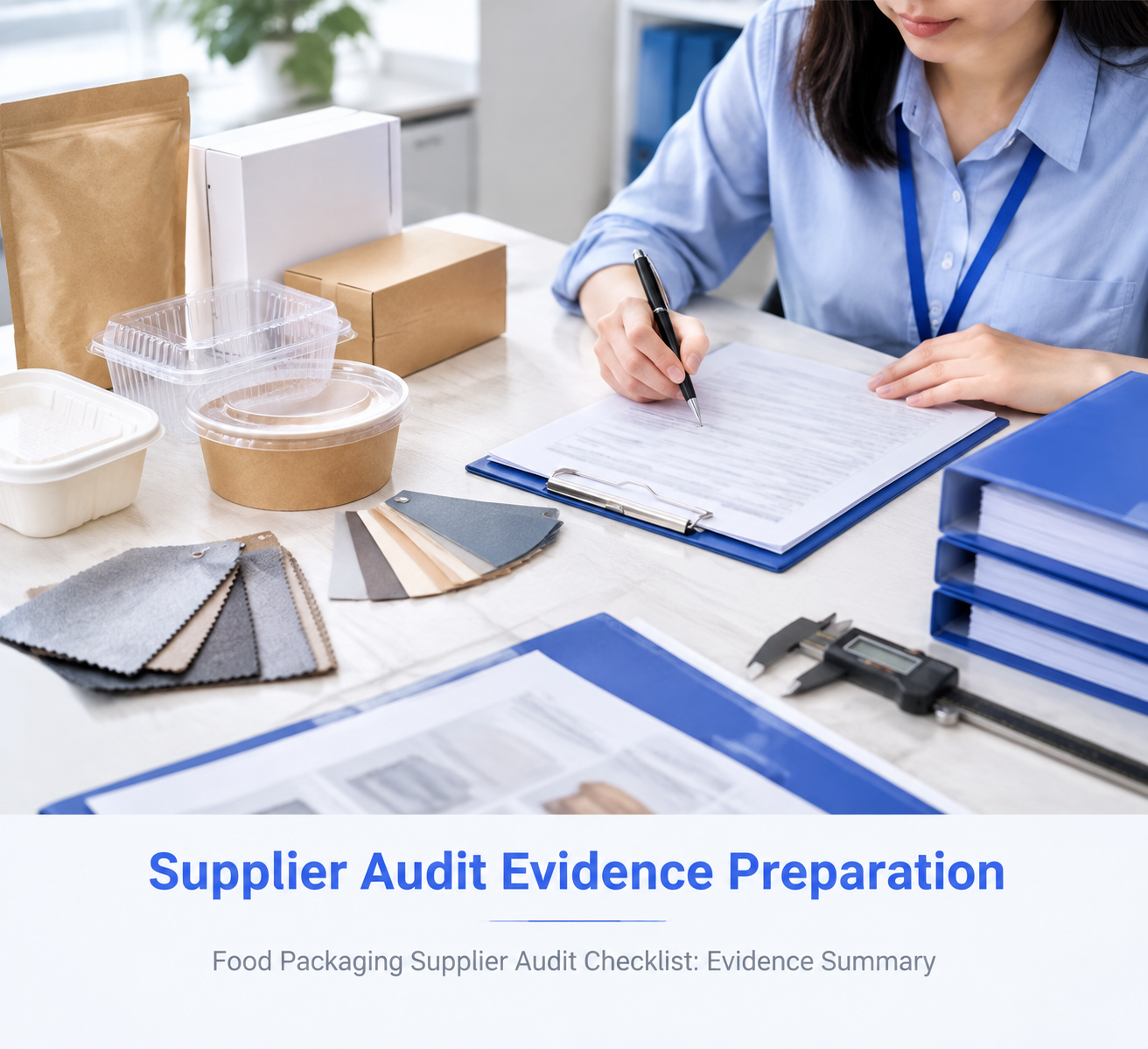
Record what you verified, not simply whether a supplier answered yes. For each item, capture the evidence reference, finding, responsible person, and closure date.
- Identity: Confirm the legal entity, factory address, manufacturing role, and subcontracted operations.
- Materials: Match substrates, coatings, inks, adhesives, and accessories to controlled specifications.
- Compliance: Review applicable documentation against the exact product, intended use, and destination market.
- Samples: Confirm approval records and differences between prototypes and production samples.
- Production: Check process instructions, change control, maintenance, and capacity assumptions.
- Quality: Review defect criteria, inspection records, measurement equipment, and rejected-stock controls.
- Traceability: Follow one finished lot back to materials and forward to shipment records.
- Delivery: Verify MOQ, scheduling, carton specifications, storage conditions, and export responsibilities.
Key takeaways: Approve a defined scope, require evidence for important claims, and close significant findings before releasing affected orders. Material performance, compliance, MOQ, price, and lead time depend on the exact specification and destination market.
Choose the Right Audit Method
Choose the audit method according to product risk, order exposure, and how much evidence can be verified remotely.
| Method | Useful for | Main limitation | Practical verification |
|---|---|---|---|
| Document review | Initial screening and specification checks | Records may not reflect current factory practice | Check dates, scope, site identity, and product references |
| Live remote audit | Following processes and reviewing records with staff | Camera coverage and access may be limited | Request a live route and a buyer-selected lot trace |
| On-site audit | Observing hygiene, production, storage, and controls | A visit captures only the conditions observed | Sample records from different shifts and recent orders |
| Independent audit | Obtaining specialist or local verification | Value depends on auditor competence and agreed scope | Provide your specifications and required evidence beforehand |
An on-site audit can also be independent; these approaches can be combined. For a new overseas supplier, begin with document screening, then investigate unresolved risks through a live or on-site review.
Verify Manufacturer Identity, Materials, and Compliance
Confirm who makes the product and whether the supporting evidence applies to its actual material construction.
Compare the contracting entity with the factory identity and export arrangements. Ask which activities happen in-house and which are subcontracted, including printing, coating, forming, and accessory supply. Outsourcing requires clear approval, specifications, and incoming verification.
Request a controlled bill of materials: the list of components used to make the package. Check substrate grade, relevant thickness or basis weight, coating identity, ink system, adhesive, and lid material. The guide to paper food packaging coatings explains why coating descriptions require closer examination.
Review food-contact evidence for the intended food type, contact conditions, and destination requirements. Match report sample descriptions to the supplied construction; a report for a different coating or resin may not support your order. Verify any claimed certification’s holder, site, scope, and validity.
Also separate environmental claims. Recyclable means compatible with a relevant collection and recycling route; compostable requires specified conditions and supporting evidence. Biodegradable alone does not establish disposal conditions or timing. Paper appearance does not establish that packaging is plastic-free.
Match Audit Checks to Each Packaging Product
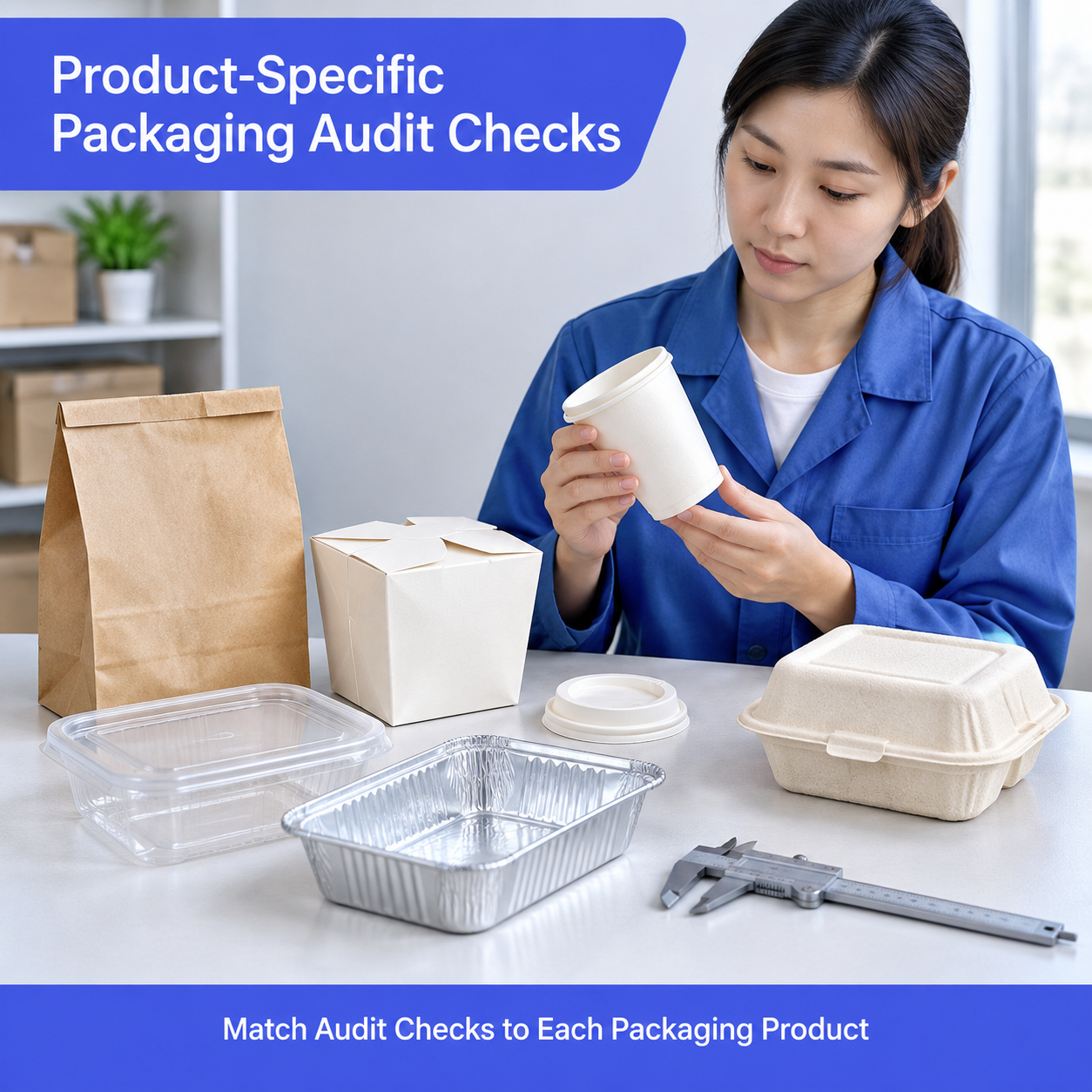
Use product-specific checks because different packaging structures fail in different ways. The following product table identifies audit priorities rather than universal performance ratings.
| Product family | Specifications to verify | Controls and sample checks |
|---|---|---|
| Paper cups and bowls | Capacity, rim dimensions, coating, seams, compatible lids | Forming settings, seam integrity, leakage, and lid retention under intended use |
| Takeaway boxes | Board grade, dimensions, crease pattern, closure, barrier construction | Folding consistency, grease exposure, stacking, and delivery handling |
| Food bags and wrap paper | Paper grade, dimensions, seams where applicable, print placement | Tear behavior, grease resistance, odor, and ink transfer risk |
| PP or PET containers | Resin identity, dimensions, relevant wall thickness, matching lid | Forming consistency, distortion, closure fit, and application suitability |
| Aluminum trays or bagasse containers | Material construction, rim profile, dimensions, lid or closure | Deformation, stacking, closure fit, and food-specific performance |
Agree on test conditions that represent your menu and handling process. Define food simulants or actual foods as appropriate, filling conditions, contact duration, transport handling, and acceptance limits. Use the packaging dimensions and capacity guide to align measurement methods before comparing results.
Check Sample Approval and Production Controls
Approved samples should connect directly to the production specification and its revision history.
- Identify the sample stage. Establish whether it is a stock sample, structural prototype, print proof, or production-made sample.
- Record approval criteria. Include dimensions, capacity, material construction, appearance, functional performance, and lid fit where relevant.
- Retain references. Keep labeled approved samples and controlled artwork accessible to both buyer and factory.
- Check production translation. Review setup instructions, first-piece approval, in-process checks, and handling of deviations.
- Control changes. Require notification and appropriate approval before changing materials, tooling, subcontractors, or production sites.
For custom printing, inspect artwork version control, color references, registration checks, and handling of obsolete files. The custom food packaging artwork requirements guide supports a clearer approval process.
A sample made through a different process may confirm shape or appearance without establishing mass-production performance. Record those limitations before accepting it.
Review Inspection, Traceability, and Corrective Action

Reliable quality control requires defined acceptance criteria, usable records, and a clear response when results fail.
Inspect incoming-material checks, in-process records, final inspection, and equipment calibration or verification. Ask who can stop production and who authorizes release. Observe cleanliness, pest prevention, foreign-material controls, and protection of food-contact surfaces.
Define critical, major, and minor defects for your product. Agree on sampling plans and acceptance limits rather than treating a generic inspection level as suitable for every risk. For detailed finished-product checks, consult the packaging quality control checklist.
Select one recent finished lot and trace it to material receipts, production records, inspection results, and dispatch records. Then review a real complaint: containment, root cause, corrective action, and evidence that the fix worked. A documented problem resolved effectively can provide more useful evidence than an unsupported claim of zero defects.
Assess MOQ, Capacity, Storage, and Export Readiness
Commercial readiness means the supplier can explain how your approved specification becomes a scheduled, protected, correctly documented shipment.
Ask how MOQ changes by size, material, print design, and accessory. Separate tooling, sampling, packaging, and freight assumptions from unit pricing. The food packaging MOQ guide explains the production factors behind minimum quantities.
Check capacity against your order mix and replenishment peaks. Request the scheduling assumptions behind quoted lead time, including material availability, proof approval, production, inspection, and dispatch. For chain rollouts, evaluate backup arrangements and how competing orders affect allocation.
Review storage protection against moisture, dust, pests, odors, and crushing. Confirm inner packing, carton quantities, lot labels, pallet requirements, and loading protection. Verify responsibility for export documents, shipping terms, and destination-specific requirements. Do not assume a previous export order establishes readiness for a different market.
Turn Audit Findings into an Approval Decision
Use your food packaging supplier audit checklist to make a documented decision, with significant risks evaluated separately from any overall score.
- Classify findings. Distinguish missing evidence from confirmed process failures, and assess their effect on safety, compliance, performance, or supply.
- Set closure requirements. Assign an owner, deadline, required evidence, and verification method.
- Define approval status. Approve, conditionally approve, or hold the affected scope according to your procurement policy.
- Verify initial production. Confirm that the first commercial batch follows the approved specification and corrective actions.
- Plan reassessment. Review performance periodically and after significant material, site, ownership, or process changes.
An average score should not override unresolved food-contact suitability or traceability failures. For restaurant chains, consolidate complaints across locations; for importers, connect findings to receiving inspections and customer feedback.
Supplier Audit FAQs
These answers address common decisions when applying a food packaging supplier audit checklist.
Conclusion: Approve the Process Behind the Product
A useful food packaging supplier audit checklist connects specifications, factory practices, records, and shipment controls. Approve the supplier for a defined product scope, verify significant corrective actions, and monitor commercial performance after launch.
Guangzhou YBJ Paper & Plastic Co. has operated since 1998 and supports custom paper and plastic food packaging through design, sampling, production, quality control, and export service. Discuss your requirements at the specification level so proposed materials, documentation, and commercial terms can be evaluated accurately.
FAQ
Is a factory audit the same as a pre-shipment inspection?
No. A factory audit evaluates the supplier’s systems, capabilities, and controls. A pre-shipment inspection evaluates a particular finished batch against agreed requirements. Buyers may need both because a satisfactory audit does not guarantee every shipment.
Can an overseas supplier be approved through a remote audit?
A remote audit can support approval when the product risk and available evidence justify it. Use live process observation, buyer-selected records, and representative samples. Arrange on-site verification when important conditions cannot be confirmed remotely.
Does a food-contact test report cover all products from one supplier?
No. Assess whether the report covers the actual material construction, intended food contact, and destination requirements. Different coatings, inks, resins, or use conditions may require additional evidence or testing.
How often should a food packaging supplier be audited?
Set the interval according to product risk, order volume, supplier performance, and your procurement policy. Significant complaints, material substitutions, new sites, or major process changes can justify an earlier reassessment. There is no universal interval suitable for every supplier.
What should buyers do when an audit finds a serious problem?
Document the finding, contain the affected risk, and require corrective action with supporting evidence. Hold the affected approval or order release when necessary. Verify closure before accepting the supplier’s statement that the issue has been resolved.
Need the Right Packaging for Your Food Product?
Tell us your product and packaging type, food application, dimensions or capacity, preferred material and coating, quantity, printing requirements, lid or accessory needs, and destination market. Share your artwork and supplier-audit requirements for review. Our team will recommend a suitable structure and prepare sampling and quotation options based on your specification.