

Table of Contents
- What Export Carton Packing Must Achieve
- Master Carton Specifications to Confirm
- Packing Priorities by Food Packaging Format
- Floor Loading vs. Palletized Shipping
- Pallet Layout and Load Stability
- Container Loading and Freight Calculations
- Carton Labels and Shipment Traceability
- Sampling, Transit Checks, and Receiving
- MOQ, Production, and Total Delivered Cost
- Frequently Asked Questions
- Conclusion: Approve the Shipping Pack Before Production
Specify master cartons, inner packs, pallet layouts, and container loading before approving an order. This buyer guide explains how to protect empty food packaging while controlling freight volume, warehouse handling, and receiving risks.
What Export Carton Packing for Food Packaging Must Achieve
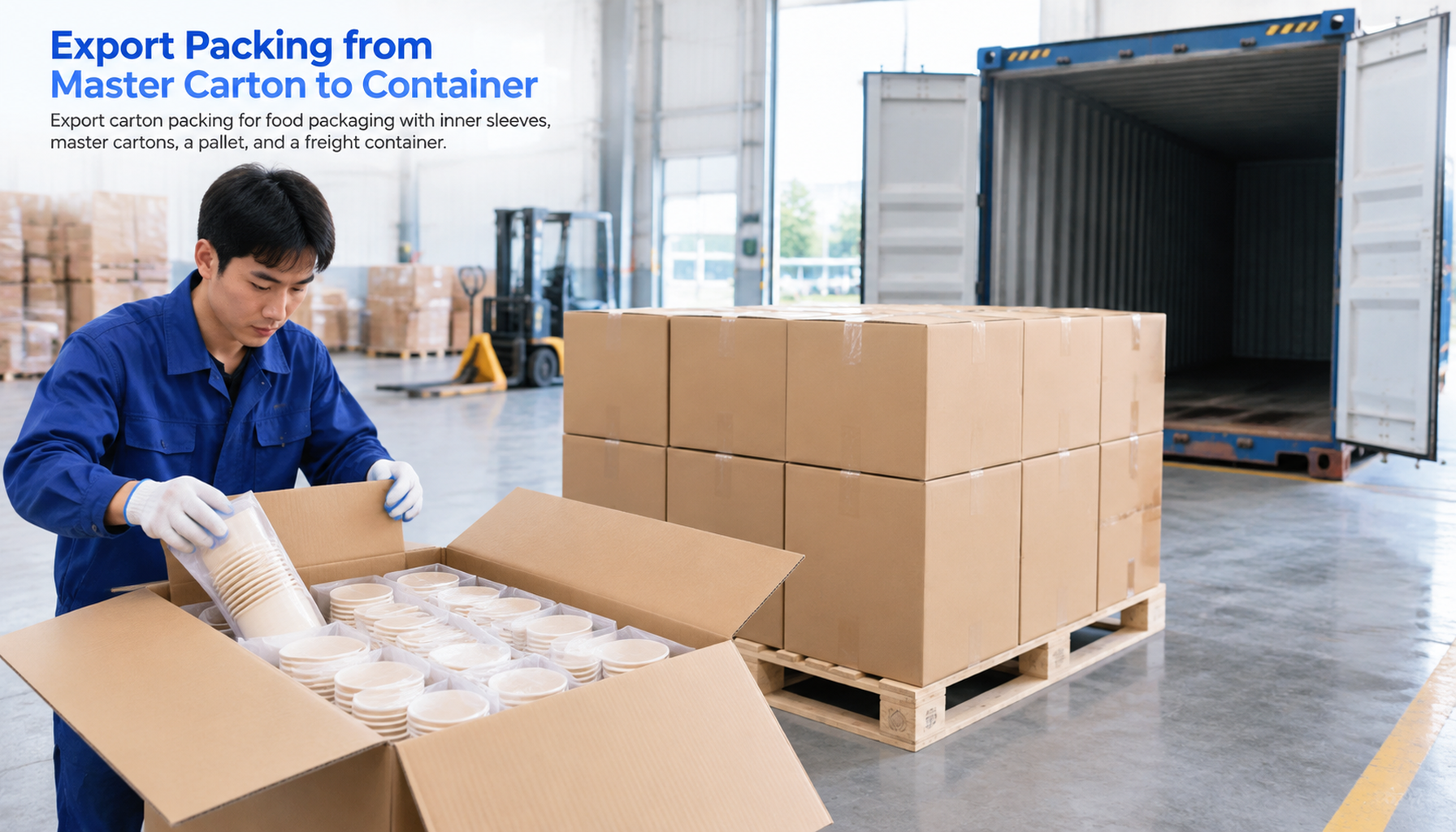
Export carton packing for food packaging should protect empty food-contact items, preserve their shape and cleanliness, and fit the buyer’s unloading and warehouse process. Specify inner packs, master carton dimensions and strength, pallet requirements, labels, and the loading method before approving production. The lowest carton cost is not necessarily the lowest delivered cost.
This guide concerns shipping empty cups, boxes, bags, containers, and related items—not shipping food inside them.
- Inner pack
- A smaller bundle, sleeve, or bag holding an agreed quantity of packaging inside the shipping carton.
- Master carton
- The outer shipping box containing one or more inner packs, commonly made from corrugated board.
- Palletized load
- Cartons secured on a handling platform for movement as one unit.
- Floor-loaded shipment
- Cartons loaded directly into a container without pallets.
Material performance, food-contact compliance, MOQ, price, and lead time depend on the exact specification and destination market. Outer cartons do not replace the compliance assessment for the food-contact packaging itself.
Master Carton Specifications to Confirm
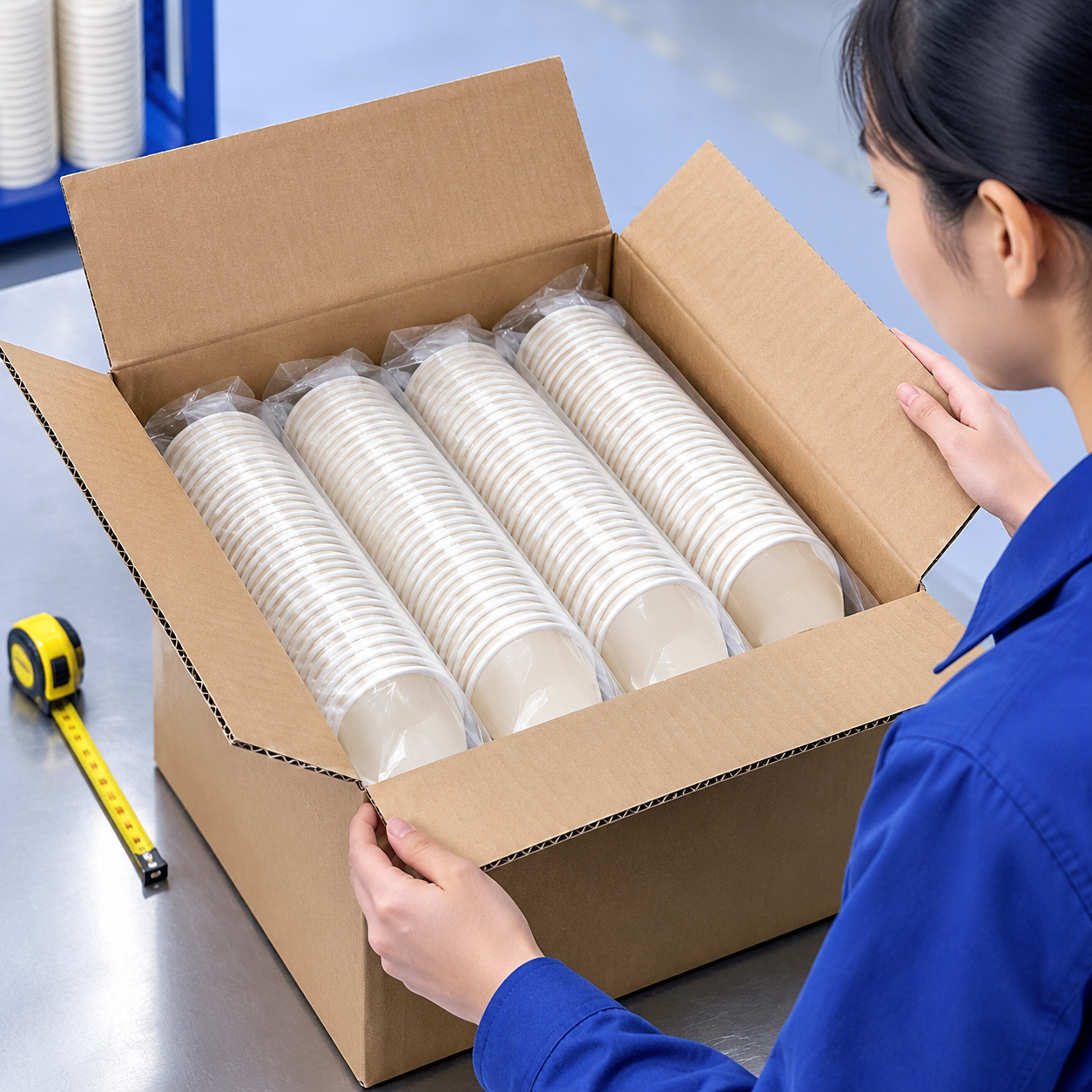
A usable carton specification describes both the corrugated box and how products are arranged inside it. “Strong export carton” is too vague for purchasing or inspection.
- Dimensions: record internal dimensions for product fit and external packed dimensions for freight and pallet planning; state units and tolerances.
- Quantity: define pieces per inner pack, inner packs per carton, and total pieces per carton.
- Board construction: agree wall construction, flute configuration, and measurable strength requirements appropriate to the load.
- Weight: record product net weight and fully packed gross weight, including protective materials.
- Protection: specify liners, dividers, pads, or sleeves where needed to prevent abrasion, contamination, and distortion.
- Closure: agree the tape, adhesive, or other closure and its application pattern.
An edge crush test assesses corrugated board resistance along its edge; a box compression test evaluates the assembled box under compression. Neither alone establishes safe stacking in humid storage or transport. Carton geometry, closures, load distribution, and stacking duration also matter.
Inner bags should protect cleanliness without trapping production moisture. Confirm cleanliness controls and suitability wherever protective materials may contact food-contact surfaces.
Packing Priorities by Food Packaging Format
Choose inner packing around the product’s likely transit damage, not simply its material name. The following product-format table gives specification priorities rather than fixed packing quantities.
| Product format | Main shipping concern | Packing detail to verify |
|---|---|---|
| Paper cups and bowls | Rim distortion, rubbing, difficult separation | Nesting depth, sleeve count, carton clearance, and post-transit lid fit |
| Flat-packed paperboard boxes | Creasing, bent corners, print scuffing | Bundle orientation, edge support, and opening performance after compression |
| Paper bags and wrapping sheets | Moisture, wrinkling, count discrepancies | Bundle count, protective wrapping, and carton rigidity |
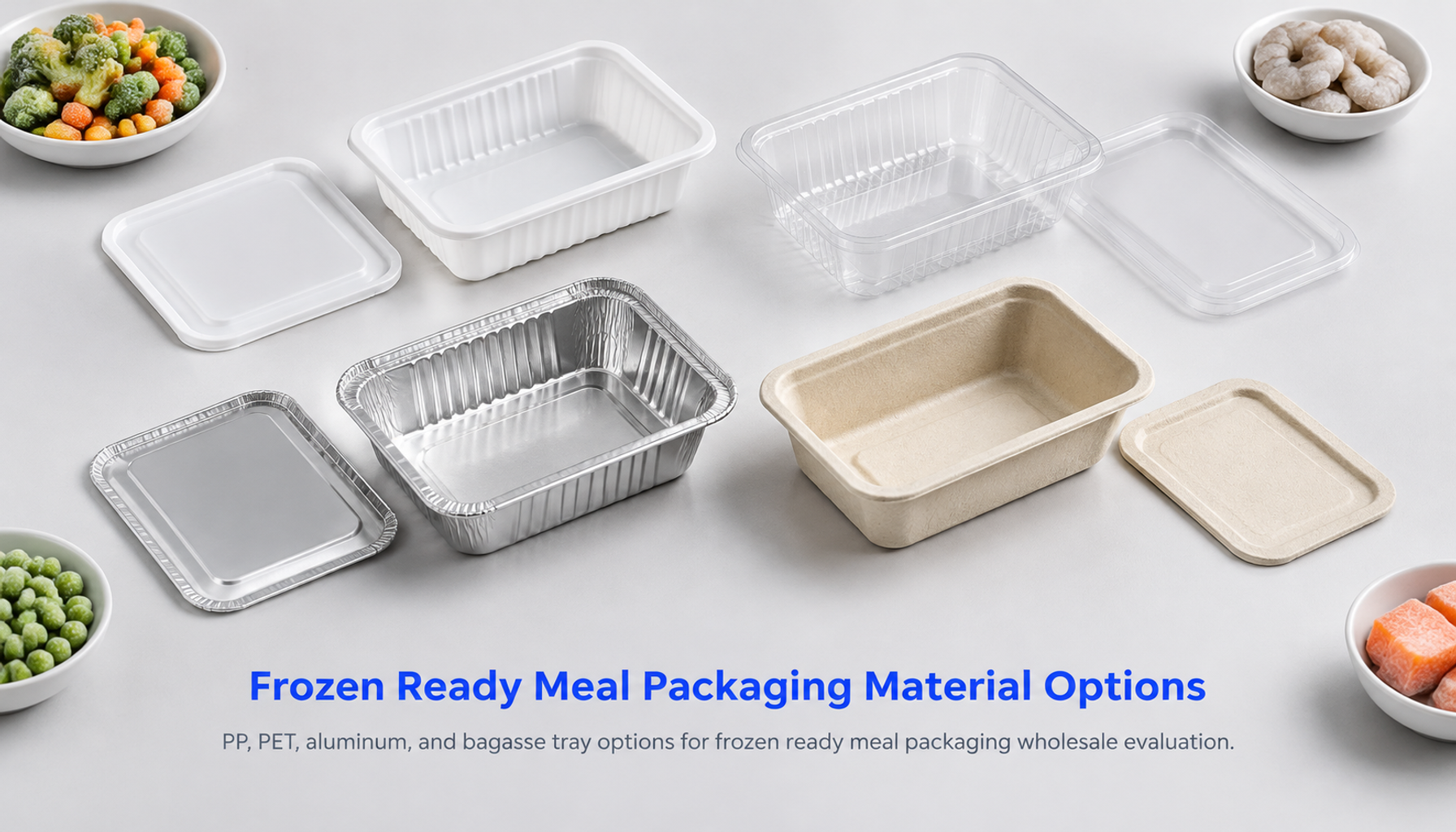
| PP or PET containers and lids | Cracks, deformation, static-attracted dust | Nesting clearance, inner sleeves, and matched lid quantities |
| Aluminum foil trays | Dented rims and crushed stacks | Stack support, separators where needed, and corner protection |
| Bagasse containers | Edge damage, distortion, moisture exposure | Stack fit, cleanliness protection, and dry packing conditions |
For paper bags, align the shipping pack with the bag structure and liner specification described in the bakery paper bag specification guide. Do not increase nesting pressure merely to obtain a higher carton count.
Floor Loading vs. Palletized Shipping
Floor loading may improve space utilization, while palletization usually simplifies mechanical handling. The better choice depends on receiving equipment, cargo vulnerability, freight mode, and labor costs.
| Factor | Floor-loaded cartons | Palletized cartons |
|---|---|---|
| Space utilization | Avoids pallet volume; actual efficiency depends on carton geometry | Pallet height and unused footprint can reduce usable capacity |
| Unloading | Usually requires individual carton handling | Supports unit handling when equipment is compatible |
| Damage control | Requires careful stacking and restraint | Requires stable unit loads, suitable wrapping, and edge protection |
| Warehouse integration | May require palletizing after arrival | Can move into storage if dimensions and load limits match |
| Additional materials | May need blocking, bracing, or dunnage | Adds pallets and securing materials |
For consolidated freight, ask the forwarder whether palletization or specific handling protection is required. Additional transfer points can increase exposure to impact and mixed-cargo contamination.
Recyclable, compostable, biodegradable, and plastic-free are different claims. Assess each shipping component separately: a paper carton does not make a shipment plastic-free if it uses plastic liners or stretch film. Recycling and composting also depend on material construction and available destination facilities.
Pallet Layout and Load Stability
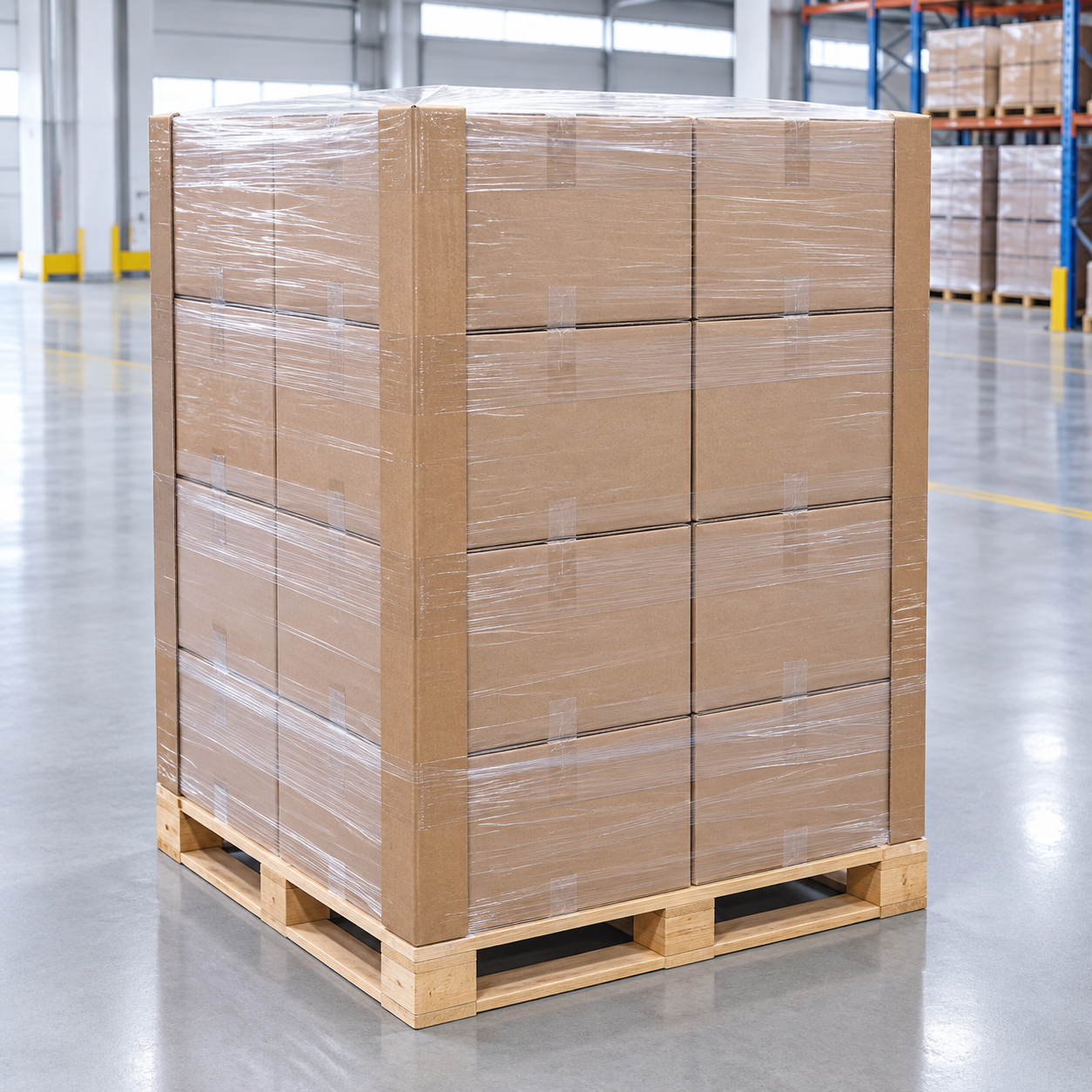
Design the pallet pattern around carton support and the receiving warehouse’s limits. A familiar pallet footprint is not automatically suitable for every buyer.
- Confirm accepted pallet dimensions, entry configuration, maximum loaded height, and gross weight.
- Calculate cartons per layer using actual external carton dimensions. Avoid unsupported carton overhang.
- Compare column and interlocked patterns. Column stacking often supports compression strength better; interlocking may improve stability but can reduce vertical support.
- Check whether deck gaps leave carton edges unsupported. Consider appropriate layer pads or another pallet design.
- Specify restraint, corner protection, and stretch wrapping without crushing lightweight products.
Solid-wood pallets and wood dunnage may be subject to ISPM 15 requirements under destination rules. Confirm treatment, marking, condition, and any additional import requirements; qualifying processed-wood materials can be treated differently.
Pallet capacity and carton stacking capacity are separate limits. Neither should be inferred from a photo or from another shipment’s packing pattern.
Container Loading and Freight Calculations
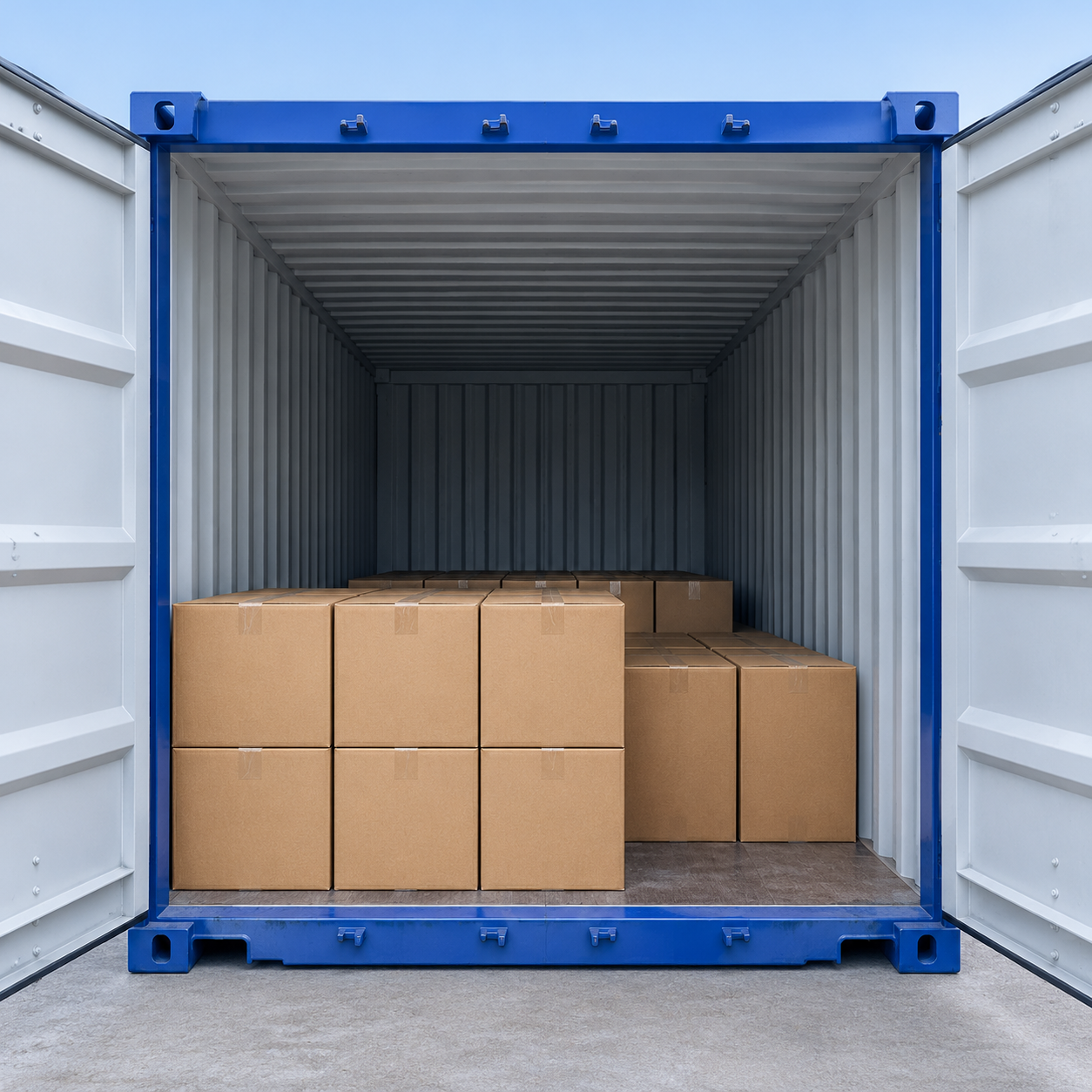
Calculate shipment volume from finished outer dimensions, then verify a physical loading layout. Empty food packaging often uses substantial space relative to its weight, but the actual freight constraint must be calculated.
Planning formulas
- Carton CBM = external length × width × height, all expressed in meters.
- Total carton CBM = carton CBM × carton count.
- Pieces per pallet = cartons per layer × layers × pieces per carton.
- Palletized shipment volume should include pallet height, wrapping, and any load projection.
For illustration only, a carton measuring 0.60 × 0.40 × 0.50 m occupies 0.12 m³. One hundred such cartons total 12 m³ before pallets or loading gaps. This is not a YBJ product specification or a guaranteed container quantity.
Do not divide nominal container volume by carton CBM and treat the result as a booking commitment. Confirm equipment dimensions, door clearance, payload, carton orientation, restraint space, and weight distribution with the forwarder.
Before loading, inspect the container for moisture entry, odors, contamination, floor damage, and visible defects. Address condensation risk through dry cargo and appropriate route-specific controls; desiccants do not repair leaks or make damp products safe.
Carton Labels and Shipment Traceability
Carton marks should let receiving staff identify and count the goods without opening every box. Agree a label proof and its position before packing.
- Buyer-approved SKU, product description, size or capacity, and artwork version.
- Pieces per carton and inner-pack quantity.
- Purchase order reference, batch or lot reference, and carton sequence where required.
- Net and gross weight, external dimensions, and required origin information.
- Handling instructions supported by the actual packing specification.
- Warehouse barcode format, placement, and scan verification requirements.
Separately identify lids, accessories, and mixed-SKU cartons. Reconcile carton quantities, pallet counts, weights, and dimensions with the packing list and relevant shipment documents. Photograph labels and loading stages, and record the container and seal details where applicable.
Shipping marks support logistics traceability; they do not establish food-contact compliance or justify certification logos.
Sampling, Transit Checks, and Receiving
Validate export carton packing for food packaging using a fully packed sample, not an empty carton alone. Agree acceptance criteria before testing.
- Approve the packing sample: verify count, arrangement, external dimensions, gross weight, closures, and labels.
- Select relevant tests: consider compression, drop, vibration, and humidity conditioning with a qualified laboratory or packaging specialist. Test conditions should reflect the route and handling risks.
- Inspect the contents afterward: check rims, corners, print abrasion, nesting release, lid fit, and usable product quantity.
- Control production: confirm the approved carton and inner-pack specification is used consistently; document changes before shipment.
- Prepare receiving checks: photograph damage before unpacking, retain affected cartons, record batch references, and quarantine wet or contaminated packaging.
Use the food packaging closure and seal testing checklist for relevant functionality checks after transit. Once received, follow suitable storage conditions for empty food packaging, preventing floor contact, moisture exposure, pests, and incompatible storage loads.
MOQ, Production, and Total Delivered Cost
Compare export carton packing for food packaging on total delivered cost per usable unit. Include cartons, inner protection, pallets, freight volume, unloading, warehouse labor, and potential damage—not only the product’s factory price.
Ask whether custom carton dimensions, printed shipping marks, special liners, or pallet patterns change MOQ or setup charges. Clarify whether order quantities must be full-carton multiples and how partial cartons are identified.
Approve packing before production and freight booking. Changing carton size late can affect procurement, packing labor, labels, pallet layouts, and shipment capacity. Sampling, testing, production, and shipping schedules require specification-specific confirmation.
The food packaging supplier quote comparison checklist helps align packing inclusions and delivery scope. State the agreed Incoterms rule and named place so competing quotations are assessed on a consistent basis.
Frequently Asked Questions
Is double-wall corrugated board always necessary?
No. Wall construction should follow packed weight, carton geometry, stacking duration, humidity exposure, and handling risks. Validate the proposed structure with agreed strength requirements and packed-carton testing.
How many pieces should a master carton contain?
Choose a count that balances product protection, manageable carton weight, inner-pack distribution, and freight efficiency. Confirm it through a packed sample rather than increasing nesting pressure to reach a target quantity.
Should empty food packaging ship on pallets?
Use pallets when handling requirements, transfer risks, or warehouse operations justify them. Floor loading may save space, but compare destination unloading labor, damage risk, and any forwarder requirements before deciding.
Can carton CBM determine the exact container quantity?
No. CBM is a planning input. Actual capacity also depends on container dimensions, door clearance, carton orientation, pallet layout, restraint space, payload, and permitted stacking.
What should buyers request before packing approval?
Request a packed sample, carton specification, inner-pack count, external dimensions, gross weight, label proof, pallet or floor-loading plan, and agreed inspection criteria. Confirm destination requirements and any effects on MOQ, cost, and schedule.
Conclusion: Approve the Shipping Pack Before Production
Effective export carton packing for food packaging connects product protection with freight planning and receiving efficiency. Approve the complete packed unit before production, and verify the loading plan before booking shipment.
Key takeaways
- Specify measurable carton and inner-pack requirements.
- Use actual packed dimensions for freight calculations.
- Match pallets and loading methods to the destination warehouse.
- Validate product usability after representative transit checks.
YBJ Packing, Guangzhou YBJ Paper & Plastic Co., has manufactured food packaging since 1998 and supports design, samples, production, quality control, and export service for B2B buyers.
FAQ
Is double-wall corrugated board always necessary?
No. Wall construction should follow packed weight, carton geometry, stacking duration, humidity exposure, and handling risks. Validate the proposed structure with agreed strength requirements and packed-carton testing.
How many pieces should a master carton contain?
Choose a count that balances product protection, manageable carton weight, inner-pack distribution, and freight efficiency. Confirm it through a packed sample rather than increasing nesting pressure to reach a target quantity.
Should empty food packaging ship on pallets?
Use pallets when handling requirements, transfer risks, or warehouse operations justify them. Floor loading may save space, but compare destination unloading labor, damage risk, and any forwarder requirements before deciding.
Can carton CBM determine the exact container quantity?
No. CBM is a planning input. Actual capacity also depends on container dimensions, door clearance, carton orientation, pallet layout, restraint space, payload, and permitted stacking.
What should buyers request before packing approval?
Request a packed sample, carton specification, inner-pack count, external dimensions, gross weight, label proof, pallet or floor-loading plan, and agreed inspection criteria. Confirm destination requirements and any effects on MOQ, cost, and schedule.
Need the Right Packaging for Your Food Product?
Tell us your product and packaging type, food application, dimensions or capacity, material, coating, quantity, printing requirements, lids or accessories, and destination market. Include artwork and any carton, pallet, or receiving restrictions. Our team will recommend a suitable structure and prepare artwork review, sampling, and quotation options.