

Table of Contents
- Noodle Soup Container Specifications: Why They Matter
- Material Options for Noodle and Soup Containers
- Leak-Proof Design: Coatings, Seams, and Testing
- Heat Resistance and Temperature Performance
- Lid Compatibility: Ensuring a Secure Closure
- B2B Specification Checklist for Procurement
- MOQ, Sampling, and Production Considerations
- Conclusion: Building a Specification Sheet That Prevents Failures
A practical B2B guide to specifying noodle and soup containers that hold hot broth without leaking, warping, or losing their lids. Covers materials, coatings, heat limits, lid pairing, testing, and procurement checks.
Noodle Soup Container Specifications: Why They Matter
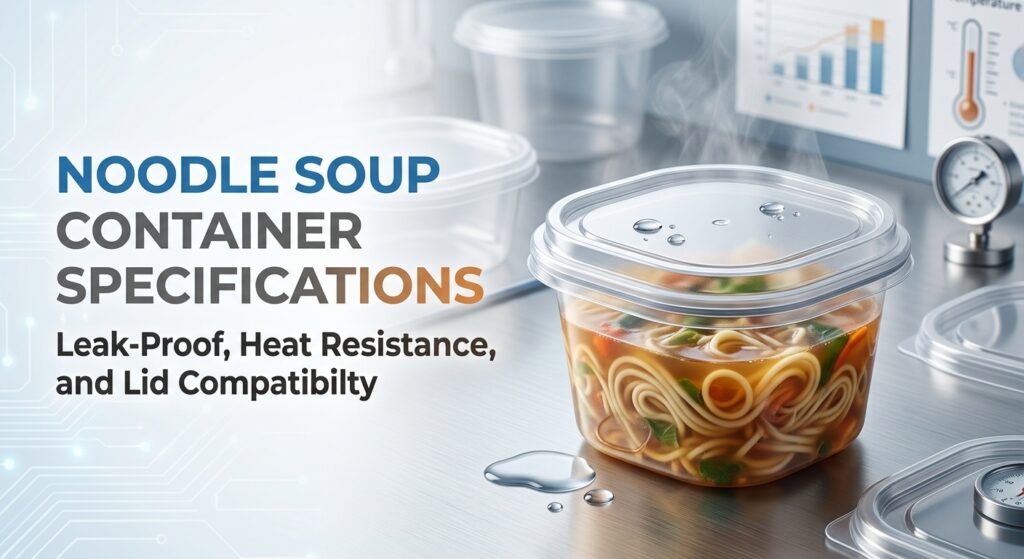
When sourcing packaging for hot noodle soups, pho, ramen, or brothy takeout dishes, noodle soup container specifications are not just technical details—they determine whether the container survives transport without leaking, warping, or popping its lid. The main buying question is: “What combination of material, coating, heat resistance, and lid design will keep hot liquid inside the container from the kitchen to the customer?” This guide answers that directly for B2B buyers, covering leak-proof construction, temperature tolerance, lid compatibility, and the checks you should run before placing an order.
Before comparing products, it helps to define three terms. Leak-proof means the container and lid system can hold liquid without seepage under normal handling, tilt, and stacking. Heat resistance is the upper temperature a material can withstand without deforming, softening, or releasing substances. Lid compatibility refers to the mechanical fit and sealing interface between a specific container rim and its lid, which often varies by manufacturer and must be tested together.
All performance values in this article are general guidelines, not guarantees. Actual results depend on the exact material grade, coating weight, lid tooling, fill temperature, and destination market regulations. Always request supplier documentation and test samples in your own operation.
Material Options for Noodle and Soup Containers
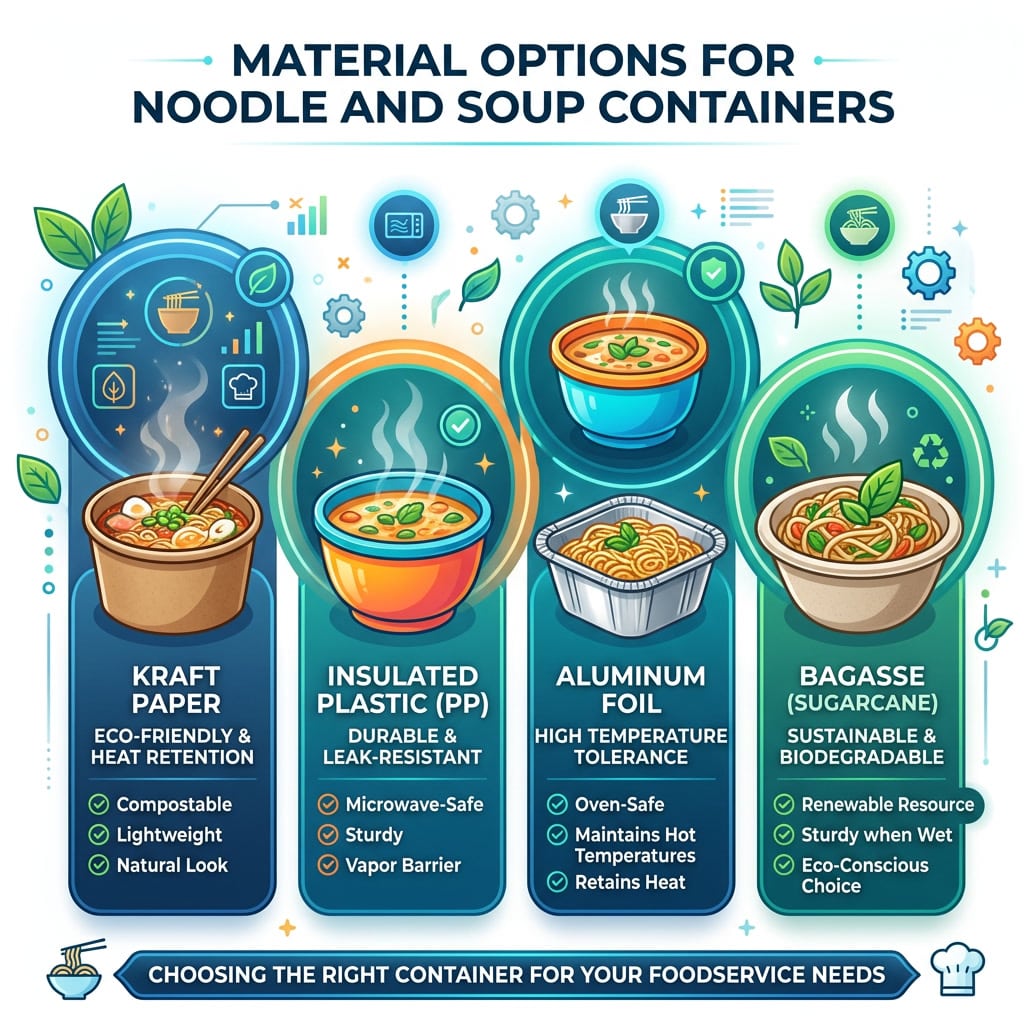
Noodle and soup containers are made from several material families, each with different leak-proof barriers, heat limits, and lid pairing options. The table below summarizes typical selections.
| Material | Common Structure | Heat Resistance (Typical) | Leak-Proof Mechanism | Lid Compatibility |
|---|---|---|---|---|
| Paperboard with PE coating | Food-grade paperboard + polyethylene lining | Hot fill up to ~90–95°C; not for oven | Heat-sealed seams + coating barrier | Snap-on, flat, dome, or heat seal film |
| Paperboard with PLA or water-based coating | Paperboard + bio-based or dispersion coating | Hot fill up to ~85–90°C; verify for broth | Coating barrier + sealed side seam | Snap-on, flat, or compatible film |
| PP (polypropylene) | Injection molded or thermoformed PP | Microwave safe up to ~120°C; not for oven | Integral wall + lid gasket or snap fit | PP lids, often with vented dome |
| Bagasse / molded fiber | Sugarcane fiber, may have PLA or PFAS-free coating | Hot fill up to ~90°C; not for oven | Coating or lamination; less reliable for long liquid hold | Matching fiber or PP lids; often heat seal film |
| Aluminum foil | Foil container with optional coating | Oven and hot fill up to 250°C+; check coating | Seamless drawn body; crimped foil lid or board lid | Foil lid or board lid; not microwave safe |
Recyclable, compostable, and plastic-free claims are not interchangeable. PE-coated paper is usually not compostable and often not accepted in curbside recycling; PLA-coated paper may be industrially compostable only where facilities exist; bagasse is typically compostable but may have a bioplastic lining; aluminum is recyclable but not compostable. A “plastic-free” paper container may still use a synthetic dispersion coating. Ask for the exact lining chemistry and certification for your destination market.
For hot noodle soups, paperboard with PE coating and PP containers are the most common choices in high-volume takeout and delivery because they balance cost, leak resistance, and lid availability. See our noodle box material and size guide for more on paper-based formats.
Leak-Proof Design: Coatings, Seams, and Testing
Leak-proof performance is the most critical specification for noodle soup containers. It comes from three elements working together: the internal barrier coating, the integrity of the side seam and bottom closure, and the lid seal. A container can be made from the right material but still fail if the seam is poorly formed or the lid does not seat correctly. The following three checks break down what to evaluate.
Coating and Barrier Options
Paper and molded fiber containers rely on an internal coating to prevent liquid from soaking into the substrate. Common options include:
- PE (polyethylene) coating — most cost-effective and widely used; provides a strong moisture and grease barrier; not compostable.
- PLA (polylactic acid) coating — bio-based and industrially compostable in facilities that accept it; typically thinner and may have lower heat tolerance than PE.
- Water-based dispersion coating — can be repulpable and plastic-free in some formulations; barrier performance varies by supplier and may need testing for hot, oily broth.
- PFAS-free oil and grease resistant (OGR) treatment — often used for fiber bowls; verify if it is suitable for prolonged hot liquid contact.
Always ask the supplier for the coating weight (gsm) and the maximum hot fill temperature the coating can withstand without pinholing or delaminating.
Seam Construction and Weak Points
The side seam and bottom closure are the most common leak points in paper soup containers. Look for these features in your specification:
- Skived and heat-sealed side seam — the paper edge is thinned and bonded, leaving no exposed raw edge inside the cup.
- Folded and glued bottom with heat-sealed disc — the bottom disc must be fully covered by the sidewall and sealed with heat, not just glue.
- Reinforced rim curl — a tight, even curl provides a stable surface for the lid to grip and prevents liquid from wicking over the top edge.
- For molded fiber — check for uniform wall thickness and absence of cracks or thin spots at the base corners.
Request cut-away samples or production cross-sections to inspect the seam integrity before approving a new supplier.
Leak Test Protocols to Request
Do not assume a container is leak-proof because the material looks right. Ask your supplier or third-party lab to perform these standard tests and provide results:
- Static water test — fill container with room-temperature water, apply lid, and place on absorbent paper for 30–60 minutes; check for seepage.