

Table of Contents
- Start with the complete packaging system
- Frozen ready meal packaging wholesale: material comparison
- Match packaging formats to the meal and sales channel
- Specify the tray, closure, and filling process
- Validate freezing, distribution, and reheating
- Check food-contact documents and disposal claims
- Compare MOQ, branding, and total purchasing cost
- Protect packaging during storage and export
- Frequently asked questions
- Conclusion and key takeaways
Choose frozen ready meal packaging by evaluating the complete tray, closure, freezing process, and reheating instructions. Compare PP, PET, aluminum, and bagasse, then define the specifications and validation needed before a wholesale order.
Start with the complete packaging system
For frozen ready meal packaging wholesale, select a tray and closure that are validated for your actual freezing, storage, distribution, and reheating conditions. PP, PET, aluminum, and bagasse can serve different applications, but a material name alone cannot establish suitability. Begin with the food, filling process, target shelf life, consumer heating method, and destination market.
Frozen meals create several linked demands: cold handling can reduce impact resistance, sauces can challenge seals, and freezing can change product volume. A pack must also survive stacking and remain usable when the consumer removes its lid or film.
- PP
- Polypropylene, a plastic used in many food containers; freezer and heating suitability depend on its grade and finished construction.
- PET
- Polyethylene terephthalate. APET is amorphous PET, commonly associated with clear packaging; CPET is crystallized PET, used in some heat-resistant meal trays. Their heating capabilities differ.
- Bagasse
- Sugarcane processing fiber formed into molded packaging. Barrier treatments and closure design affect moisture resistance.
- Packaging system
- The tray, lid or film, seal, label or sleeve, and any secondary packaging assessed together.
Frozen ready meal packaging wholesale: material comparison
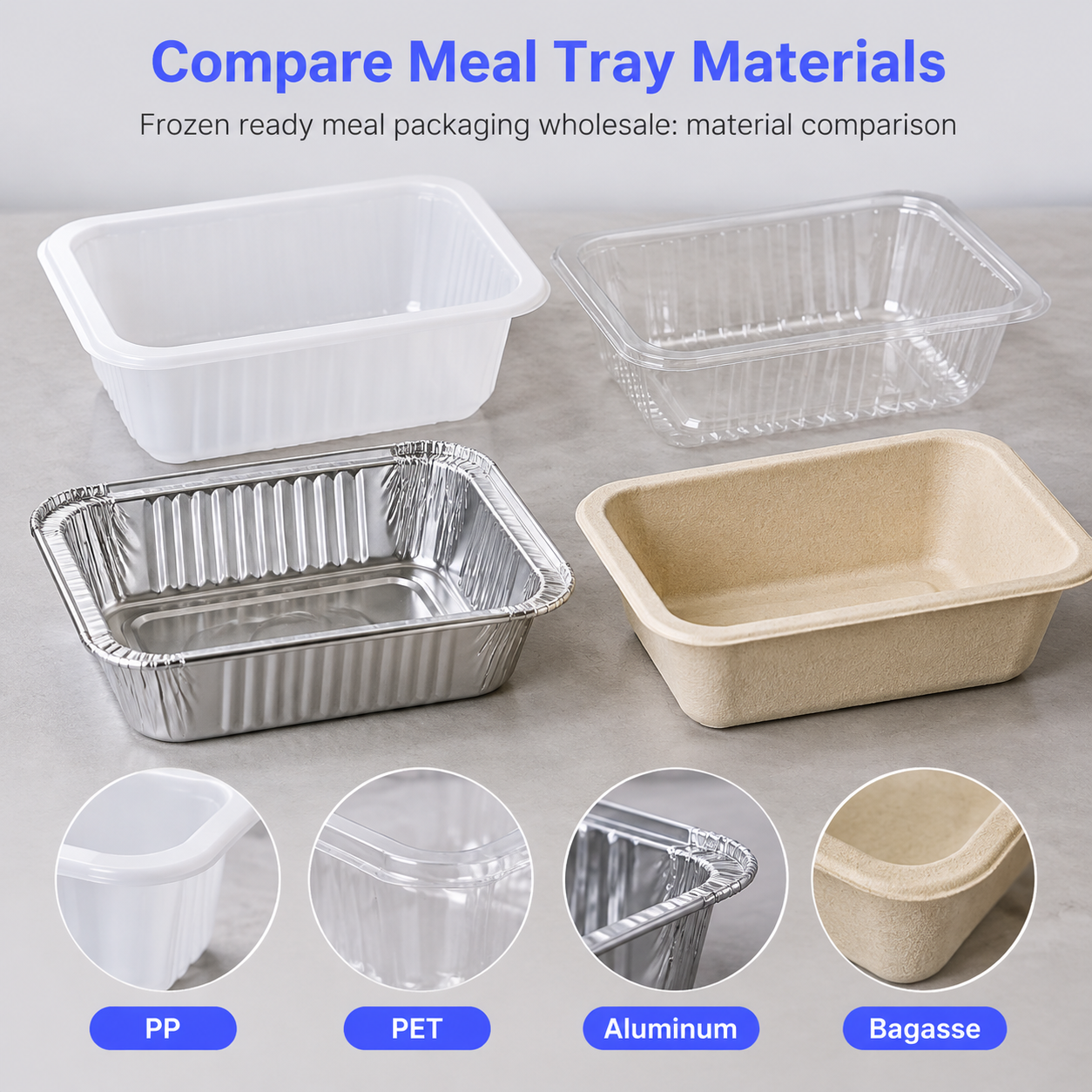
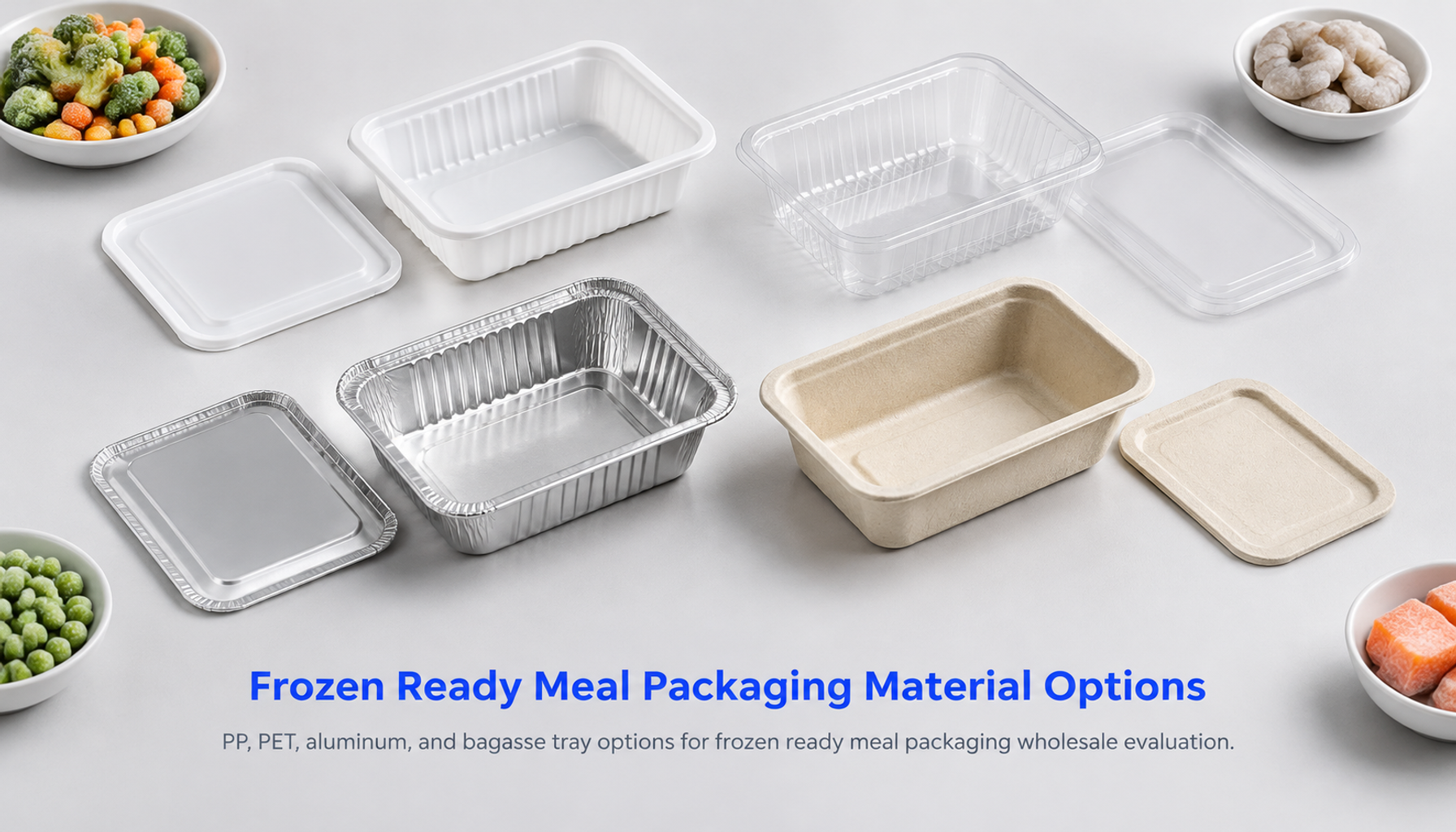
Compare materials against the required use cycle, especially the transition from frozen storage to consumer preparation. None of these options should receive a universal freezer, microwave, or oven claim.
| Material | Potential application | Main trade-off | Evidence to request |
|---|---|---|---|
| PP | Microwave-oriented meals using an approved tray and closure | Cold impact performance varies by formulation and wall design | Exact resin grade, cold handling results, heating conditions, and compatible lidding |
| APET | Clear presentation where food is transferred before heating | Clarity does not establish heat resistance | Frozen-use validation, closure compatibility, and explicit heating restrictions |
| CPET | Meals requiring an appropriately rated heat-resistant tray | Appearance, cost, and forming requirements differ from APET | Grade identification and approved freezer, microwave, or oven conditions |
| Aluminum | Oven-oriented meals in a suitably specified foil container | Rims can deform; acidic or salty food contact may require an appropriate coating | Gauge, alloy, coating where needed, closure design, and oven-use instructions |
| Bagasse | Fiber-based formats where moisture exposure and reheating are validated | Wet foods, condensation, and long storage can challenge untreated structures | Barrier composition, wet strength, frozen-storage results, and closure performance |
For plastic procurement, the PP packaging box buyer’s guide provides related specification context. The PET packaging wholesale guide is useful for presentation and customization questions; confirm the precise PET type separately.
Match packaging formats to the meal and sales channel
Shortlist formats by how the meal will be portioned, sealed, displayed, and prepared. The configurations below are sourcing options to evaluate, rather than confirmed stock products or guaranteed capabilities.
| Packaging format | Application to evaluate | Ordering details |
|---|---|---|
| Single-compartment PP tray with compatible film | Sauced rice, pasta, or mixed meals | Working fill volume, flange dimensions, film specification, venting instructions |
| Clear APET tray with lid or film | Visible frozen portions transferred before heating | Cold impact resistance, lid retention, clarity, transfer instructions |
| CPET meal tray with removable lidding | Heat-and-serve retail meals | Approved heating conditions, seal compatibility, tray rigidity |
| Aluminum tray with compatible closure | Oven-prepared casseroles or baked meals | Gauge, rim profile, coating, lid removal instructions |
| Bagasse tray with validated barrier and closure | Fiber-based meal programs | Moisture resistance, sealability, wet strength, disposal information |
Multi-compartment designs can separate portions, but require checks for cross-compartment leakage and uneven heating. Review the aluminum foil food container sourcing guide for foil specifications and the sugarcane bagasse container buyer’s guide for molded-fiber considerations.
Specify the tray, closure, and filling process
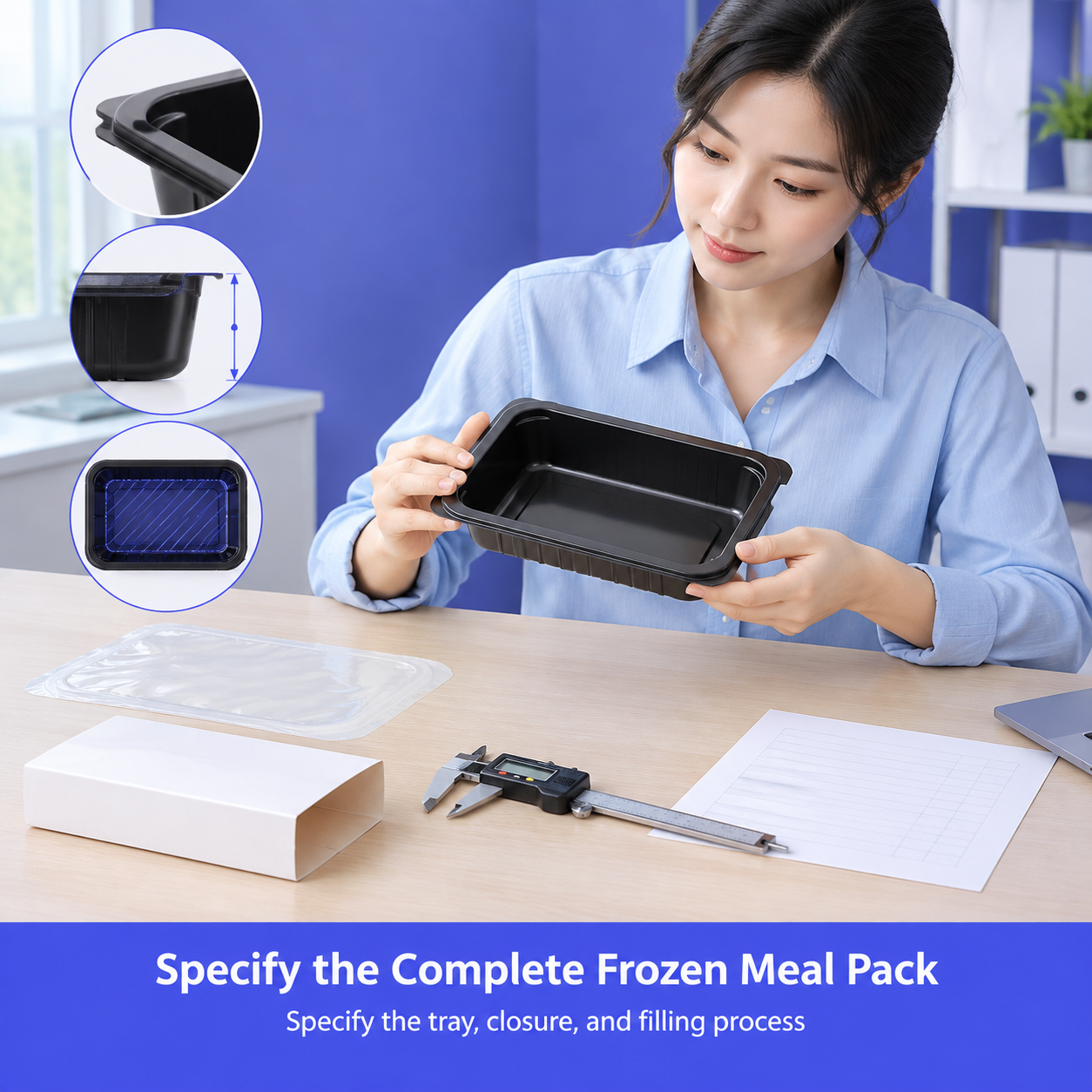
A useful specification describes the filled pack and production conditions, not simply its nominal capacity. Weight alone cannot determine tray size because rice, vegetables, sauces, and proteins have different bulk volumes.
- Food and process: recipe characteristics, fill temperature, freezing method, storage duration, and expected handling.
- Dimensions: external footprint, internal depth, flange width, compartment layout, and dimensional tolerances.
- Capacity: brimful capacity, intended fill weight and volume, and headspace for the actual recipe.
- Construction: material grade, wall thickness or weight, foil gauge, and any coating or barrier layer.
- Closure: matching lid code or film structure, peel behavior, seal requirements, and consumer opening method.
- Equipment: filling and sealing machine interfaces, tooling dimensions, and acceptable operating window.
A snap-on lid does not automatically provide a hermetic barrier. Where shelf life depends on limiting moisture loss or oxygen exposure, specify the complete barrier system. Freezer burn is associated with moisture loss; selecting a rigid tray alone will not control it. Check sealing flanges for food contamination during realistic filling trials.
Validate freezing, distribution, and reheating

Approve representative filled samples through the intended lifecycle before committing to production. Empty samples help assess fit and appearance, but cannot demonstrate performance with your food.
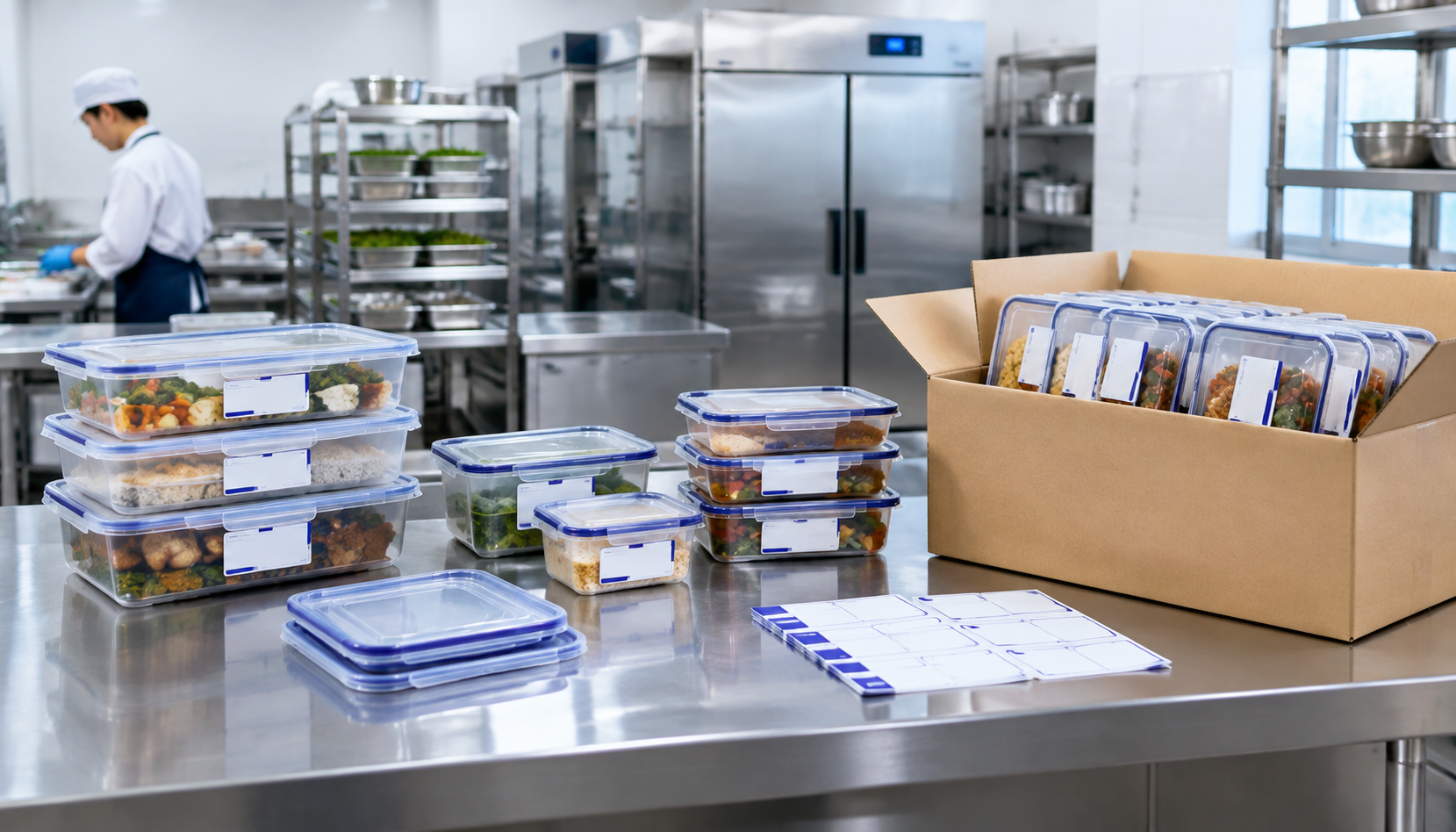
- Fill and seal: use representative recipes, fill weights, and production equipment. Check flange cleanliness, leaks, and opening force.
- Freeze: reproduce the intended freezing process. Inspect deformation, cracking, lid movement, and seal changes.
- Store: evaluate packs across the proposed shelf-life conditions. Check moisture loss, food quality, barrier integrity, and fiber softening where relevant.
- Distribute: test cold-conditioned drops, vibration, compression, and stack stability against the actual route.
- Prepare: follow proposed consumer instructions. Assess tray stability, leakage, handling, and lid or film removal.
Include realistic temperature excursions if they occur in the distribution model. Packaging validation does not replace food safety or microbiological shelf-life validation.
Do not assume a freezer-suitable tray is suitable for an oven. Aluminum microwave use requires explicit container and appliance guidance; without it, provide another preparation route. Plastic and bagasse heating instructions must also match the tested construction and food load.
Check food-contact documents and disposal claims
Food-contact evidence must cover the exact packaging specification, intended use, and destination market. Request material identification, relevant declarations, supporting test reports where applicable, and traceability for trays, coatings, films, inks, and adhesives.
Check whether the evidence covers your food type, contact duration, and heating conditions. A report for another resin, coating, or tray design may not establish suitability for the ordered pack. Requirements differ between markets, so confirm the documentation scope before sample approval.
- Recyclable: depends on the finished structure and available collection, sorting, and processing systems.
- Compostable: requires evidence against an applicable standard and identification of industrial or home composting conditions.
- Biodegradable: describes breakdown under specified conditions; it does not establish a practical disposal route.
- Plastic-free: requires checking the complete structure, including coatings, liners, and closures.
Bagasse fiber does not automatically make a coated tray compostable or plastic-free. Likewise, a recognizable plastic resin or aluminum base does not guarantee local recycling acceptance.
Compare MOQ, branding, and total purchasing cost
Compare frozen ready meal packaging wholesale quotes using the same approved specification and complete pack cost. A lower tray price may be offset by more expensive film, sealing changes, excessive rejects, or inefficient carton packing.
Ask suppliers to separate tray, closure, printing, tooling, samples, inspection, and freight charges. Confirm the trade term, carton quantities, payment terms, and which costs recur. MOQ can vary by material, mold, size, print method, color, and accessory; request it per component and per artwork version.
For branding, evaluate printed sleeves, labels, lidding, or direct printing according to the available process. Adhesives and printed surfaces should tolerate the intended cold and condensation exposure. The CMYK and Pantone food packaging printing guide explains color decisions useful when coordinating tray sleeves and retail artwork.
Approve an identifiable sample, artwork version, and specification before production. Confirm checkpoints for dimensions, closure fit, appearance, packing, and lot traceability. Sampling and production lead times depend on tooling, materials, approvals, order volume, and scheduling; obtain a written schedule for your order.
Protect packaging during storage and export
Empty packaging and filled frozen meals need separate logistics plans. Empty trays generally need clean, protected storage under supplier-specified conditions; filled meals require the validated cold chain.
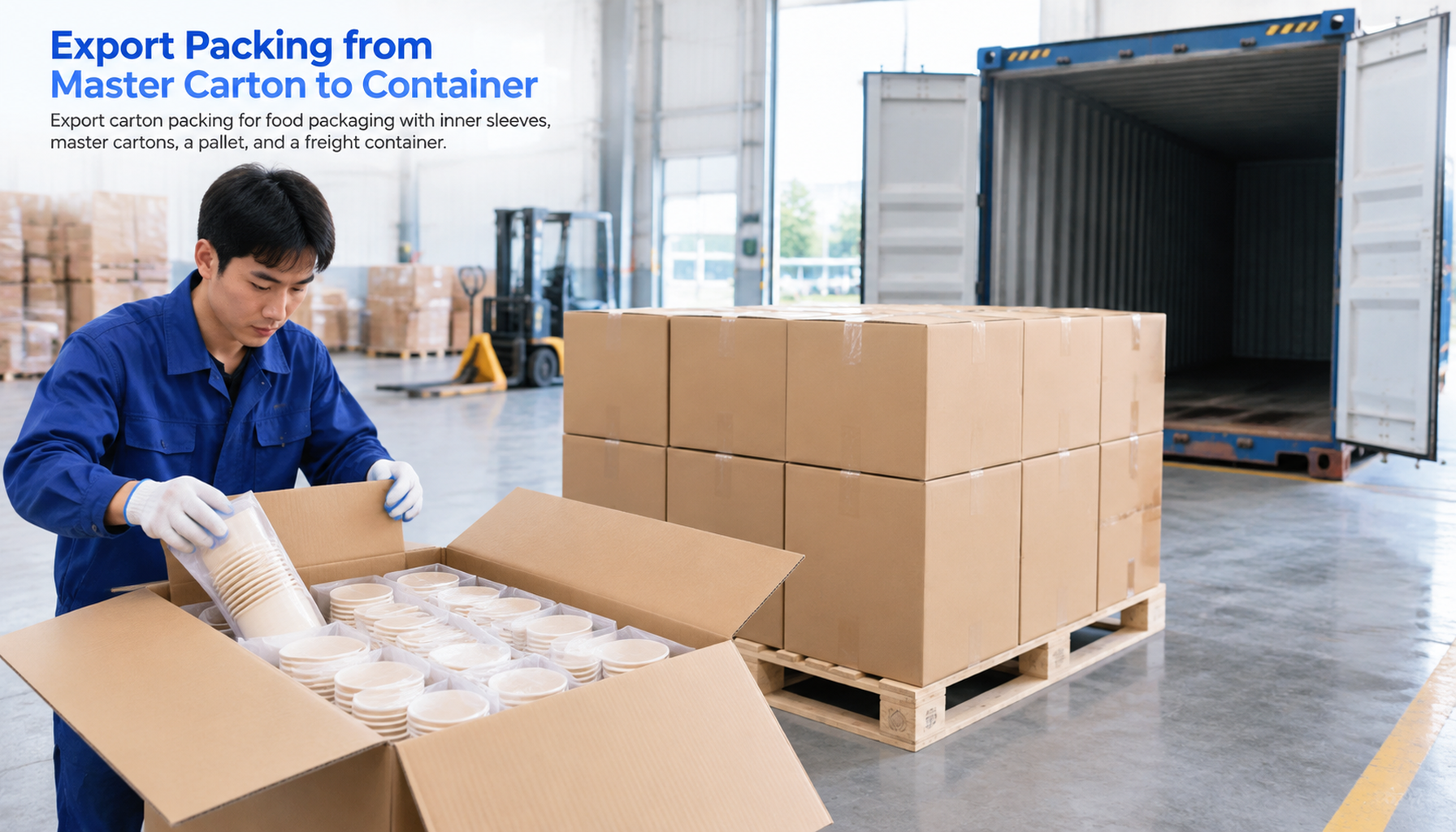
For empty packaging, confirm carton dimensions, units per carton, nesting depth, pallet configuration, and protection against crushing or moisture. High nesting density reduces shipping volume only if trays separate reliably on the filling line. Protect aluminum rims and molded-fiber edges from deformation.
For filled packs, confirm stack limits after freezing, secondary-carton support, pallet stability, and label readability after condensation. Check that export shipping arrangements cover the actual goods being shipped. Shipping empty containers from China does not establish the cold-chain performance of meals later packed in them.
Frequently asked questions
These answers address common material and ordering questions. Final approval should refer to the exact tray, closure, food application, and destination market.
Conclusion and key takeaways
The strongest frozen ready meal packaging wholesale decision starts with a defined food application and ends with an approved, tested packaging system. Compare materials against the complete use cycle, then confirm compliance, production consistency, and delivered cost.
- Distinguish APET from CPET before discussing reheating.
- Validate the tray and closure together with representative meals.
- Confirm coatings, barriers, and disposal claims for the finished pack.
- Base wholesale orders on approved specifications and samples.
FAQ
Is PP suitable for frozen ready meals?
PP can be suitable when the exact grade, tray construction, and closure pass the intended frozen-use tests. Confirm cold impact resistance, seal integrity, and any microwave instructions; PP identification alone is insufficient.
Can PET frozen meal trays go directly into an oven?
Do not assume they can. APET and CPET have different heat behavior. Only use a PET tray in an oven when the supplier has approved the exact construction and heating conditions, with compatible closure instructions.
Can aluminum meal containers be microwaved?
Only follow explicit instructions covering both the container and the microwave appliance. Without compatible guidance, specify an oven preparation route or transfer the food to an appropriate microwave-safe dish.
Is bagasse suitable for saucy meals stored frozen?
It requires application-specific validation. Check the barrier treatment, moisture absorption, wet strength, closure, and performance through storage and thawing. Fiber content alone does not establish suitability or compostability.
What determines MOQ for a custom frozen meal packaging order?
MOQ depends on the material, tray design, tooling, printing process, artwork versions, and closure components. Ask for component-level MOQs and confirm whether existing tooling can meet your specification before commissioning a custom mold.
Need the Right Packaging for Your Food Product?
Tell YBJ Packing your product type and food application, dimensions and capacity, preferred material and coating, quantity, printing requirements, lid or accessory needs, and destination market. Include freezing and reheating conditions, grease and moisture exposure, and the intended disposal route. Guangzhou YBJ Paper & Plastic Co., operating since 1998, supports design, samples, production, quality control, and export service. Our team can review a suitable structure and prepare sampling and quotation options based on your specification.