


Table of Contents
- What Are Noodle Boxes and Why Coating Matters
- Noodle Box Materials and Coating Options
- Paperboard Grades and Thickness
- Coating Types: PE, PLA, Water-Based, and Uncoated
- Standard Noodle Box Sizes and Capacity Guidelines
- Common Size Ranges and Menu Pairing
- Leak Resistance: Testing Methods and Design Factors
- Fold-Lock Corners and Liquid Retention
- Coating Integrity and Heat Tolerance
- Custom Printing and Branding Considerations for Noodle Boxes
- B2B Sourcing Checklist for Noodle Boxes
- Recommended Noodle Boxes for Different Applications
A practical B2B guide to noodle boxes for Asian takeaway containers, covering standard sizes, paperboard coatings, leak resistance testing, and custom printing considerations.
What Are Noodle Boxes and Why Coating Matters
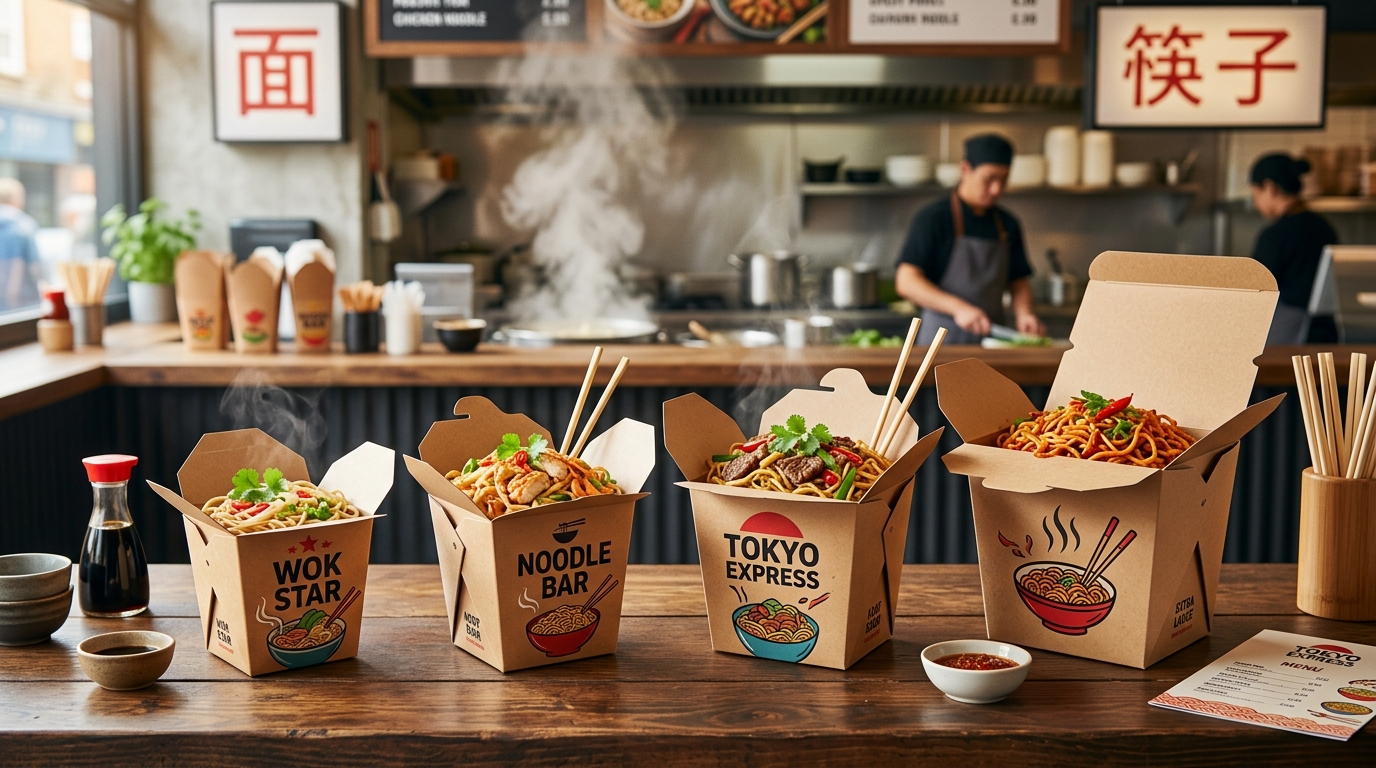
Noodle boxes are folded paperboard containers designed primarily for Asian-style takeaway and delivery dishes such as lo mein, pad thai, chow mein, and rice noodles. For B2B buyers, the three most important specifications are size, coating, and leak resistance. These factors directly affect portion control, food safety, customer experience, and brand presentation.
The classic noodle box has a folded base with interlocking bottom flaps and a top that folds into a handle or tuck closure. The coating—usually a thin layer of polyethylene (PE), polylactic acid (PLA), or a water-based barrier—prevents oils and sauces from soaking through the paperboard. Without an effective coating, the box becomes soggy, leaks, and fails during delivery. Selecting the right coating and size requires balancing cost, performance, and your target market’s sustainability expectations.
This guide explains how to evaluate each variable and match it to your menu, delivery radius, and branding goals.
Noodle Box Materials and Coating Options
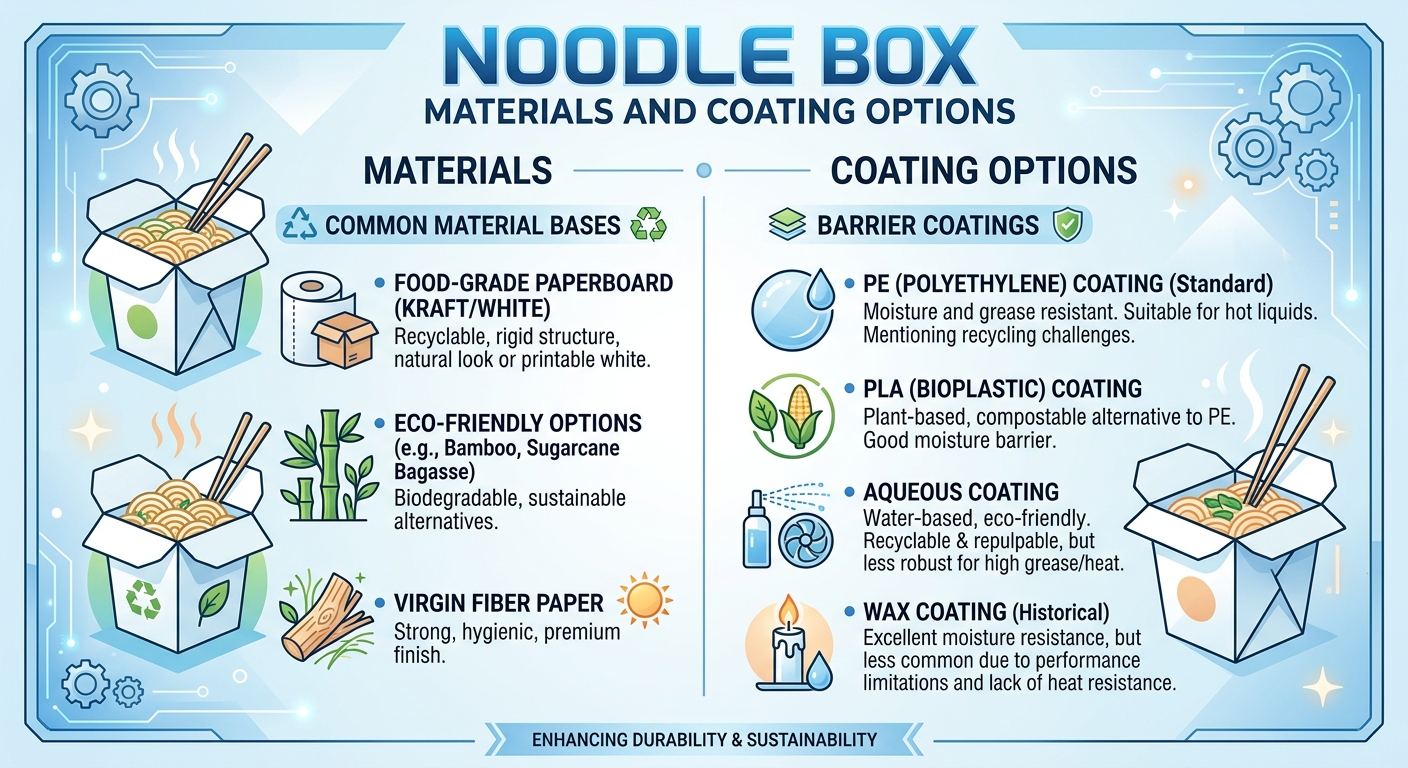
Most noodle boxes are made from solid bleached sulfate (SBS) or coated natural kraft paperboard. SBS offers a bright white printing surface and consistent appearance, while kraft provides a more natural, eco-oriented look. The base paperboard is typically between 250 gsm and 350 gsm, but thickness alone does not determine leak resistance—the coating and fold construction matter just as much.
Below are the common coating options and what buyers should know about each:
- PE (polyethylene) coating: Provides excellent moisture and grease resistance. Widely used for hot and oily foods. Not compostable in most industrial facilities; recyclability depends on local infrastructure.
- PLA (polylactic acid) coating: A bio-based polymer often marketed as compostable. Performance can be similar to PE for short hold times, but heat tolerance and moisture barrier may be lower. Verify industrial compostability certification before making claims.
- Water-based barrier coating: A dispersion coating that provides moderate grease resistance. Often repulpable and easier to recycle than PE, but may not withstand prolonged contact with very oily or liquid-heavy dishes.
- Uncoated paperboard: Only suitable for dry snacks or items with minimal sauce. Uncoated boxes will absorb moisture and lose structural integrity quickly.
The choice of coating affects food-contact compliance, printing quality, and end-of-life disposal. Always request a detailed coating specification from your supplier and test with your actual menu items.
Paperboard Grades and Thickness
Paperboard grade directly influences print quality, folding performance, and box durability. Key parameters include caliper (thickness), basis weight, stiffness, and moisture resistance. Common grades for noodle boxes include solid bleached sulfate (SBS), coated unbleached kraft (CUK), and folding box board (FBB).
- SBS: Smooth, bright, and ideal for high-quality graphics. Often used for premium takeaway brands.
- CUK: Natural brown appearance with a coated surface for printing. Offers strong tear resistance and a rustic feel.
- FBB: Multi-layer construction with mechanical pulp middle; balances cost and stiffness.
When comparing suppliers, request the basis weight (gsm) and caliper (microns or points) rather than relying only on product photos. A 300 gsm SBS noodle box may perform differently than a 300 gsm CUK box due to fiber composition and coating.
Coating Types: PE, PLA, Water-Based, and Uncoated
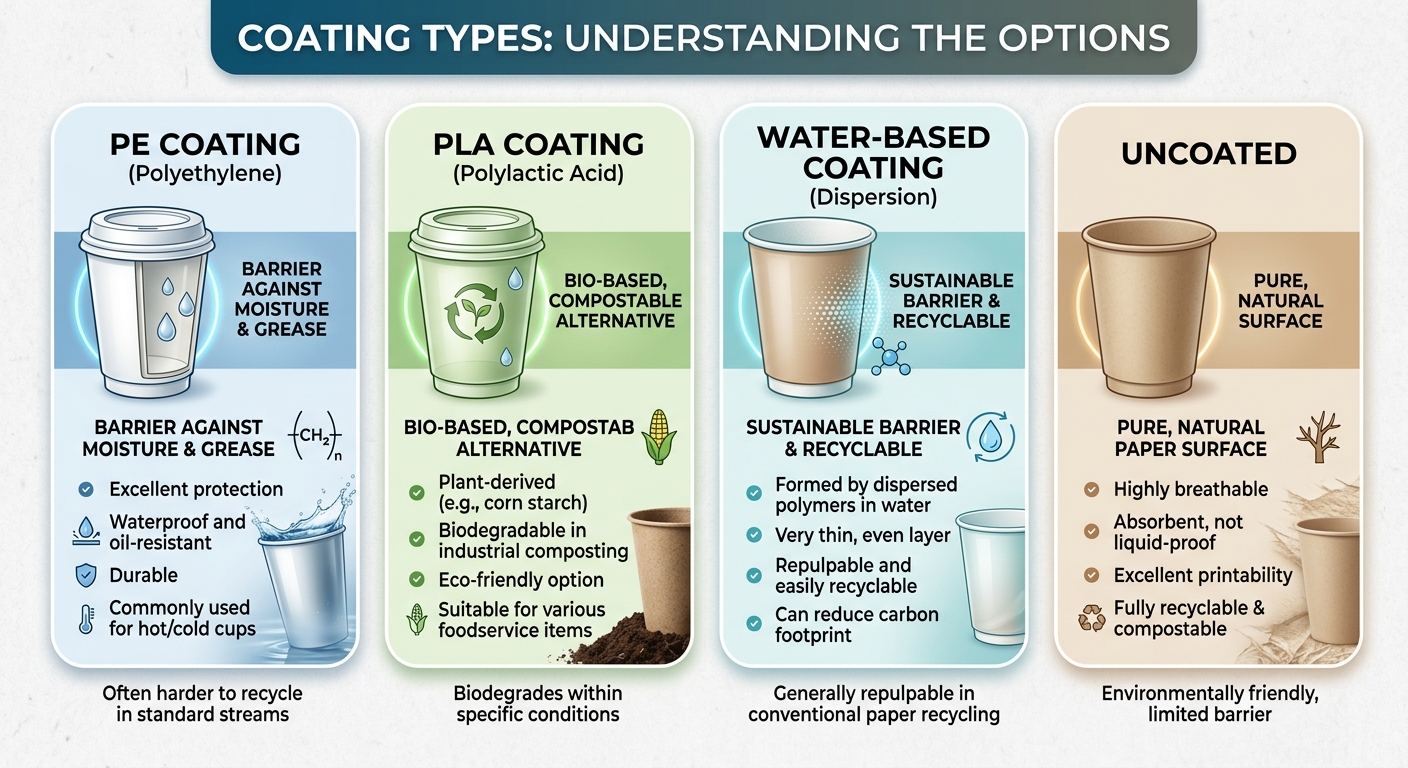
The coating is the primary barrier against oil and water. Here is a practical comparison:
| Coating Type | Grease Resistance | Moisture Resistance | Typical Hot Food Use | End-of-Life |
|---|---|---|---|---|
| PE | High | High | Suitable for hot, oily dishes | Recyclable in some streams, not compostable |
| PLA | Moderate to High | Moderate | Best for short hold times; verify heat limit | Compostable only in industrial facilities; verify certification |
| Water-based | Moderate | Moderate | Good for less oily foods | Repulpable / recyclable in many paper streams |
| Uncoated | Low | Low | Dry or lightly sauced items only | Recyclable and compostable (if no contaminants) |
Always ask for the coating’s food-contact compliance documentation for your target market (FDA 21 CFR, EU Framework Regulation, etc.). Do not assume a bio-based coating is automatically compostable; the entire box structure, inks, and adhesives must meet the relevant standard.
Standard Noodle Box Sizes and Capacity Guidelines
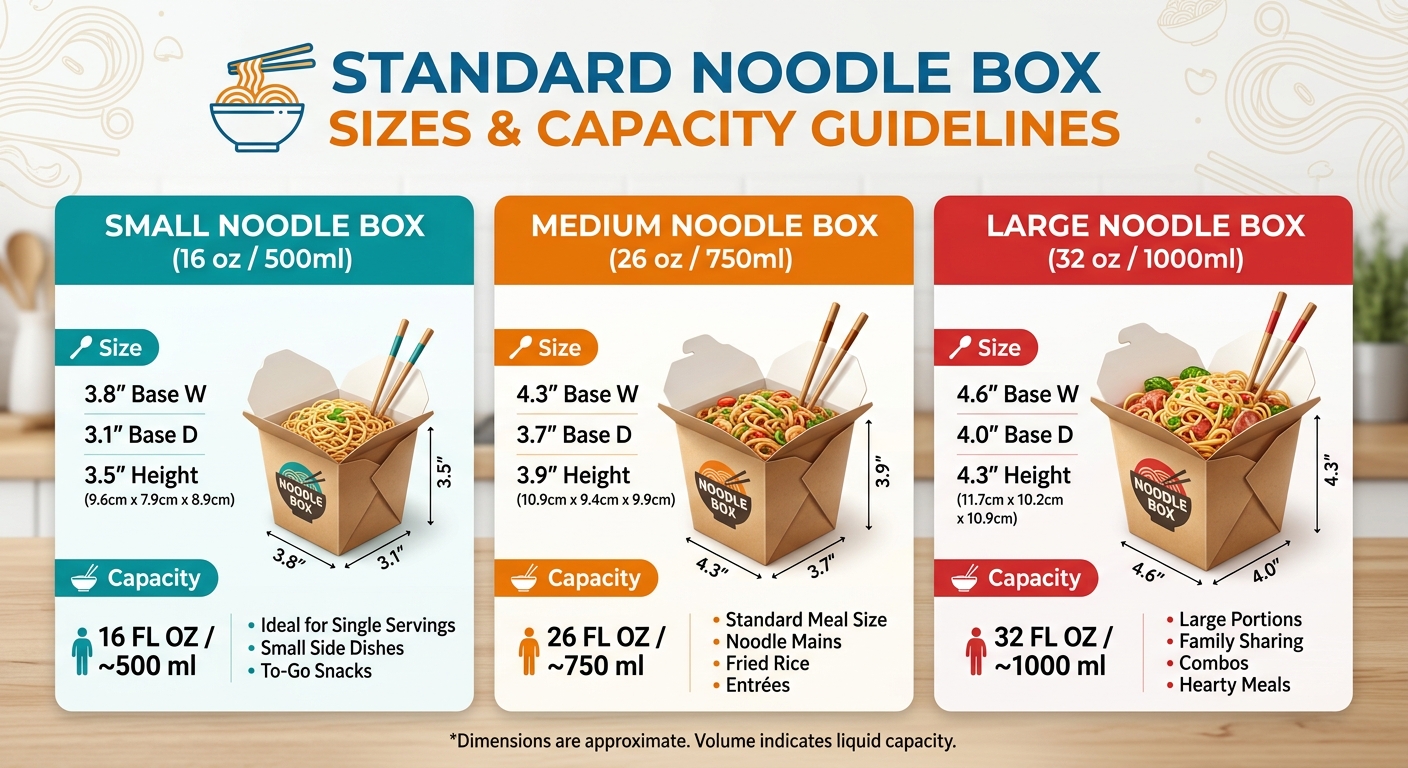
Noodle boxes are typically specified by fluid ounce capacity, but dimensions vary by manufacturer. The most common capacities range from 16 oz to 32 oz for single servings, with smaller 8 oz boxes used for side portions and larger 48 oz boxes for family-sized meals or sharing boxes.
When evaluating size, consider not only the volume but also the usable interior space after folding. A 26 oz box may be ideal for a standard noodle entrée with moderate sauce, while a 32 oz box suits dishes with added proteins and vegetables. Always request a dimensioned drawing and, if possible, a physical sample to test portion fit.
Common Size Ranges and Menu Pairing
- 8 oz (approx. 236 ml): Appetizers, spring rolls, small sides, or sauce portions.
- 16 oz (approx. 473 ml): Light noodle salads, small rice dishes, or side noodle portions.
- 26 oz (approx. 768 ml): Standard single-serving noodle entrée with moderate sauce.
- 32 oz (approx. 946 ml): Large single serving, protein-heavy dishes, or deluxe noodle bowls.
- 48 oz (approx. 1.42 L): Family meals, sharing boxes, or catering portions.
These are approximate volume conversions; actual dimensions vary by design. Pair the size with your average portion weight and sauce volume. Overfilling a noodle box stresses the fold-lock corners and increases leak risk, even with a good coating.
Leak Resistance: Testing Methods and Design Factors
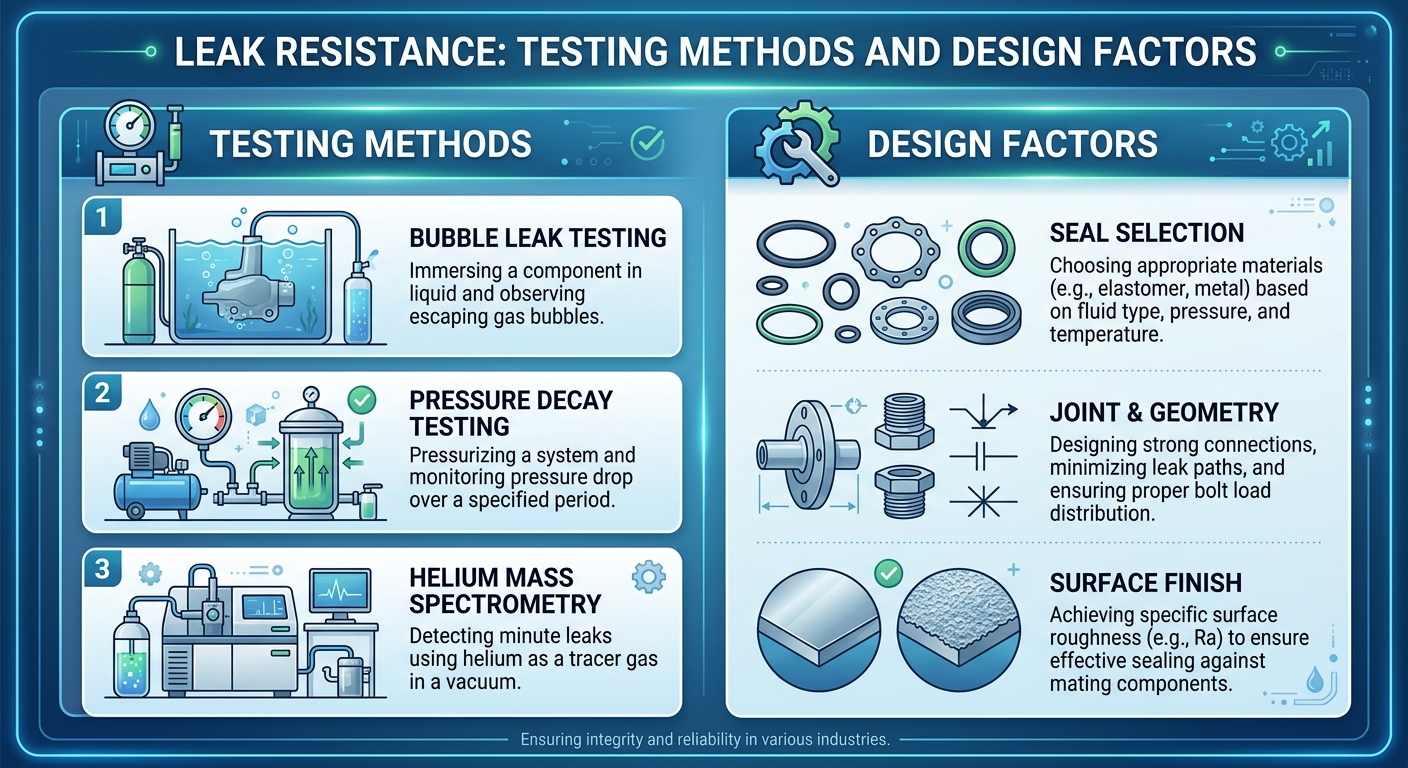
Leak resistance in noodle boxes is never absolute—it depends on coating integrity, fold precision, and the liquid content of the food. A box that passes a water test may still leak with hot oil because oil has lower surface tension. The most reliable way to evaluate a noodle box is to test it with your actual menu items under simulated delivery conditions.
Common evaluation methods include:
- Water fill test: Fill the box with water to a specified level and observe for 30–60 minutes. Note that water behaves differently from sauces.
- Hot oil test: Place a small amount of hot oil in the box and tilt it to simulate transport. Look for wicking at folds and corners.
- Vibration or shake test: Pack the box with food, close it, and subject it to gentle shaking or vibration to mimic delivery.
- Stack test: Stack filled boxes to check if weight causes bottom deformation or leakage.
Design factors that improve leak resistance include reinforced bottom flaps, tight fold-lock corners, and a coating that is continuous across all surfaces. Ask your supplier about their internal leak test protocols and request documented results if available.
Fold-Lock Corners and Liquid Retention
The classic noodle box uses a folded base with interlocking flaps that create a flat bottom. The corners are the most vulnerable points for liquid escape because multiple paper layers meet at sharp angles. If the cutting die is worn or the fold lines are imprecise, the corners may not close tightly, creating capillary paths for sauce to wick through.
When evaluating samples, inspect the bottom corners under bright light for gaps. A well-made box should have corner folds that overlap completely without tearing the paperboard. Some manufacturers add a spot of adhesive or a reinforced patch to the bottom, but this can affect recyclability and cost. Discuss your leakage concerns with the supplier and ask about their quality control for die-cutting and folding consistency.
Coating Integrity and Heat Tolerance
The coating must remain intact at the temperatures of the food being packed. Hot noodle dishes can reach 80–95°C (176–203°F) at packing, and the box may be closed immediately. A coating that softens or develops pinholes under heat loses its barrier function. Ask your supplier for the maximum recommended filling temperature for the specific coating.
PE coatings generally tolerate high temperatures well, but some bio-based or water-based coatings may have lower heat thresholds. If you are using heat lamps or holding cabinets, test the boxes under those conditions for at least 30 minutes. Also, check that the printing inks and varnishes do not react with the coating at elevated temperatures, as this can cause off-odors or migration issues.
Custom Printing and Branding Considerations for Noodle Boxes
Custom printing turns a generic noodle box into a brand touchpoint. The most common methods for noodle boxes are flexographic printing for high volumes and offset lithography for premium graphics. Digital printing is available for short runs and prototypes.
Key considerations:
- Ink coverage and color accuracy: Large solid areas on kraft may require a white underprint. SBS provides a brighter base for CMYK.
- Food-safe inks: Ensure the inks and varnishes are suitable for indirect food contact and comply with regulations in your destination market.
- Coating compatibility: Some coatings accept printing better than others. PE-coated boards may require corona treatment or a primer for ink adhesion.
- Design placement: Remember that the box is folded; graphics on the bottom or hidden flaps won’t be seen. Use a dieline template to preview the assembled view.
Work with a packaging supplier that provides a digital proof.