


Table of Contents
- Introduction: Defining Food Wrap Paper Types
- Greaseproof Paper: Specifications and Uses
- Waxed Paper: Specifications and Uses
- Parchment Paper: Specifications and Uses
- Selection Criteria: Matching Paper to Food Application
- Customization, Ordering, and Storage Considerations
- Conclusion: Specify Your Needs for the Right Wrap
A practical B2B guide to selecting the right food wrap paper. Covers greaseproof, waxed, and parchment paper specifications, performance trade-offs, customization, and procurement considerations.
Introduction: Defining Food Wrap Paper Types
Food wrap paper is a lightweight, single-use paper product designed to protect food from contamination, retain moisture, or prevent grease transfer during handling and short-term storage. For foodservice operators and packaging buyers, selecting the correct wrap paper type directly impacts food presentation, operational efficiency, and customer satisfaction. The three most common types—greaseproof, waxed, and parchment—are often confused, but each has distinct material properties, specifications, and best-use cases.
This guide defines each type, explains the key specifications you should request from suppliers, and provides practical selection criteria for foodservice applications. Material performance, food-contact compliance, MOQ, price, and lead time depend on the exact specification and destination market, so always confirm details with your packaging manufacturer.
Greaseproof Paper: Specifications and Uses

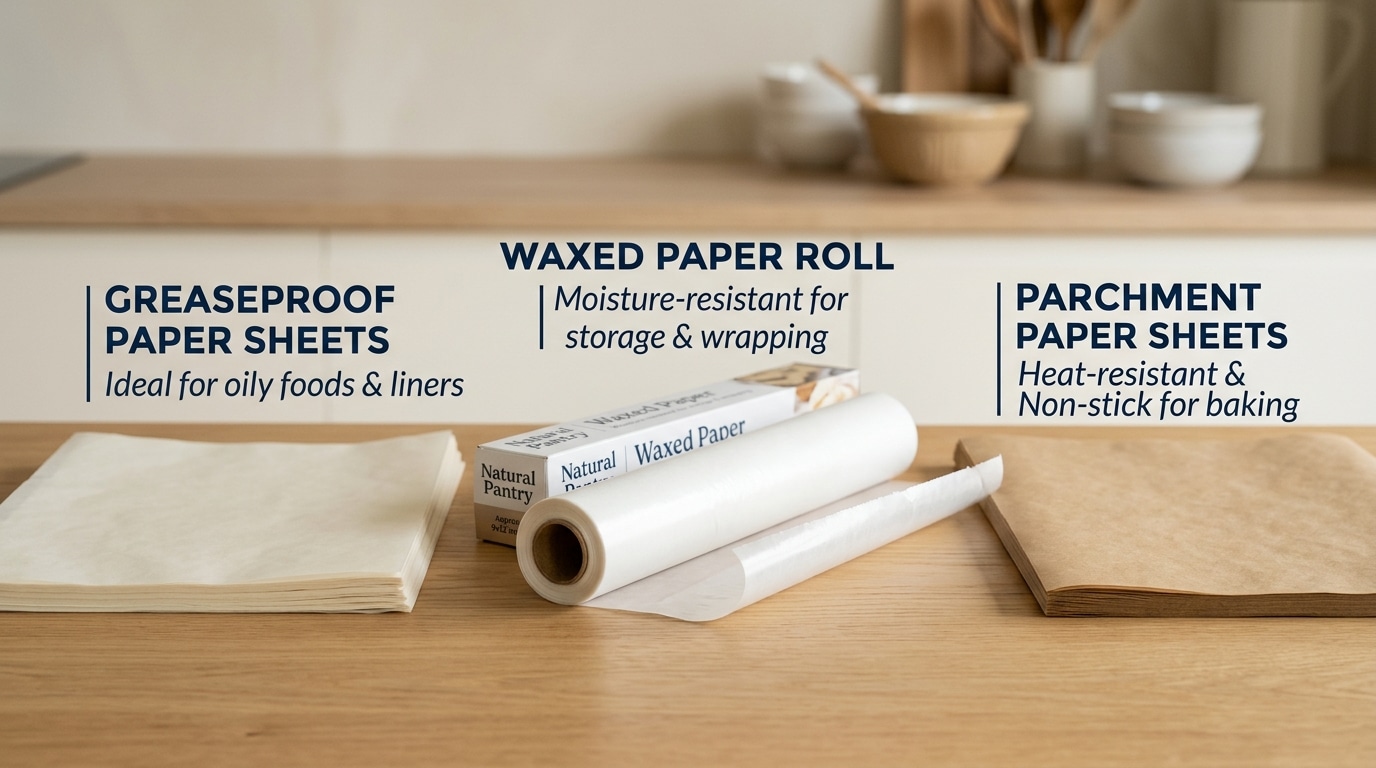
Greaseproof paper is a lightweight, uncoated paper engineered to resist the penetration of oils and fats. It is produced by highly refining the paper pulp to create a dense, low-porosity sheet. This mechanical barrier, not a chemical coating, provides its grease-resistant properties. Greaseproof paper is commonly used for wrapping sandwiches, burgers, pastries, and lining food baskets or trays.
Key specifications to request from suppliers include:
- Basis weight: Typically 30–45 gsm (grams per square meter). Lower weights are more economical but may tear more easily with very greasy or wet foods.
- Caliper (thickness): Usually 0.03–0.05 mm. Thicker caliper improves strength and insulation.
- Grease resistance level: Often measured by the Kit test (e.g., Kit 3 to Kit 6). Higher Kit numbers indicate better grease holdout.
- Wet strength: Some grades include wet-strength additives to prevent disintegration when in contact with moist foods.
- Food-contact compliance: Must meet FDA 21 CFR 176.170 or EU framework regulations for direct food contact.
Greaseproof paper is not heat-sealable and is generally not suitable for direct oven or microwave use. It works best for room-temperature or warm foods with moderate grease levels. If you need custom printing for branding, flexographic printing is common on greaseproof paper, but ensure the ink system is food-safe and does not compromise the grease barrier.
Waxed Paper: Specifications and Uses

Waxed paper is a paper substrate coated with a thin layer of food-grade wax, typically paraffin or soybean wax. The wax coating provides an additional moisture barrier and a slightly glossy surface, making it suitable for wrapping cold or room-temperature items such as sandwiches, baked goods, and cheese. Waxed paper is not heat-resistant and should never be used in ovens or with hot foods, as the wax will melt.
Typical specifications include:
- Base paper weight: Usually 35–50 gsm before wax coating.
- Wax coating weight: 5–12 gsm per side, applied as a single or double side coating. Double-side waxed paper offers better moisture protection.
- Total basis weight: Often 40–60 gsm after coating.
- Moisture barrier: Good resistance to water vapor, but not a complete vapor barrier for long-term storage.
- Heat resistance: None; wax melts at approximately 40–60°C depending on the wax type. Do not use for hot food or microwave.
- Food contact: Must use food-grade wax compliant with FDA 21 CFR 176.170 or EU regulations.
Waxed paper is less common in modern foodservice due to the rise of greaseproof and parchment alternatives, but it remains popular for wrapping sandwiches, lining bakery boxes, and separating layers of baked goods. It is also more economical than parchment in some markets. When printing on waxed paper, low-migration inks are required because the wax can act as a carrier for ink components.
Parchment Paper: Specifications and Uses

Parchment paper, also known as baking paper, is a cellulose-based paper treated with a silicone or Quilon coating on one or both sides. This treatment gives it excellent non-stick properties, high heat resistance, and good grease and moisture holdout. Parchment paper is widely used for lining baking sheets, wrapping greasy or hot foods, and en papillote cooking.
Key specifications:
- Basis weight: Typically 38–45 gsm for standard grades; heavier weights (up to 60 gsm) are available for demanding applications.
- Coating type: Silicone is preferred for high-temperature and repeated-use applications; Quilon (chrome complex) is more economical but less heat-resistant (max ~180°C) and not suitable for high-acid foods.
- Heat resistance: Silicone-coated parchment can withstand oven temperatures up to 220–230°C for short periods. Quilon-coated parchment is rated up to 180°C.
- Non-stick performance: Both sides may be coated, or one side depending on use. Double-sided coating offers maximum versatility.
- Moisture and grease barrier: Excellent for short-term wrapping; not a complete moisture barrier for long-term storage.
- Food-contact compliance: FDA 21 CFR 176.170 and 176.180 for direct food contact; EU regulations apply.
Parchment paper is more expensive than greaseproof or waxed paper, but its heat resistance and non-stick properties make it essential for baking and hot food applications. When sourcing, clarify whether you need a natural (brown) or bleached (white) appearance, as this affects branding and cost.
Selection Criteria: Matching Paper to Food Application
Choosing the right food wrap paper requires matching the paper’s performance characteristics to the specific food item, service temperature, and operational workflow. Consider the following decision points:
Food Temperature
Cold or room temperature: Greaseproof, waxed, or parchment all work, but waxed may be most cost-effective for simple wrapping. Warm or hot (below 100°C): Use greaseproof or parchment; avoid waxed paper. Oven or high heat (above 150°C): Only silicone-coated parchment is suitable.
Grease Level
For very greasy foods like fried items or bacon, choose a higher Kit rating greaseproof or parchment. Greaseproof with Kit 5+ is often sufficient for sandwiches; parchment provides superior holdout and can withstand hotter grease without breaking down.
Moisture Resistance
Waxed paper offers the best moisture vapor barrier among the three, but only at cold temperatures. Parchment resists moisture well at up to moderate heat. Greaseproof has lower moisture resistance unless wet-strength treated.
Need for Non-Stick Release
If the paper will line baking trays or come into contact with sticky foods like cheese or caramel, parchment is the only choice. Greaseproof and waxed papers will stick.
Printing and Branding
All three types can be custom printed, but ink adhesion and food safety vary. Greaseproof and parchment are more commonly printed because their surfaces are more stable. Waxed paper printing requires specialized inks that do not migrate through the wax.
Cost and Performance Balance
Greaseproof is generally the most economical for bulk wrapping, waxed is mid-range, and parchment is premium. Evaluate the total cost per wrap, including waste and customer perception, not just the unit price.
Customization, Ordering, and Storage Considerations
When ordering custom food wrap paper, provide your supplier with complete specifications to avoid production errors. Key details include:
- Sheet size: Specify width and length in millimeters or inches, or roll width and length for roll stock.
- Material and grade: Greaseproof, waxed, or parchment, with basis weight and coating type.
- Printing: Number of colors, print coverage, and artwork file format. Flexographic printing is common for short runs, while rotogravure suits high-volume orders.
- Packing style: Sheets in reams, rolls, or interleaved. Interleaving is popular for foodservice ease of use.
- Quantity and MOQ: MOQs vary by manufacturer and printing method. Flexo printing typically starts at 50,000–100,000 sheets, while rotogravure may require 500,000+.
- Compliance documentation: Request food-contact compliance certificates (FDA, EU) and, if needed, Kosher or allergen statements.
Storage is critical for maintaining paper quality. Store wrap paper in a cool, dry environment away from direct sunlight and strong odors. High humidity can cause greaseproof paper to lose its barrier properties, and heat can melt waxed paper or degrade silicone coatings. Rotate stock using first-in, first-out (FIFO) to prevent aging.
For international buyers, clarify shipping terms (FOB, CIF), packaging for export (pallets, moisture barriers), and lead times. Samples should be requested before mass production to verify print quality, food compatibility, and handling performance.
Conclusion: Specify Your Needs for the Right Wrap
Greaseproof, waxed, and parchment papers each serve distinct purposes in foodservice. Greaseproof offers economical grease resistance for moderate applications; waxed provides a moisture barrier for cold items; parchment delivers heat resistance and non-stick performance for baking and hot foods. By understanding the key specifications—basis weight, coating type, grease resistance, heat tolerance, and compliance—you can make an informed procurement decision.
Always communicate your exact food application, temperature range, packaging format, printing needs, and destination market to your supplier. This ensures you receive a product that meets performance expectations and regulatory requirements while staying within budget.
Get a Custom Quote for Your Food Wrap Paper
Tell us your product type, food application, dimensions or capacity, material preference, coating, quantity, printing requirements, lid or accessory needs, and destination market. Our team will provide accurate recommendations and a competitive quote.