


Table of Contents
- What Food Packaging Batch Traceability Means
- Minimum Records to Require from a Packaging Supplier
- How to Specify Packaging Lot Codes and Carton Identification
- The Record Chain from Raw Material to Shipment
- Material Change Control and Specification Revisions
- Testing, Retained Samples, and Complaint Investigation
- Buyer Checklist for an RFQ or Quality Agreement
- Conclusion: Make Traceability Part of the Purchase Specification
A practical buyer specification for tracing food packaging from material and production records to cartons, shipments, retained samples, and customer complaints.
What Food Packaging Batch Traceability Means

Food packaging batch traceability is the documented ability to identify which packaging specification, materials, production batch, inspection records, cartons, and shipment were involved in a supplied order. For a buyer, the purpose is practical: if a printed bag, paper container, cup, film, carton, or lid has a defect, the records should help identify the affected quantity and separate it from unaffected stock.
Packaging batch: A defined quantity produced under substantially consistent conditions and linked to production, inspection, and packing records.
Lot code: An identifier assigned to a production quantity, shipment, or other controlled unit so it can be located in records.
Traceability: The documented connection between the approved specification, materials, manufacturing activity, finished cartons, shipment, and customer receipt.
Traceability is not the same as printing a date or code on every individual food package. Depending on the product and process, identification may be applied to master cartons, pallets, labels, delivery documents, or production records. The correct system depends on the packaging format, order structure, customer requirements, and destination market.
It should also be distinguished from food-contact compliance. Compliance documents help show whether a material and product are suitable for the intended use; traceability shows which supplied quantity those documents and specifications relate to. Buyers should manage both.
Minimum Records to Require from a Packaging Supplier
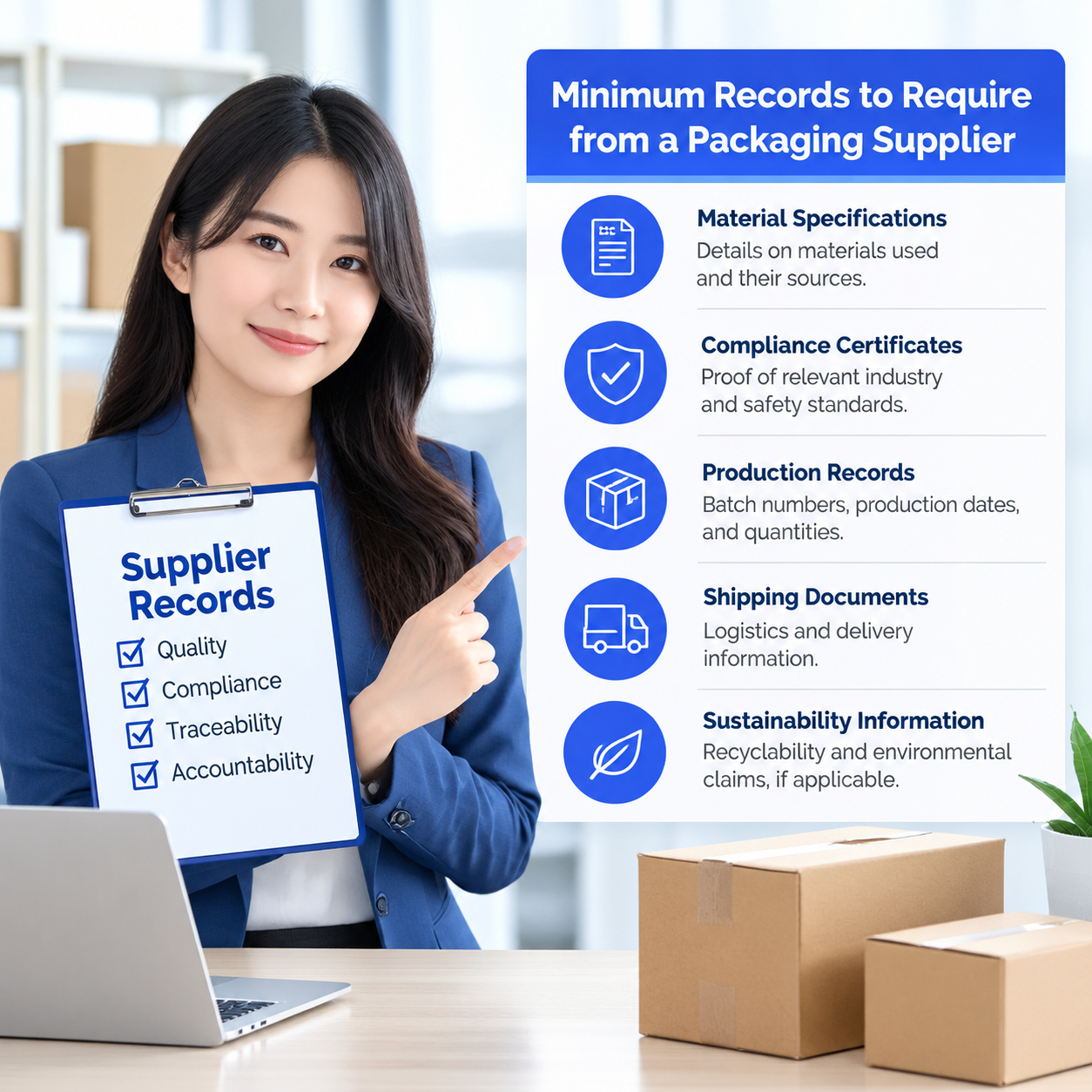
A buyer specification should state the records required for each production batch or shipment. The supplier may use paper records, an enterprise system, spreadsheets, or controlled forms; the important point is that the records are complete, legible, retrievable, and linked by the same identifiers.
Core supplier batch records
- Purchase and product identity: buyer purchase order, supplier item number, artwork revision, approved sample reference, dimensions, capacity where applicable, material structure, coating, accessories, and packaging configuration.
- Material identity: paperboard, paper, plastic film, resin, aluminum, bagasse, ink, adhesive, coating, or other relevant input identifiers. The record should identify the supplier or internal material lot when available.
- Production information: manufacturing date or production period, machine or line where recorded, quantity produced, quantity accepted, quantity rejected, and rework or disposition information.
- Inspection results: checks appropriate to the product, such as dimensions, print appearance, color reference, seal or seam condition, odor, fit, carton count, and visible damage.
- Packing and shipment information: master-carton numbers or ranges, pallet identification where used, quantities per carton, shipment date, packing list, invoice reference, and destination.
- Retained packaging samples: a controlled sample linked to the production batch, specification, and date retained.
Not every packaging product requires the same test record. A printed paper bag may need different checks from a lidded soup container or a plastic freezer bag. The buyer should specify the critical characteristics instead of requesting generic paperwork that does not help investigate a failure.
For a broader inspection framework, see the packaging quality control checklist, then adapt it to the actual packaging format.
How to Specify Packaging Lot Codes and Carton Identification

Packaging lot codes should be simple enough for warehouse staff to read and specific enough for quality personnel to retrieve the related records. Do not prescribe a code format without confirming that the supplier can apply it consistently across cartons, pallets, documents, and digital records.
Questions to settle in the specification
- What unit receives the code? Define whether the code appears on each master carton, pallet label, inner pack, delivery document, or another controlled unit.
- What does the code identify? State whether it identifies a production batch, packing batch, shipment, artwork revision, or a combination. A shipment number alone may not identify the manufacturing batch.
- Where is it placed? Specify a visible label area that does not cover essential handling, product, or regulatory information.
- How is it read? Define human-readable characters first. A barcode or QR code can support scanning, but it should not replace a readable identifier unless the buyer has a reliable scanning process.
- How is it verified? Require a check that carton labels match the packing list, purchase order, product specification, and actual contents.
- How are mixed cartons handled? If a carton or pallet can contain more than one lot, require separate identification or a documented mixed-lot procedure.
Carton identification should also account for export handling. Labels may be exposed to compression, abrasion, moisture, temperature changes, and repeated warehouse movement. The buyer and supplier should agree on label material, print legibility, placement, and a practical method for correcting an incorrect label without creating hidden ambiguity.
QR codes can be useful for linking a carton to digital records, but the code content, access permissions, data ownership, and backup process should be agreed before implementation. See the guide to QR codes on food packaging for printing and placement considerations.
The Record Chain from Raw Material to Shipment
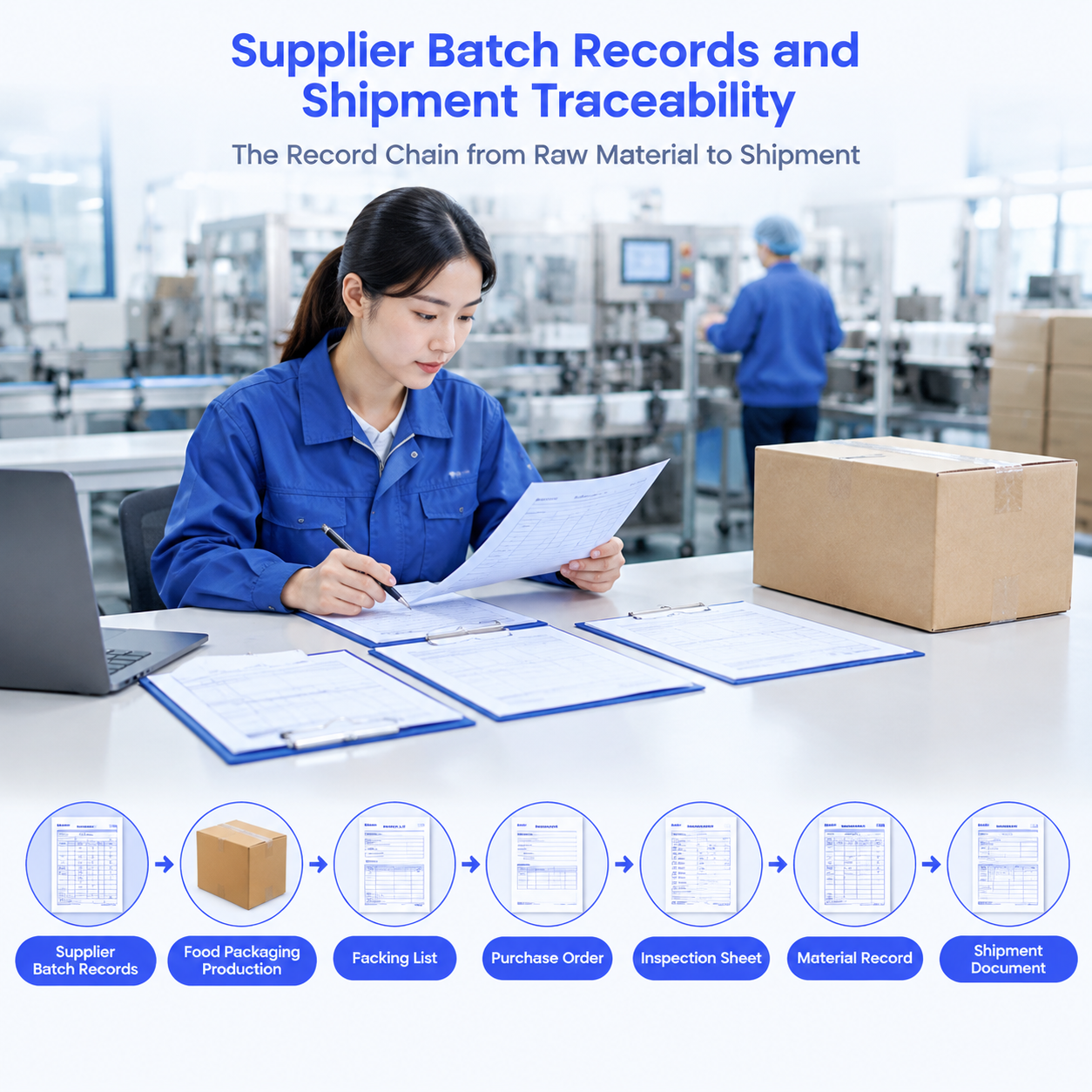
A traceability system works only when each record points to the next record. Buyers can test this continuity by selecting one finished carton and asking the supplier to trace it backward and forward.
| Traceability stage | Information to connect | Buyer verification question |
|---|---|---|
| Approved specification | Artwork revision, dimensions, material, coating, structure, accessories | Can the supplier show which approved version was produced? |
| Incoming materials | Material descriptions and available supplier or internal lot references | Can the finished batch be linked to its key inputs? |
| Production | Production date or period, line or order reference, quantity and rejects | Can the supplier identify the manufacturing quantity? |
| Inspection | Measured or observed results and disposition of nonconforming goods | Can the inspection record be matched to the batch? |
| Packing | Carton numbers, quantities, pallet information, lot code | Can warehouse staff isolate affected cartons? |
| Shipment | Packing list, invoice, shipment date, destination, carrier reference | Can the supplier identify where the batch was sent? |
The reverse direction matters as well. Given a material change, failed inspection, or packaging complaint, the supplier should be able to identify the potentially affected orders and customers without assuming that every shipment is affected. The actual scope depends on the quality of the records and the definition of the batch.
For importers, request records in a format that can be retained with the purchase order and shipping file. The retention period should be agreed according to the buyer’s quality system, customer requirements, and destination-market obligations. Do not assume one universal retention period applies to every packaging product or market.
Material Change Control and Specification Revisions

Material change control is the process used to evaluate, approve, document, and communicate a change before it is incorporated into supplied packaging. It should cover more than a paper or plastic grade. Changes to coating, ink, adhesive, sealant, dimensions, tooling, printing method, supplier, manufacturing site, or packing configuration may affect performance or identification.
Buyer requirements for controlled changes
- Define changes that require advance notice and buyer review.
- Identify the affected specification, artwork revision, material structure, and expected first production batch.
- Explain whether a new sample, fit check, print approval, or performance test is needed.
- Keep old and new versions clearly separated in production and inventory records.
- Assign an effective date or first affected lot, subject to the buyer’s approval process.
- Record the decision, responsible persons, supporting documents, and disposition of obsolete stock.
A supplier should not substitute a material simply because the new material appears similar. Food-contact suitability, print behavior, stiffness, grease or moisture performance, sealing, odor, fit, recyclability or compostability claims, and destination-market requirements may all need review. The appropriate evaluation depends on the exact change and intended application.
Buyers should also define emergency communication. If a supplier discovers that a batch does not match the approved specification, the supplier needs a clear contact route, quarantine expectation, and method for identifying affected cartons and shipments.
Testing, Retained Samples, and Complaint Investigation

Retained packaging samples provide a physical reference for investigating a complaint, print dispute, fit problem, odor concern, seam issue, or suspected material change. A retained sample is useful only when it is protected from mix-ups and linked to a defined lot and specification.
Specify a practical retained-sample process
- Identify the sample with the product code, lot code, production date or period, artwork revision, and supplier order reference.
- Record who selected the sample and when it was selected.
- Store enough representative material to examine the relevant features without confusing samples from different lots.
- Define storage conditions appropriate to the packaging material and avoid exposure that could change the sample.
- Record the retention duration and disposal approval in line with the buyer’s requirements.
Testing should be risk-based and agreed before production. Depending on the packaging, checks may include dimensions, capacity, weight or thickness where specified, print and color approval, seal or seam integrity, lid fit, odor, visual defects, compression or handling performance, and food-contact documentation. A test result should state the method or acceptance criterion sufficiently for the buyer and supplier to understand what was checked.
For packaging complaint traceability, the buyer should capture the product name, packaging code, lot or carton code, delivery reference, quantity affected, photographs, food application, storage and handling conditions, and the nature and timing of the complaint. The supplier can then compare the complaint sample with retained samples and batch records. Neither party should conclude the cause from a code alone; investigation may require physical samples, process review, and checks of the finished food application.
Buyer Checklist for an RFQ or Quality Agreement

Add the following points to the RFQ, purchase specification, supplier quality agreement, or order confirmation. Adapt them to the product rather than treating them as a universal legal checklist.
Traceability specification checklist
- Packaging product code and approved specification revision.
- Food application, dimensions or capacity, material, coating, accessories, and printing requirements.
- Definition of the production batch and the lot-code format or minimum identification information.
- Required carton identification, pallet labels, packing-list references, and handling of mixed lots.
- Supplier batch records linking materials, production, inspection, packing, and shipment.
- Inspection points and acceptance criteria for critical characteristics.
- Retained packaging sample identification, storage, and retention requirements.
- Advance notice and approval rules for material change control and specification revisions.
- Nonconforming-product, quarantine, correction, and complaint escalation procedures.
- Record format, access method, language, retention period, and responsible contacts.
Before approving a supplier, perform a document exercise: provide a sample lot code and ask which records would be returned, how quickly they could be retrieved, and whether the supplier can identify the relevant carton range and shipment. The exercise often reveals gaps that are not visible in a general quality statement.
Sampling and production should use the same approved identification logic. A sample that is not linked to the final production specification can create false confidence. Confirm the sample’s material, coating, printing, dimensions, accessories, and intended application before approval.
MOQ, sampling arrangements, production timing, storage conditions, and shipping documentation depend on the exact packaging specification and destination market. They should be confirmed in the quotation and order documents rather than assumed from a general product description.
Conclusion: Make Traceability Part of the Purchase Specification

Food packaging batch traceability should be specified before production, not reconstructed after a complaint. Require a connected record chain from the approved artwork and material structure to supplier batch records, carton identification, shipment documents, retained samples, and controlled changes. Then test the system with a real or simulated lot-code investigation.
The right level of detail depends on the packaging type, food application, material, coating, printing process, order quantity, customer requirements, and destination market. A clear specification helps buyers isolate affected stock, investigate complaints efficiently, and approve changes without losing control of product identity.
FAQ
What should a food packaging lot code identify?
A food packaging lot code should identify a defined production or packing quantity and connect it to the approved specification, inspection records, cartons, and shipment documents. The exact format depends on the supplier’s system and the buyer’s needs. A shipment number by itself may not identify the manufacturing batch.
Should every individual food package have a lot code?
Not necessarily. Some packaging supply chains use carton, pallet, or shipment-level identification rather than coding every bag, box, cup, or container. The correct level depends on the risk, order structure, customer requirements, and ability to isolate affected stock. The buyer should define the required identification unit.
How long should packaging batch records be retained?
There is no single retention period that applies to every packaging product and destination market. The period should be agreed with the supplier based on the buyer’s quality system, customer requirements, product use, applicable market obligations, and complaint-investigation needs.
What are retained packaging samples used for?
Retained packaging samples provide a physical reference for investigating print, color, dimensions, fit, odor, seam, material, and other complaints. They must be clearly linked to the lot code, specification revision, production period, and order reference to be useful.
What changes should require supplier approval?
Buyers should define approval rules for changes to material grade, coating, ink, adhesive, dimensions, tooling, printing method, supplier, manufacturing site, artwork, or packing configuration when the change could affect performance, food-contact suitability, appearance, claims, or traceability. The review may require a new sample or testing depending on the exact change.
Need the Right Packaging for Your Food Product?
Tell us the food application, packaging type, size or capacity, material, quantity, printing requirements, and destination market. Our team can recommend a suitable structure and prepare sampling and quotation options. For a more accurate recommendation, also include any coating, lid or accessory, traceability, and carton-identification requirements.