

Table of Contents
- Why Food Packaging Compliance Documents Matter
- Core Food Packaging Compliance Documents to Request
- How to Review a Supplier Declaration of Compliance
- Test Reports, Material Records, and Traceability
- Match Documents to the Exact Packaging Specification
- A Practical Compliance Document Workflow
- Common Document Gaps That Delay Imports
- Conclusion: Build a Documented Approval File
Food packaging compliance documents help importers verify that packaging is suitable for its intended food contact, manufacturing process, and destination market. This guide explains what to request, how to review each document, and which gaps require clarification before purchase.
Why Food Packaging Compliance Documents Matter

Food packaging compliance documents are supplier records that help an importer verify whether a specific package, material, coating, ink, adhesive, or component is suitable for its intended food-contact use and destination market. Request them before mass production, not only when goods are held at customs or reviewed by a customer.
These documents do not automatically prove compliance in every country. Requirements depend on the package structure, food type, contact conditions, manufacturing process, quantity, and destination market. The importer remains responsible for confirming which rules and records apply to the finished product.
- Food safety: The package should be supported by information relevant to migration, composition, odor, and intended use where applicable.
- Import readiness: Customs, distributors, retailers, or local authorities may request product and manufacturing records.
- Supplier control: Documents create a reference for approving materials, artwork, production lots, and changes.
- Risk management: Clear records make it easier to investigate complaints, nonconformities, or changes in raw materials.
For application-specific decisions, also consider packaging performance. A compliance file for a takeaway container may need to address hot food, grease, moisture, sealing, stacking, or transport conditions—not merely the base material.
Core Food Packaging Compliance Documents to Request
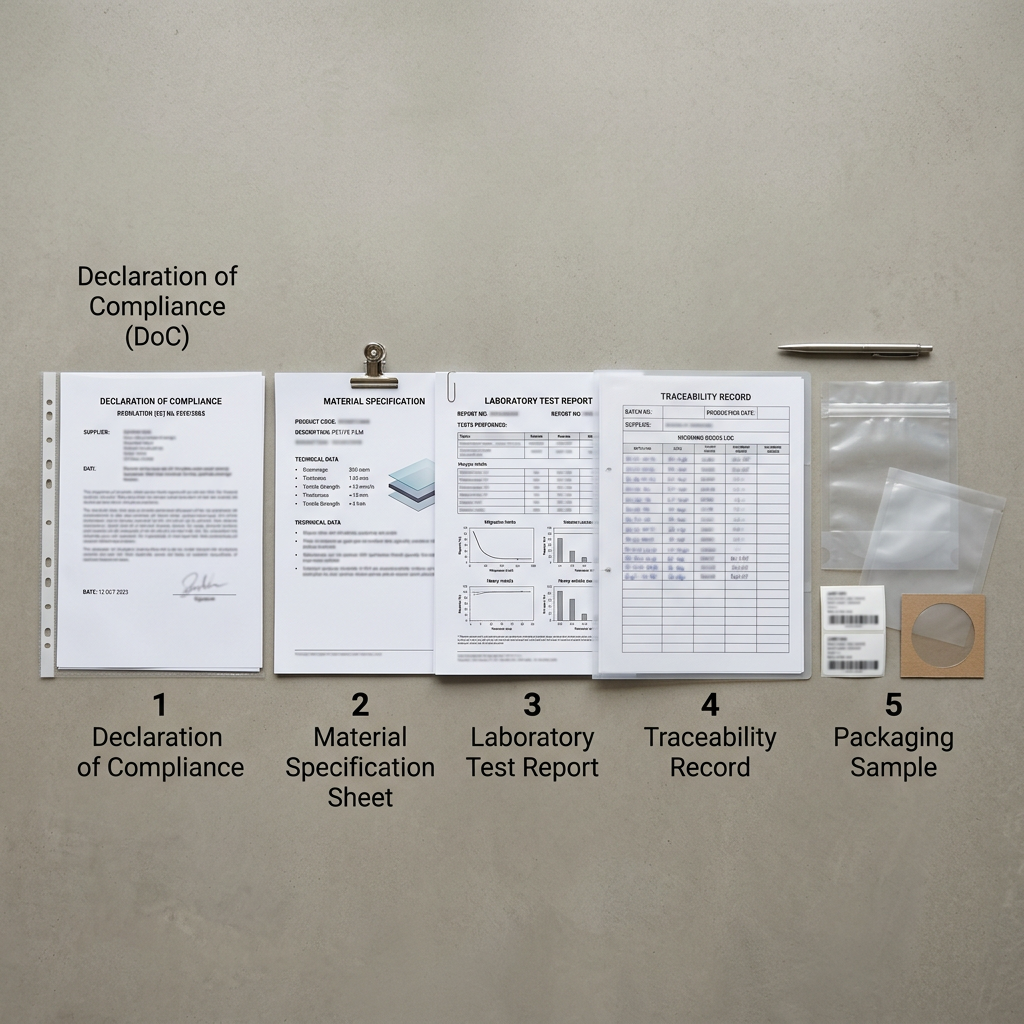
Ask the supplier to identify which documents apply to the exact finished package and which apply only to individual raw materials. A practical request normally includes the following records.
1. Declaration of compliance or conformity
This supplier statement should identify the product, material structure, intended food-contact use, relevant market or regulatory framework, and any limitations. Check the issue date, signer, company identity, product code, and revision number.
2. Material and component specification
Request the specification for paper, plastic, film, coating, adhesive, ink, lid, handle, or other food-contact component. It should make clear whether the document covers the complete article or only one layer.
3. Supporting test reports
Ask for relevant laboratory reports or test summaries when required by the destination market, customer, or risk assessment. The report should show the tested sample, material description, test method, test conditions, results, and laboratory identification. A report for a different structure or size may not support the finished package.
4. Raw-material or supplier declarations
For multilayer or printed packaging, request upstream declarations where appropriate. These may support information about resin, paper, coating, adhesive, ink, or additives, but they do not necessarily replace a declaration for the finished article.
5. Manufacturing and traceability information
Request the factory name and address, production identification method, batch or lot traceability approach, and change-notification process. The exact record format depends on the supplier and contract.
6. Food-contact use limitations
Ask the supplier to state known limitations, such as food category, contact duration, temperature or heating conditions, freezing use, grease exposure, or whether the product is intended for direct contact. Do not assume performance from a generic material name.
How to Review a Supplier Declaration of Compliance
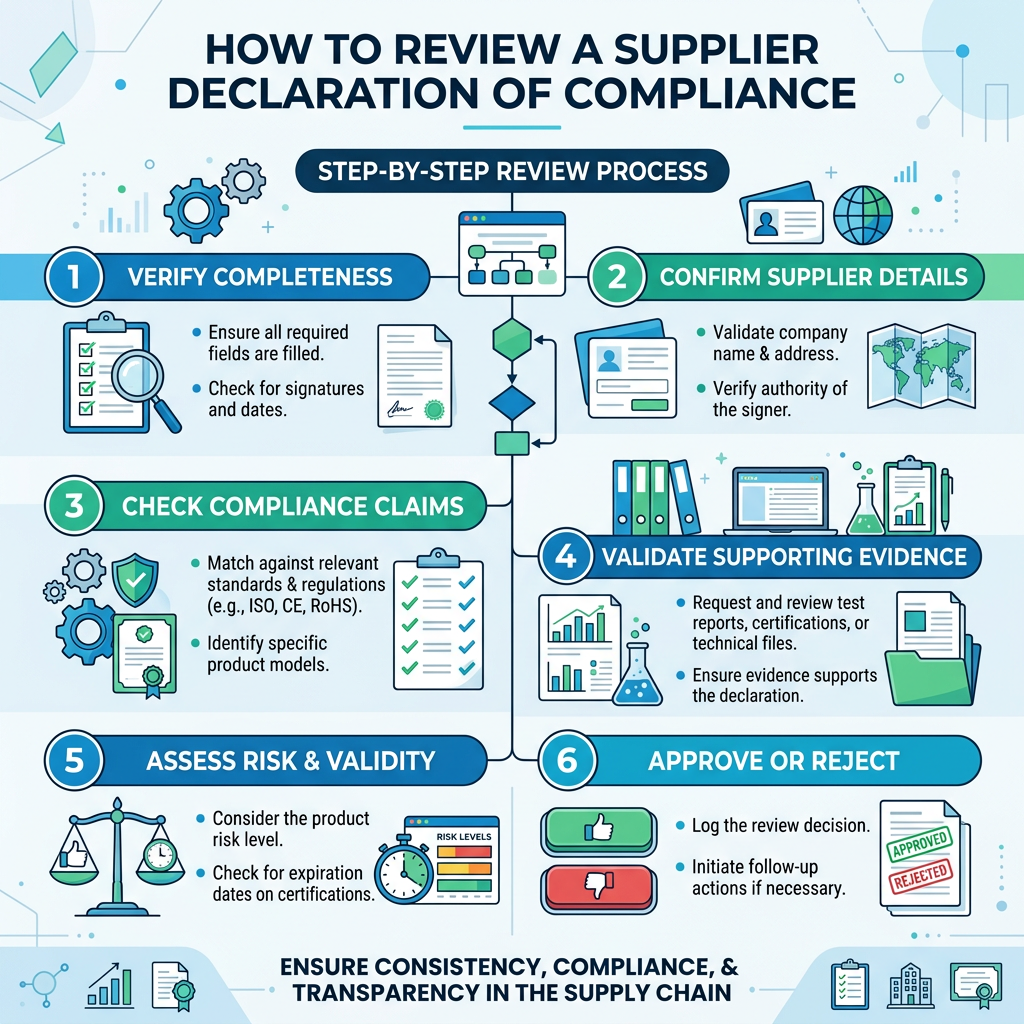
A declaration is useful only when its scope matches the product you are buying. Review it as a controlled document rather than accepting a generic certificate attached to an email.
- Identify the legal entity: Confirm the issuing company, manufacturing site, address, contact details, date, and authorized signatory.
- Match the product: Check the product name, SKU, drawing, material structure, thickness or basis weight, coating, printing method, closure, and accessories.
- Confirm intended use: Check whether the declaration covers direct food contact and the actual food type, contact time, storage, serving, filling, or heating conditions.
- Check the market: Ask which destination-market requirements were considered. A document written for one jurisdiction may not satisfy another.
- Check limitations: Look for exclusions, maximum conditions, use restrictions, and statements that require additional testing by the importer.
- Control revisions: Record the document version and ask the supplier to notify you before changes to materials, inks, coatings, adhesives, equipment, or production location.
If the declaration refers to an attached test report, verify that the report number and tested construction are clearly connected to the finished package. If the wording is vague, request a product-specific revision.
Test Reports, Material Records, and Traceability

Testing should answer a defined compliance or performance question. Before accepting a report, ask what was tested and whether the sample represents the production item.
- Sample identity: Product code, dimensions, material layers, coating, print, adhesive, and lid or accessory should be identifiable.
- Sample source: Clarify whether the sample came from commercial production, a pilot run, or a raw-material supplier.
- Test scope: Confirm that the test addresses the intended contact and use conditions rather than a different application.
- Results and units: The report should present results clearly and identify any limits, deviations, or observations.
- Laboratory details: Record the laboratory name, report date, methods, and accreditation or qualification information where relevant to the buyer’s requirement.
- Traceability: Connect approved artwork, specification, purchase order, production lot, inspection record, and shipping documents.
For printed packaging, ask how the supplier controls ink and adhesive selection, curing or drying, set-off risk, and the distinction between the food-contact and non-food-contact sides. The appropriate evidence depends on the construction and application. Do not request or accept a test result without understanding its scope.
Sampling is also a practical control. Inspect representative samples for dimensions, sealing, odor, appearance, print, fit, and application performance before approving mass production. The guide to requesting packaging samples explains what buyers should check before a production order.
Match Documents to the Exact Packaging Specification
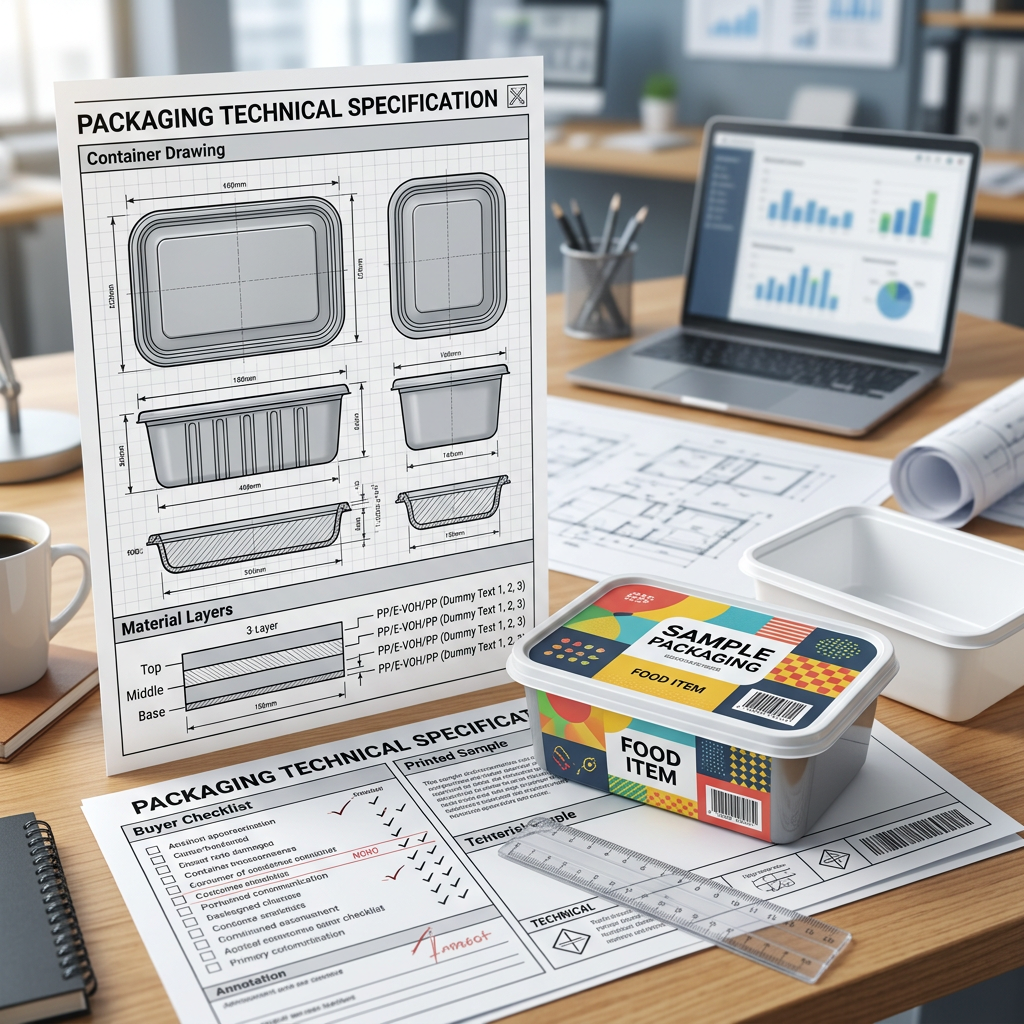
Compliance review should begin with a controlled specification. Record the details that can change food-contact suitability or package performance:
- Package type, drawing, dimensions, capacity, and tolerances
- Base material, grade, thickness, basis weight, and number of layers
- Coatings, barriers, adhesives, inks, varnishes, windows, and closures
- Food application, including dry, acidic, fatty, frozen, chilled, or hot products
- Contact duration and expected storage, filling, serving, or transport conditions
- Whether the package is direct food contact or separated by an inner liner
- Printing coverage, print side, and any label or accessory materials
- Destination country or market and customer-specific documentation requirements
Terms such as recyclable, compostable, biodegradable, and plastic-free describe different claims and should not be treated as interchangeable. If an environmental claim is important, request the specific material construction and supporting evidence required for the target market. A compliance document for food contact does not by itself validate an environmental claim.
A Practical Compliance Document Workflow
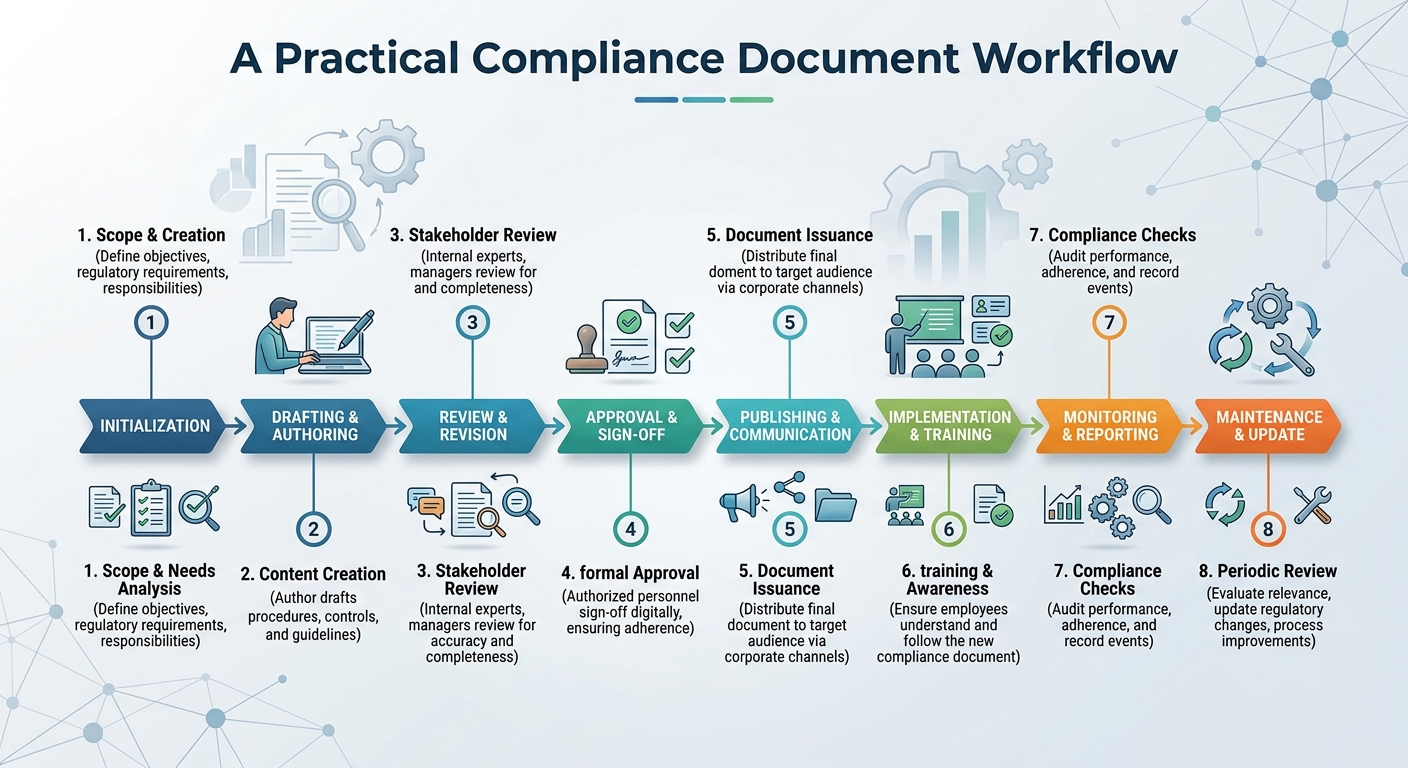
Use the following workflow to reduce missing information and avoid approving documents for the wrong product.
- Define the purchase: Prepare the product specification, intended food, destination market, quantity, printing, accessories, and expected use conditions.
- Send a document request: Ask for the declaration, specifications, relevant test reports, component records, traceability information, and limitations.
- Review scope: Compare every document with the drawing, sample, bill of materials, and final artwork.
- Resolve gaps: List missing fields and ask the supplier to clarify or issue a revised document. Do not silently assume that an upstream declaration covers the completed article.
- Approve a sample: Confirm that the physical sample matches the documented structure and intended application.
- Set purchase controls: Include the approved specification, document revision, quality requirements, inspection method, and change-notification expectation in the order or quality agreement.
- Retain records: Store approved documents, samples or sample photos, purchase orders, inspection records, batch information, and shipping documents.
MOQ, sampling arrangements, production timing, storage conditions, and shipping documents depend on the exact specification and order. Ask the supplier to confirm these items separately from regulatory documentation.
Common Document Gaps That Delay Imports
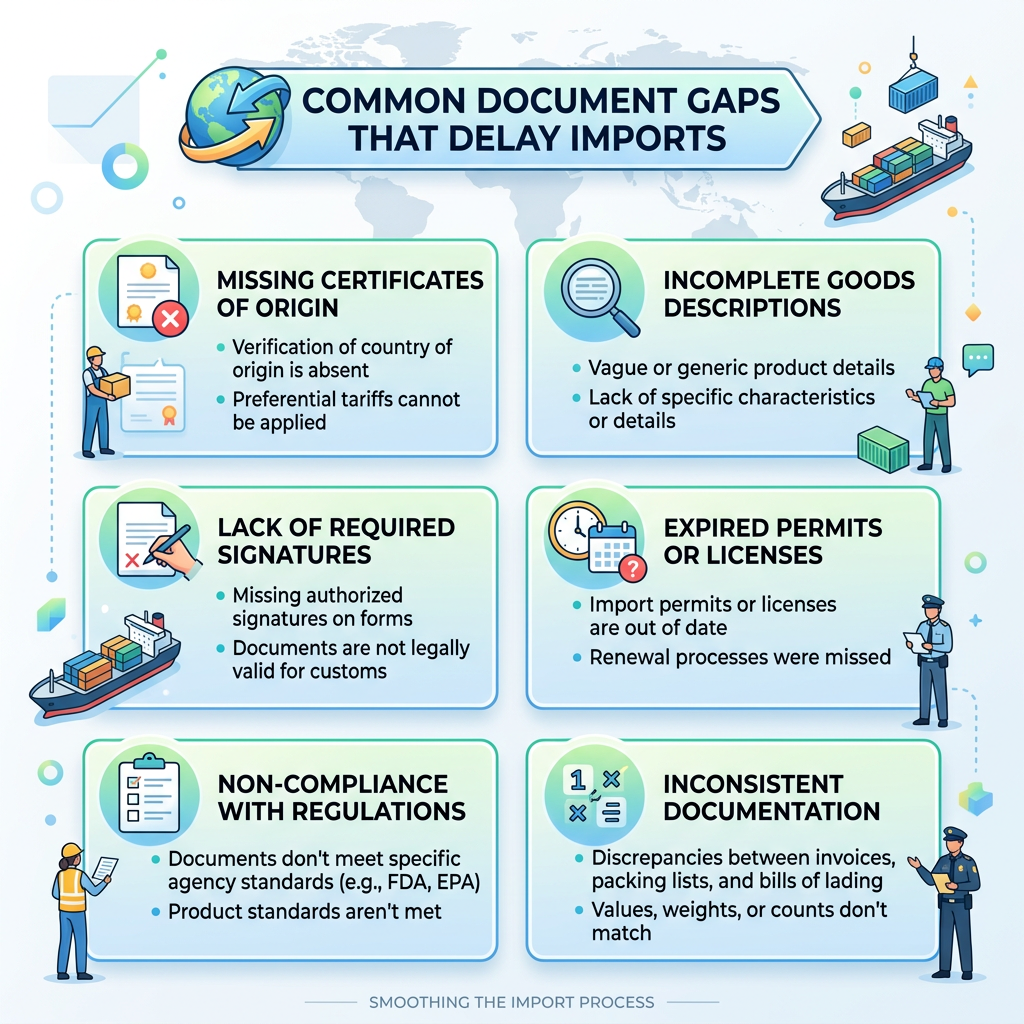
Importers commonly encounter documents that are present but not sufficiently specific. Typical warning signs include:
- A declaration names only a material family, without identifying the finished package structure.
- The report covers a raw film or paper but not the printed, coated, glued, or converted article.
- The supplier provides a certificate with no issue date, product code, revision, or issuing entity.
- The intended food, contact time, temperature, or storage condition is not stated.
- The document references a market or regulation that does not match the destination.
- The approved sample differs from the tested or declared construction.
- There is no documented process for notifying buyers about material or factory changes.
- Environmental claims are made without defining the construction or evidence required by the destination market.
These gaps do not necessarily mean the package cannot be used. They mean the importer needs clarification, additional evidence, or a market-specific review before approval. A supplier’s quality system can support procurement, but it does not replace the importer’s responsibility to verify the applicable requirements.
Conclusion: Build a Documented Approval File
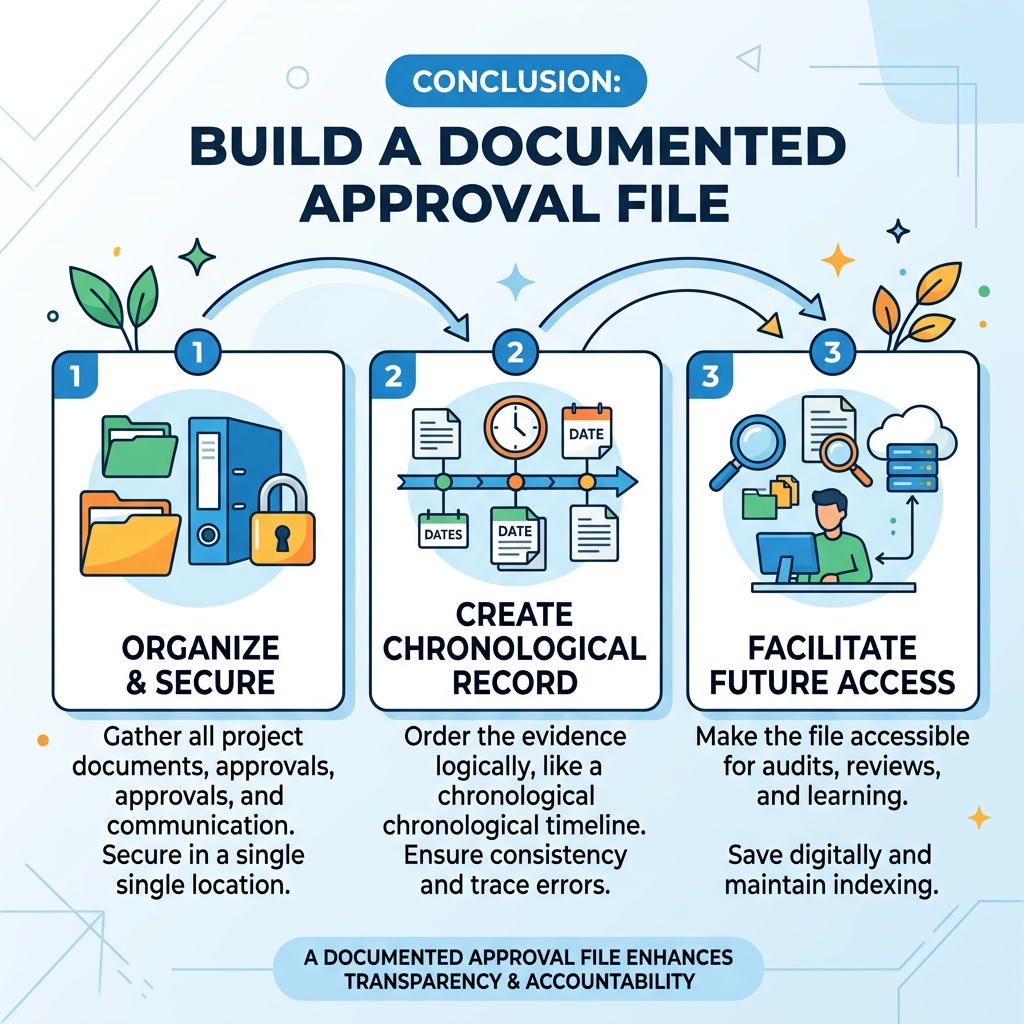
Food packaging compliance documents should be reviewed as part of a complete approval file, not as isolated certificates. Request a product-specific declaration, material and component specifications, relevant test evidence, use limitations, traceability information, and change controls. Then match those records to the actual sample, artwork, production specification, and destination-market requirements.
Material performance, food-contact compliance, MOQ, price, sampling, production timing, storage, and shipping requirements depend on the exact specification and destination market. When the package includes printing, coatings, adhesives, lids, or multiple layers, review the complete construction rather than relying on the base material name alone.