

For cinemas, stadiums, amusement parks, and concession stands, popcorn is more than just a snack—it is a high-margin revenue driver. However, the vessel that holds this product is equally critical. Custom popcorn containers wholesale sourcing is not merely about finding a paper bucket; it is about engineering a brand experience, ensuring structural integrity, and maximizing operational efficiency. Whether you are a procurement officer for a theater chain or a distributor supplying local event venues, understanding the technical specifications of food-grade packaging is essential for making informed buying decisions.
In this comprehensive guide, we will explore the intricate details of manufacturing, printing, and ordering custom popcorn containers. From selecting the right paperboard weight (GSM) to understanding grease-resistant coatings and optimizing logistics, this resource provides the professional insights needed to source high-quality packaging from reliable manufacturers like YBJ Packing.
The Strategic Value of Branded Popcorn Packaging
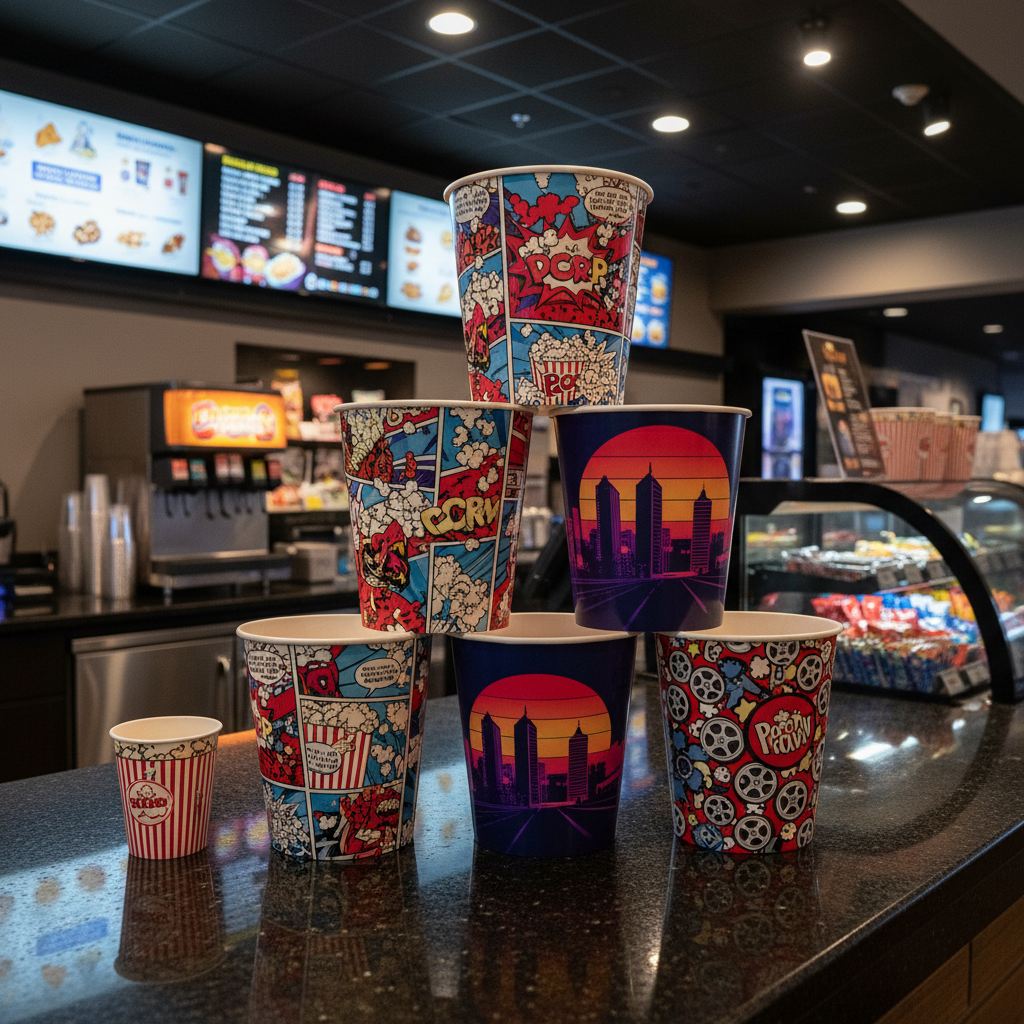
In the competitive food service landscape, packaging serves as a mobile billboard. When a customer walks through a venue holding a vibrant, high-quality popcorn tub, they are endorsing your brand. Generic packaging represents a missed marketing opportunity. Custom printed containers allow businesses to reinforce brand identity, promote upcoming movie releases, or advertise cross-promotions with partners.
Beyond aesthetics, the physical quality of the container impacts the customer experience. A flimsy container that leaks butter or collapses under the weight of a jumbo serving can ruin a customer’s enjoyment and damage the venue’s reputation. High-quality wholesale popcorn containers must balance visual appeal with robust structural engineering.
Material Specifications for Food-Grade Popcorn Buckets
The foundation of any premium popcorn container is the raw material. Industrial buyers must specify the correct paper grade to ensure the container can withstand the rigors of use while remaining cost-effective.
Paperboard Grades and Stiffness (GSM)
Popcorn containers are typically manufactured from virgin paperboard to ensure food safety and structural rigidity. The thickness and weight of the paper are measured in Grams per Square Meter (GSM). Choosing the correct GSM is vital for preventing the container from buckling.
- Small Containers (32oz – 46oz): Typically require 230gsm to 260gsm paperboard. These sizes hold less weight and require less structural reinforcement.
- Medium Containers (64oz – 85oz): Often use 280gsm to 300gsm paperboard. This range provides the necessary stiffness to hold the volume of popcorn without deforming when gripped.
- Large and Jumbo Tubs (130oz – 170oz): Require heavy-duty board, ranging from 320gsm to 350gsm or more. For these sizes, the paperboard must be rigid enough to support a significant volume of product and often includes a double-wall construction or reinforced rim for added stability.
Most high-quality containers utilize Ivory Board (also known as SBS – Solid Bleached Sulfate) or Food-Grade White Cardboard. These materials offer a pristine white surface that is ideal for high-resolution printing, ensuring that colors appear vibrant and text is sharp.
Food Safety and Compliance
Sourcing custom popcorn containers requires strict adherence to food safety standards. The paperboard must be free from harmful chemicals and optical brightening agents (OBAs) that could migrate into food. Reputable manufacturers ensure that all raw materials comply with international standards such as FDA regulations (for the US market) or EU food contact materials regulations. Always request compliance documentation when vetting a new supplier.
Grease Resistance and Coating Technologies
Popcorn is often served with butter, oils, and seasonings. Without an effective barrier, grease can penetrate the paper fibers, causing unsightly stains on the exterior artwork and compromising the structural integrity of the bucket. This is known as “wicking.” To prevent this, manufacturers apply specific coatings.
PE (Polyethylene) Coatings
The industry standard for grease resistance is Polyethylene (PE) coating. This thin plastic layer is bonded to the paperboard during the manufacturing process.
- Single PE Coating: Applied to the interior of the container. This is generally sufficient for standard popcorn applications where the primary concern is preventing grease from soaking through to the outside.
- Double PE Coating: Applied to both the interior and exterior. While more common in cold beverage cups to prevent condensation damage, double PE coating can be used for premium popcorn buckets to give the exterior a glossy finish and extra durability against moisture or buttery fingers.
Aqueous and PLA Coatings
As sustainability becomes a priority for many brands, alternative coatings are gaining traction. Aqueous coatings are water-based and offer decent grease resistance while being easier to recycle in standard paper streams. PLA (Polylactic Acid) is a bioplastic derived from renewable resources like corn starch. PLA-lined containers are compostable in industrial facilities, making them an excellent choice for eco-conscious brands, though they may come at a higher price point than standard PE options.
Standard Sizes and Capacities for Cinemas and Events
Standardization helps in logistics, storage, and pricing strategies. While custom sizes are possible, adhering to industry-standard capacities simplifies the procurement process.
Small to Medium (32oz – 46oz)
These sizes are ideal for children’s portions or light snackers. They are compact, easy to stack, and require less storage space. The 32oz size is a staple for “kids’ combos” in theaters.
Medium to Large (64oz – 85oz)
The 64oz and 85oz containers represent the core volume for most adult moviegoers. They offer a substantial perceived value while remaining comfortable to hold with one hand. These sizes are the workhorses of the concession stand.
Large and Jumbo Tubs (130oz – 170oz)
Designed for sharing, these tubs are massive revenue generators. The 130oz and 170oz buckets often feature wider openings to facilitate sharing among groups. Due to their size, the print area is significant, offering the best canvas for elaborate artwork or promotional messaging. Because of the sheer volume of popcorn they hold, ensuring a high GSM (300+) is non-negotiable to prevent the sidewalls from collapsing.
For a complete overview of available dimensions, you can browse our full catalog of food containers.
Printing Technologies and Customization Options
The print quality of your popcorn container directly reflects your brand’s professionalism. Wholesale manufacturing utilizes advanced printing techniques to achieve photorealistic results.
Offset vs. Flexographic Printing
- Offset Printing: This is the preferred method for high-quality bulk orders. It uses plates to transfer ink onto a rubber blanket and then onto the paper. Offset printing delivers superior image quality, sharp details, and accurate color reproduction. It is ideal for complex graphics, movie posters, or intricate brand patterns. It is cost-effective for large production runs.
- Flexographic Printing: Often used for simpler designs or very high-volume runs where cost is the primary driver. While modern flexo printing has improved significantly, offset generally remains the standard for premium cinema packaging.
Color Management (CMYK vs. Pantone)
To ensure brand consistency, it is crucial to understand color models. CMYK (Cyan, Magenta, Yellow, Key/Black) is used for full-color photographic printing. However, if your brand relies on a specific signature color (e.g., “Coca-Cola Red” or “Tiffany Blue”), you should specify Pantone (PMS) colors. Pantone inks are pre-mixed to an exact formula, ensuring that your brand color looks exactly the same on every batch, regardless of the production run.
Special Finishes
To make your packaging truly stand out, consider adding special finishes:
- Spot UV: A high-gloss coating applied to specific areas (like a logo) to make them pop against a matte background.
- Embossing/Debossing: Physically raising or recessing parts of the design to add texture.
- Metallic Foils: Gold or silver foil stamping adds a premium, luxury feel, often used for premiere events or VIP packaging.
Designing for Impact: Artwork Best Practices
When preparing artwork for custom popcorn containers, technical precision is key. Buyers should work with professional designers who understand packaging die-lines.
- Vector Files: Always supply artwork in vector formats (AI, PDF, EPS). Vector graphics can be scaled infinitely without losing quality, unlike raster images (JPG, PNG) which can become pixelated.
- Bleed Areas: The design must extend beyond the cut line (usually by 3-5mm) to account for slight shifts during the die-cutting process. This prevents white edges from appearing on the finished product.
- Curved Distortion: Popcorn buckets are conical (tapered). Artwork designed on a flat rectangle will appear distorted when wrapped around a cone. Designers must use the manufacturer’s specific die-line template to warp the artwork correctly so it appears straight when the bucket is formed.
Manufacturing Process and Quality Assurance
Understanding the manufacturing workflow helps in planning lead times. The process typically involves:
- Paper Sourcing & Coating: Raw paper is treated with the PE barrier.
- Printing: The large rolls or sheets are printed with the approved design.
- Die-Cutting: The printed sheets are cut into the fan shapes that form the cup walls, and circular discs for the bottoms.
- Forming: High-speed forming machines wrap the wall paper around a mandrel and heat-seal it to the bottom disc. The side seam is also bonded, usually via ultrasonic or heat sealing.
- Quality Control (QC): Random samples are pulled for leak testing (filling with liquid/oil to check for seepage) and crush testing (checking structural rigidity).
Supply Chain and Logistics Considerations
For wholesale buyers, the physical characteristics of the product influence shipping costs and storage.
Stacking and Storage Efficiency
Popcorn containers are tapered to allow for nesting. High nesting efficiency reduces the volume of the cartons, thereby lowering shipping freight costs. However, if containers are packed too tightly, they can become stuck together (a phenomenon called “locking”), slowing down service at the concession stand. Manufacturers use precision forming to ensure a perfect “denesting” gap, allowing staff to grab one cup at a time effortlessly.
Managing Lead Times and MOQs
Custom manufacturing is not instantaneous. Minimum Order Quantities (MOQs) are typically required to offset the setup costs of printing plates and machine calibration. For offset printing, MOQs might start at 10,000 or 30,000 units depending on the size. Lead times generally range from 3 to 6 weeks post-artwork approval, plus shipping time. It is advisable to forecast inventory needs well in advance of peak seasons (like summer blockbusters or holidays).
If you are ready to plan your inventory, visit our how to order page for a streamlined process guide.
Sustainability in Disposable Food Packaging
Environmental responsibility is increasingly important in the B2B sector. Regulations in many regions (such as the EU Single-Use Plastics Directive) are shifting the market toward eco-friendly options.
Buyers should consider:
- FSC-Certified Paper: Ensures the wood pulp comes from responsibly managed forests.
- Compostable Options: As mentioned, PLA linings or water-based coatings allow the container to be composted industrially.
- Recyclability: Standard PE-lined cups can be recycled, but they require specialized facilities to separate the plastic from the paper. Communicating the correct disposal method to end-users is part of a responsible packaging strategy.
Step-by-Step Ordering Guide
To ensure a smooth procurement process, follow this checklist:
- Define Specs: Determine the sizes (oz), quantity per size, and paper thickness requirements.
- Request Samples: Never order blindly. Ask for physical samples to test the rigidity and grease resistance with your specific popcorn product.
- Prepare Artwork: Download the die-line templates from the supplier and have your design team apply the artwork.
- Approve Proofs: Review digital proofs carefully for spelling, positioning, and color codes.
- Production & Shipping: Once the deposit is paid and proofs approved, production begins. Coordinate with your freight forwarder or the supplier for delivery logistics.
For personalized assistance with your specifications, you can contact our team directly.
Frequently Asked Questions (FAQ)
1. What is the minimum order quantity (MOQ) for custom printed popcorn containers?
MOQs vary by manufacturing method and container size. Typically, custom offset printing requires an MOQ of 10,000 to 30,000 units per size to be cost-effective. Lower quantities may be available but often incur higher per-unit costs due to setup fees.
2. Can you print on the bottom of the popcorn bucket?
Yes, printing on the bottom is possible and is often used for barcodes, QR codes, or recycling information. However, this may require a separate printing plate.
3. Are these containers suitable for hot foods other than popcorn?
Yes, the food-grade paperboard and PE coating make them suitable for other dry or semi-dry hot foods like fried chicken, nachos, or potato chips. For very wet or heavy foods, verify the GSM and coating thickness with the manufacturer.
4. How do I prevent the containers from getting soggy with extra butter?
Standard popcorn buckets have a single PE lining which is effective for typical butter usage. If your venue offers self-serve butter stations where customers might use excessive amounts, we recommend requesting a thicker PE layer or a higher density paperboard to prevent saturation.
5. Do you offer lids for popcorn containers?
Yes, lids are available, particularly for take-home packs or retail environments. Common options include flat paper lids or clear plastic dome lids. Ensure the lid diameter matches the rim diameter of your specific bucket size.
6. What file format do I need for the design?
We require vector-based files such as AI (Adobe Illustrator), PDF, or EPS. All fonts should be outlined, and images embedded. Colors should be specified in CMYK or Pantone (PMS).
7. How long does production take?
After artwork approval, production typically takes 15–25 days depending on the order volume. Shipping time depends on the destination and method (sea freight vs. air freight).
Conclusion
Sourcing custom popcorn containers wholesale is a balance of art and engineering. The right container protects your product, enhances your brand, and operates efficiently within your supply chain. By paying attention to paper grades, coating technologies, and print finishes, you can elevate a simple snack into a premium cinema experience.
At YBJ Packing, we specialize in high-volume, high-quality food packaging solutions tailored to your brand’s needs. Whether you need a standard 85oz bucket or a fully customized promotional tub, our manufacturing capabilities ensure consistency and quality.
Ready to upgrade your popcorn packaging? Request a quote today or request a sample kit to see our quality firsthand.