


Introduction: The Critical Role of Thermal Retention in Food Logistics
In the competitive landscape of food service and last-mile delivery, the integrity of the product upon arrival is the single most significant factor influencing customer retention. For restaurant chains, logistics companies, and food distributors, the thermal delivery bag is not merely an accessory; it is a critical infrastructure component that bridges the gap between the kitchen pass and the customer’s dining table.
Procurement managers and operations directors must navigate a complex array of material specifications, insulation grades, and structural designs to ensure their fleet is equipped to handle specific menu items. Whether transporting hot pizzas that require moisture control or frozen groceries demanding strict cold-chain adherence, the choice of bag directly impacts food safety and brand reputation.
This comprehensive guide explores the technical composition of high-performance thermal bags, customization options for brand visibility, and the strategic sourcing considerations necessary for bulk procurement. We will examine how different material combinations affect thermal resistance (R-value), durability, and cost-effectiveness.
1. The Anatomy of a Professional Thermal Delivery Bag
To select the right product, buyers must understand the three-layer construction typical of industrial-grade delivery bags. Each layer serves a distinct function in thermodynamics and structural integrity.
The Outer Layer: Durability and Weather Resistance
The exterior shell protects the insulation and food from environmental factors like rain, dust, and abrasion. Common materials include:
- Non-Woven Polypropylene (PP): often used for budget-friendly or semi-disposable bags. It is breathable and lightweight but less durable against heavy abrasion. Ideal for shorter distances or lighter loads.
- 600D / 1680D Polyester (Oxford Cloth): The industry standard for heavy-duty fleet bags. The "D" stands for Denier, a unit of linear mass density of fibers. Higher numbers indicate coarser, thicker threads. 600D Polyester is robust, water-resistant (often PVC-coated), and withstands the rigors of motorcycle or scooter delivery.
- PVC / Tarpaulin: Completely waterproof and easy to wipe down. This material is excellent for regions with heavy rainfall but can be heavier than polyester.
The Insulation Core: Thermal Resistance
This is the functional heart of the bag. The goal is to minimize heat transfer via conduction and convection.
- EPE Foam (Expanded Polyethylene): The most common insulation material. It provides structure and thermal resistance. Thicknesses typically range from 3mm to 10mm. For extended delivery ranges, thicker foam is required.
- PU Foam (Polyurethane): Softer and more flexible than EPE, offering excellent insulation properties, often used in premium soft-sided coolers.
- Needle-Punched Cotton: Sometimes used in combination with foil for specific breathable applications, though less common in modern waterproof delivery gear.
The Inner Lining: Hygiene and Heat Reflection
The interior must be food-safe, easy to clean, and reflective.
- Aluminum Foil Lamination: Reflects radiant heat back towards the food. It is crucial for keeping hot food hot.
- PEVA (Polyethylene Vinyl Acetate): A non-chlorinated vinyl that is food-safe, waterproof, and easy to sanitize. It is often preferred for cold-chain applications due to its leak-proof nature.
For a detailed look at our material specifications, you can visit our thermal delivery bag category page.
2. Selecting the Right Bag for Your Menu
One size does not fit all. The physical state of the food (hot/crispy vs. cold/frozen) dictates the required airflow and insulation properties.
Pizza Delivery Bags
Pizza requires a delicate balance. High insulation keeps the pie hot, but total sealing traps steam, resulting in a soggy crust. Professional pizza bags often feature breathable linings or specialized grommets to release excess moisture while retaining heat. They are designed horizontally to prevent cheese slide.
Catering and Pan Carriers
For catering companies transporting full steam table pans (GN pans), bags must be rigid. These often employ a top-loading or front-loading design with reinforced sidewalls (using plastic inserts or rigid foam) to allow stacking without crushing the food containers inside.
Backpack Delivery Bags
With the rise of bike and scooter delivery fleets, ergonomics are paramount. Backpacks distribute weight across the courier’s shoulders. Key features to look for include:
- Internal Shelving: Adjustable dividers to separate hot and cold orders or to stack multiple orders vertically.
- Cup Holders: External or internal mechanisms to secure beverages.
- Reflective Strips: Essential for courier safety during night shifts.
Grocery and Cold Chain Bags
These bags prioritize leak protection and maximum density insulation to maintain frozen or chilled temperatures for hours. They are often box-shaped with heavy-duty zippers to create a tight seal.
3. Customization: Branding and Printing Options
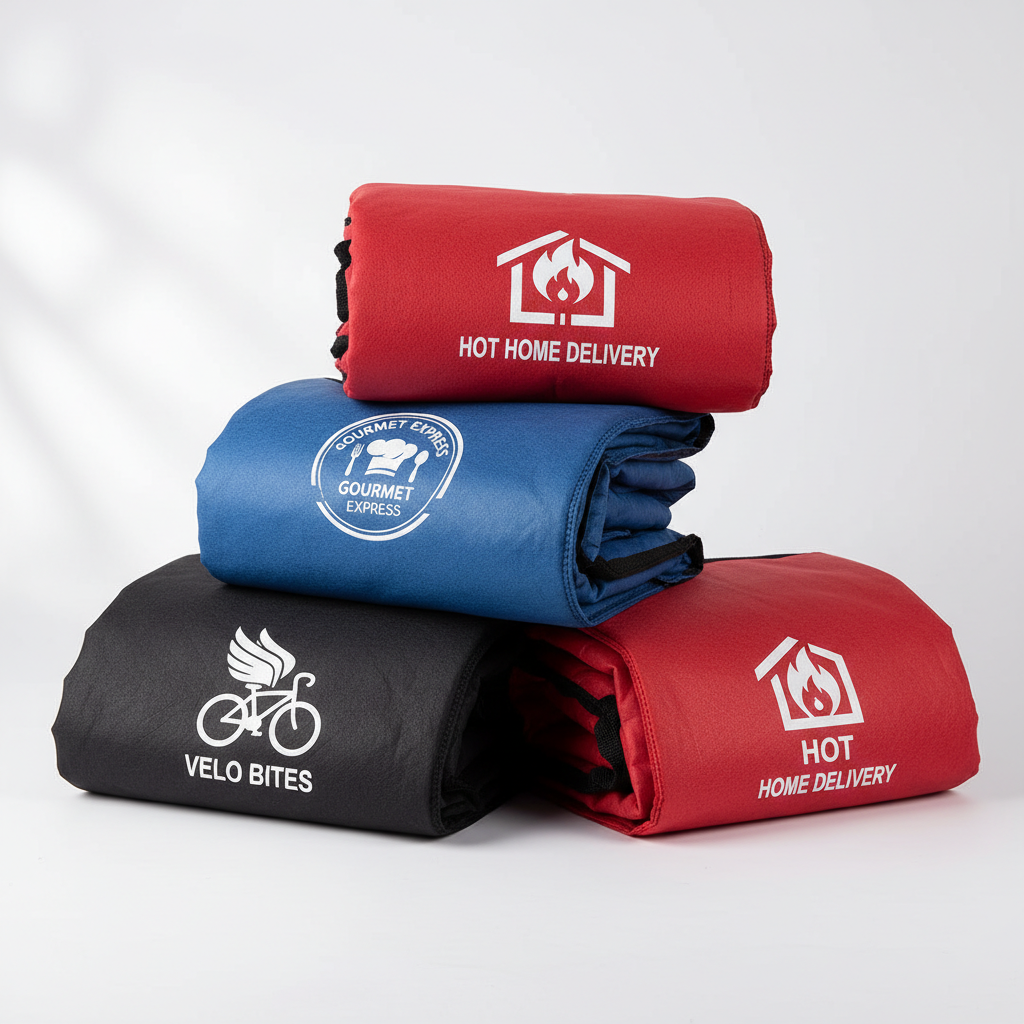
A delivery bag is a mobile billboard. Custom printing transforms a functional item into a marketing asset that generates thousands of impressions as it moves through the city. When ordering wholesale takeaway packaging, branding consistency is key.
Silk Screen Printing
Ideal for simple logos with 1-3 solid colors. It is cost-effective for medium to large runs. The ink is durable and stands up well to weather, but it cannot reproduce complex gradients or photographs.
Heat Transfer Printing
Best for full-color designs, gradients, or photographic images. The design is printed onto a carrier film and then heat-pressed onto the bag material. This allows for vibrant, complex artwork but may have a higher per-unit cost than simple screen printing.
Digital Printing
Used for high-detail customization. While less common on heavy canvas than heat transfer, it offers flexibility for smaller batches or highly intricate designs.
Artwork Requirements
To ensure the highest quality print, buyers should provide vector files (AI, EPS, or PDF). Vector graphics allow the manufacturer to scale the logo to fit large bag surfaces without pixelation. Specifying Pantone (PMS) color codes ensures that the bag matches your brand guidelines exactly.
4. Technical Specifications and Quality Indicators
When evaluating a supplier or a sample, procurement officers should inspect the following technical details to gauge longevity.
Stitching and Reinforcement
The failure point of most delivery bags is the handle attachment. Look for "X" box stitching (cross-tacking) at all stress points. Double stitching along the main seams is a standard requirement for commercial-grade bags.
Zippers and Closures
Industrial use requires industrial hardware. #10 zippers are the standard for durability; they are larger and less prone to snagging than standard dress zippers. Velcro (hook and loop) closures allow for faster access but may wear out faster than zippers over time. Many premium bags use a combination: Velcro for quick closure and zippers for a complete seal.
Weight Capacity
Verify the load rating. A standard pizza bag might need to hold 5kg, while a grocery backpack might need to support 15-20kg. The base of the bag should be reinforced, sometimes with a hard plastic board insert, to prevent sagging.
5. Manufacturing and Lead Times
Understanding the production process helps in planning inventory. Custom thermal bags are typically manufactured in batches.
MOQ (Minimum Order Quantity)
For custom sizes or printed bags, manufacturers usually set an MOQ (e.g., 500 or 1,000 units). This is because setting up the printing screens and cutting dies carries a fixed cost. Stock items may have lower minimums.
Production Timeline
Typical lead times for custom orders range from 2 to 4 weeks after artwork approval, depending on the quantity and factory schedule. Buyers should account for shipping transit times, especially for international sea freight orders.
Sampling
Before committing to a full production run, always request a pre-production sample. This allows you to test the thermal retention, fit your specific food containers, and verify print quality. If you are ready to start this process, you can learn more about how to order samples and bulk lots.
6. Use Cases Beyond Standard Delivery
While restaurant delivery is the primary use case, thermal bags are versatile tools used across various sectors.
- Pharmaceutical Transport: Maintaining temperature stability for medications during last-mile distribution.
- School Lunch Programs: Keeping bulk meals warm for satellite campus distribution.
- Corporate Catering: High-end presentation bags for boardroom lunches.
- Meal Prep Subscriptions: Insulated tote bags left at customer doorsteps.
7. Maintenance and Hygiene Protocols
To extend the lifespan of your fleet’s bags and ensure food safety compliance, establish a cleaning protocol. Bags with PVC or PEVA linings can be wiped down with food-safe sanitizers. Bags should be dried open to prevent mold growth. Outer shells made of polyester can often be spot-cleaned with mild detergent. Machine washing is generally not recommended for bags with rigid foam inserts unless specified by the manufacturer.
8. Buying Guide Checklist
Use this checklist when requesting a quote to ensure you get accurate pricing and specifications:
- Dimensions: Length x Width x Height (internal and external).
- Material Preference: Non-woven vs. Polyester vs. PVC.
- Insulation Thickness: Standard (3-5mm) or Heavy Duty (8-10mm+).
- Closure Type: Zipper, Velcro, or Magnetic.
- Printing: Number of colors, number of print locations (front, top, sides).
- Quantity: Total units required.
- Accessories: Dividers, cup holders, shoulder straps, hardboard inserts.
Frequently Asked Questions (FAQ)
1. How long can a thermal bag keep food hot?
Generally, a high-quality bag with 5-8mm foam and foil lining can keep food hot (above 60°C) for 45 to 60 minutes, depending on the initial temperature of the food and the ambient outside temperature. Adding heat packs can extend this duration.
2. What is the difference between non-woven and polyester bags?
Non-woven bags are cost-effective and lightweight, suitable for promotional use or light delivery. Polyester (Oxford) bags are heavy-duty, tear-resistant, and designed for daily, intensive commercial use.
3. Can I print a photo on my delivery bag?
Yes, using heat transfer printing or digital printing methods, photographic quality images can be applied. However, this may affect the unit cost compared to simple 1-color screen printing.
4. Are these bags waterproof?
Most commercial bags use water-resistant materials like PVC-coated polyester. While they repel rain and snow effectively, they are not usually submersible. The inner linings (PEVA/Foil) are typically waterproof to contain spills.
5. How do I clean the bags?
Wipe the interior with a warm, soapy cloth or food-safe sanitizer spray. Allow the bag to air dry completely with the lid open. Do not put bags with rigid inserts in a washing machine.
6. What is the standard MOQ for custom printed bags?
MOQs vary by design complexity, but generally, custom printed bags start around 500 to 1,000 units. Smaller quantities may be available for stock items without printing.
7. Can you make custom sizes to fit my specific containers?
Yes, as a manufacturer, we can customize the dimensions to fit specific pizza boxes, bento boxes, or catering pans. Providing the dimensions of your containers helps us design the perfect fit.
8. Do you offer samples?
Yes, sampling is a standard part of the B2B procurement process. It ensures the product meets your quality standards before mass production.
Conclusion
Investing in high-quality thermal delivery bags is an investment in your brand’s promise of quality. Whether you need rugged backpacks for a scooter fleet or elegant insulated totes for catering, selecting the right materials and specifications is crucial for operational success.
At YBJ Packing, we specialize in manufacturing durable, high-performance thermal bags tailored to your brand’s needs. From custom sizing to vibrant logo printing, we support food service businesses in delivering excellence.
Ready to upgrade your delivery fleet? Contact us today to request a quote or discuss your custom requirements with our packaging experts.