

The Critical Balance: Crispness, Heat, and Brand Integrity
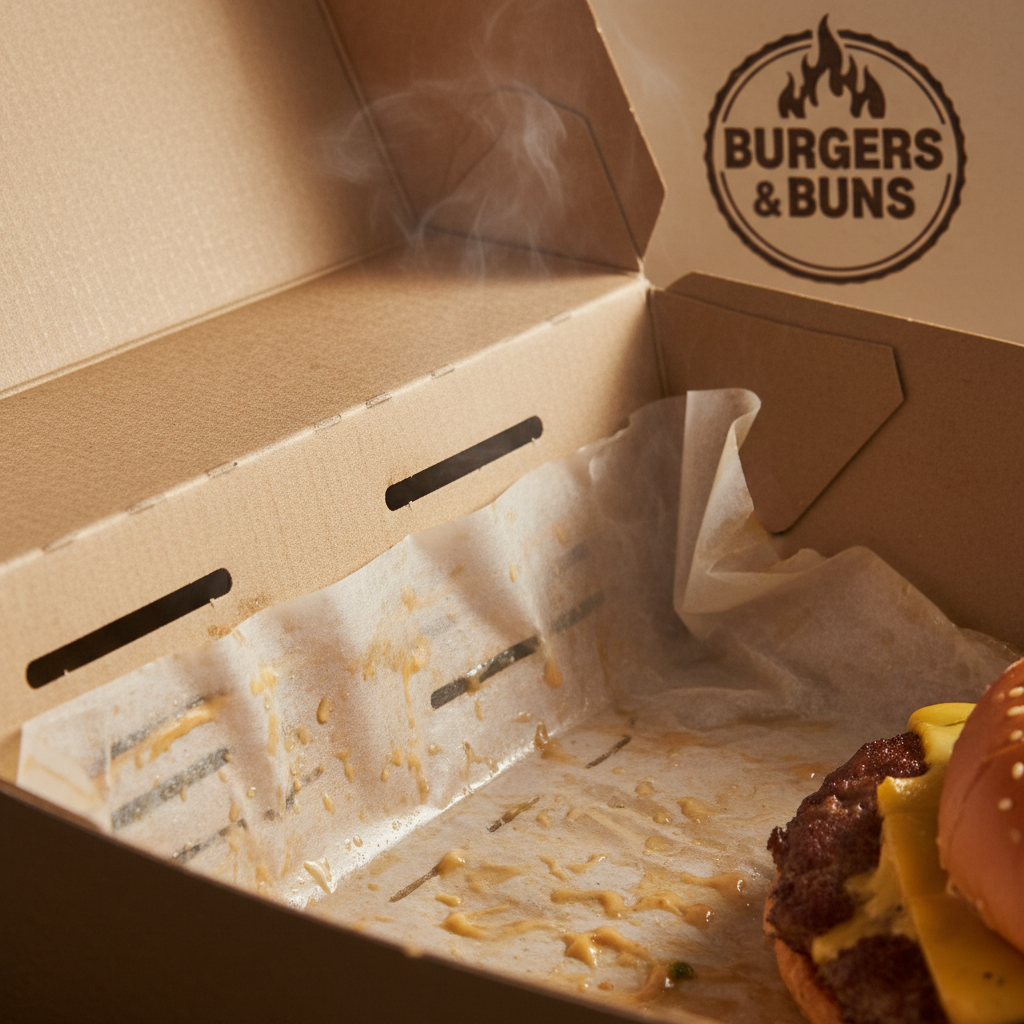
For food service brands, fried food represents a unique packaging paradox. The product must remain hot, yet retaining too much heat creates steam that turns a crispy crust into a soggy disappointment. Simultaneously, the high oil content of products like fried chicken, french fries, and donuts poses a constant threat to the structural integrity of the container. A grease stain migrating to the outside of a box is not just an aesthetic failure; it is a branding failure that signals poor quality to the consumer.
Effective packaging for fried foods is not merely a container; it is an engineered system designed to manage thermodynamic and chemical challenges. For B2B buyers—ranging from QSR chains to food distributors—selecting the right specification requires a deep understanding of material science, venting mechanics, and grease-resistant coatings.
This guide explores the technical specifications required to optimize delivery and takeaway experiences for fried products. We will examine the trade-offs between heat retention and moisture release, the chemistry of grease-resistant liners, and how to select the right custom food packaging boxes to protect both your product and your brand reputation.
The Physics of Fried Food Packaging
Moisture Migration and Sogginess
When fried food is removed from the fryer, it is significantly hotter than the surrounding air. As it cools, it releases moisture in the form of steam. In a completely sealed container, this steam condenses on the inner walls and falls back onto the food, or simply saturates the humid air surrounding the crust. This process, known as moisture migration, breaks down the starch matrix that provides the “crunch,” leading to rapid degradation of texture.
Thermal Retention
Conversely, venting too aggressively cools the food too quickly. The challenge for packaging engineers is to create a controlled environment where relative humidity is kept low enough to preserve crispness, but insulating properties are high enough to maintain serving temperature.
Grease Penetration
Fried foods typically have a high fat content. Oil has a lower surface tension than water, allowing it to penetrate standard paper fibers rapidly. Without a barrier, oil wicks through the paper board (capillary action), leading to spotting, structural collapse, and messy handling for the end consumer.
Grease Management Technologies
Selecting the right barrier coating is the first step in designing effective packaging. The industry uses several methods to achieve grease resistance, often measured by the “Kit Level” (a standard test measuring resistance to oil penetration on a scale of 1 to 12).
1. Polyethylene (PE) Linings
PE-lined paperboard is the industry standard for high-grease applications. A thin layer of polyethylene plastic is extruded onto the paperboard.
- Pros: Excellent grease barrier (Kit 12 equivalent), heat sealable (preventing leaks at corners), and provides a moisture barrier.
- Cons: Traditional PE makes recycling difficult in standard paper streams; it is not biodegradable.
- Best For: Fried chicken buckets, saucy wings, and heavy-duty takeout containers.
2. Dispersion Coatings (Aqueous)
Water-based dispersion coatings are becoming the preferred choice for brands focusing on sustainability. These coatings are applied like ink during the printing or converting process.
- Pros: Fully repulpable and recyclable; often biodegradable. Good grease resistance for moderate durations.
- Cons: May not hold up as long as PE for extremely hot, oily items stored for extended periods.
- Best For: French fry scoops, burger clamshells, and pastry boxes.
3. Greaseproof Papers (Glassine/Parchment)
These papers are mechanically treated (supercalendered) to increase density and reduce porosity, physically blocking grease without a chemical coating.
- Pros: Plastic-free, breathable.
- Cons: Lower resistance than coated boards; grease can eventually spot through over time.
- Best For: Wraps, liners for wire baskets, and greaseproof paper bags for lighter items like churros or hash browns.
4. PLA (Polylactic Acid) Linings
PLA is a bioplastic derived from renewable resources like corn starch.
- Pros: Compostable (industrial), excellent grease barrier similar to PE.
- Cons: Low heat deformation temperature (can warp if food is extremely hot, though crystallized PLA options exist); higher cost.
- Best For: Eco-conscious brands serving warm (not boiling) fried items.
Venting Strategies: Engineering Airflow
Venting is the primary mechanism for controlling moisture. However, simply punching holes in a box is insufficient. The geometry and placement of vents determine their effectiveness.
Passive Venting vs. Stack Vents
- Side Vents: Holes placed on the side walls allow cross-ventilation. This is crucial when boxes are stacked, as top vents would be blocked by the container above.
- Top/Rear Vents: Common in clamshells, allowing steam to rise naturally.
- Hidden Vents: Some designs utilize gaps in the closure mechanism (e.g., a tuck-top that doesn’t seal completely) to allow airflow without compromising the visual aesthetic.
Vent Obstruction
A common design failure occurs when the food product itself blocks the vents. For example, if a burger is wrapped tightly and placed against the rear vents of a clamshell, airflow stops. Structural design must account for “headspace”—the empty volume of air inside the package that allows circulation.
Structural Formats for Fried Foods
The shape of the packaging dictates how well it handles the product. Different fried foods require different structural approaches.
1. The Clamshell
The hinged lid box is a staple for burgers and sandwiches.
- Material: Corrugated board (F-flute or E-flute) provides insulation, keeping the burger hot while the fluting allows some airflow.
- Design Note: Rigid locking tabs are essential to prevent popping open during delivery.
2. The Scoop (Open Top)
Ideal for fries, wedges, and popcorn chicken.
- Benefit: Maximum venting (zero steam trapping).
- Drawback: Poor heat retention; food cools rapidly.
- Usage: Best for immediate consumption or serving inside a larger carrier bag.
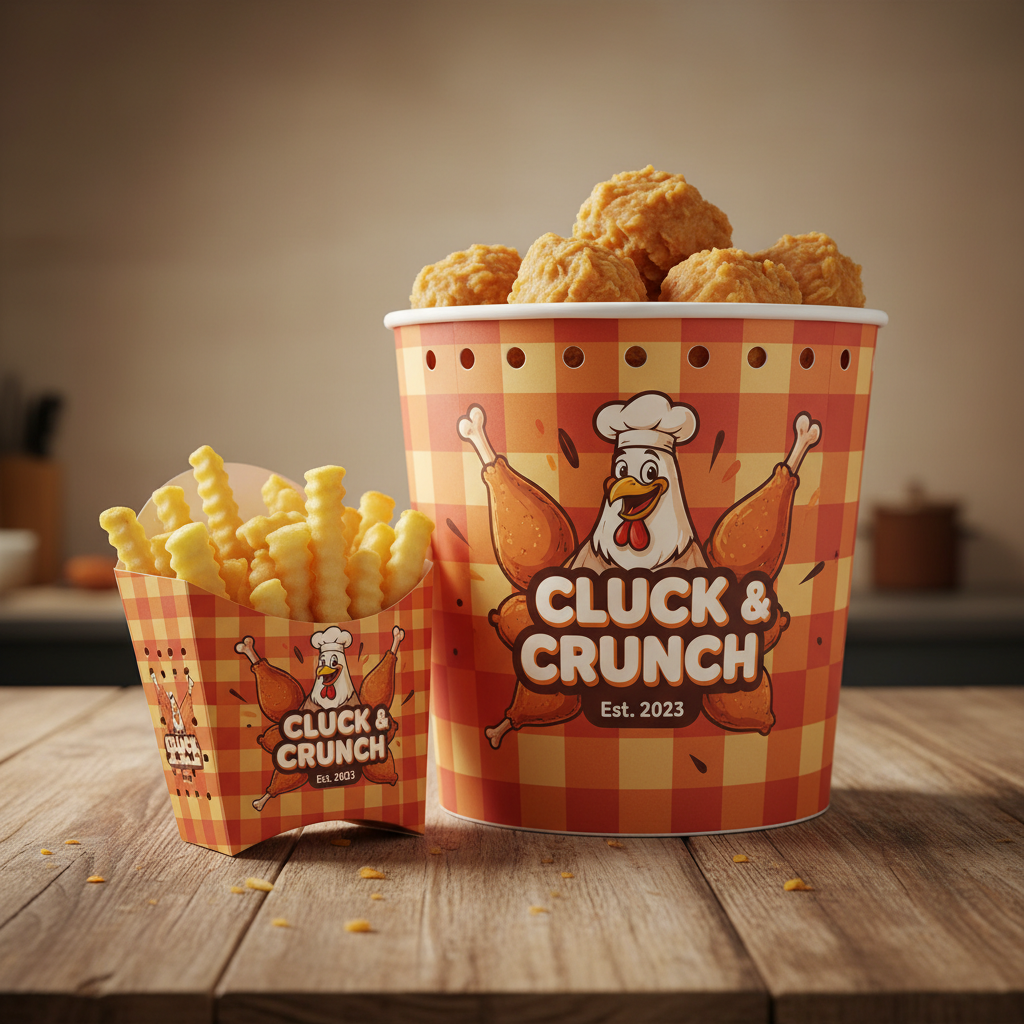
3. The Bucket
The iconic choice for bone-in fried chicken.
- Structure: Round shape distributes weight evenly; usually requires heavy-gauge paperboard with double-PE coating.
- Lid: Often paper or plastic with significant venting holes.
4. The Folded Takeout Box (Pail)
Often used for Asian cuisine or nuggets.
- Leak Resistance: Webbed corners (folded, not cut) prevent grease from leaking at the bottom seams.
- Closure: Wire handles or tab locks.
Material Selection: Kraft vs. White Board
When specifying your packaging, the base substrate is as important as the coating.
Virgin Kraft (Brown)
Unbleached kraft paper signals natural, organic, and eco-friendly values. It has long, strong fibers providing excellent tear resistance, which is vital for heavy items like loaded fries.
Bleached White Board (SBS)
Solid Bleached Sulfate (SBS) offers a pristine white surface for high-quality printing. If your branding relies on vibrant colors or complex graphics, SBS ensures color accuracy that kraft cannot match.
Recycled Content (CCNB)
Clay Coated News Back (CCNB) is made from recycled fibers. While cheaper and sustainable, it is generally not food-safe for direct contact with greasy foods unless a functional barrier film is applied. Most food-contact packaging uses virgin fiber for safety and odor neutrality.
Customization and Branding Considerations
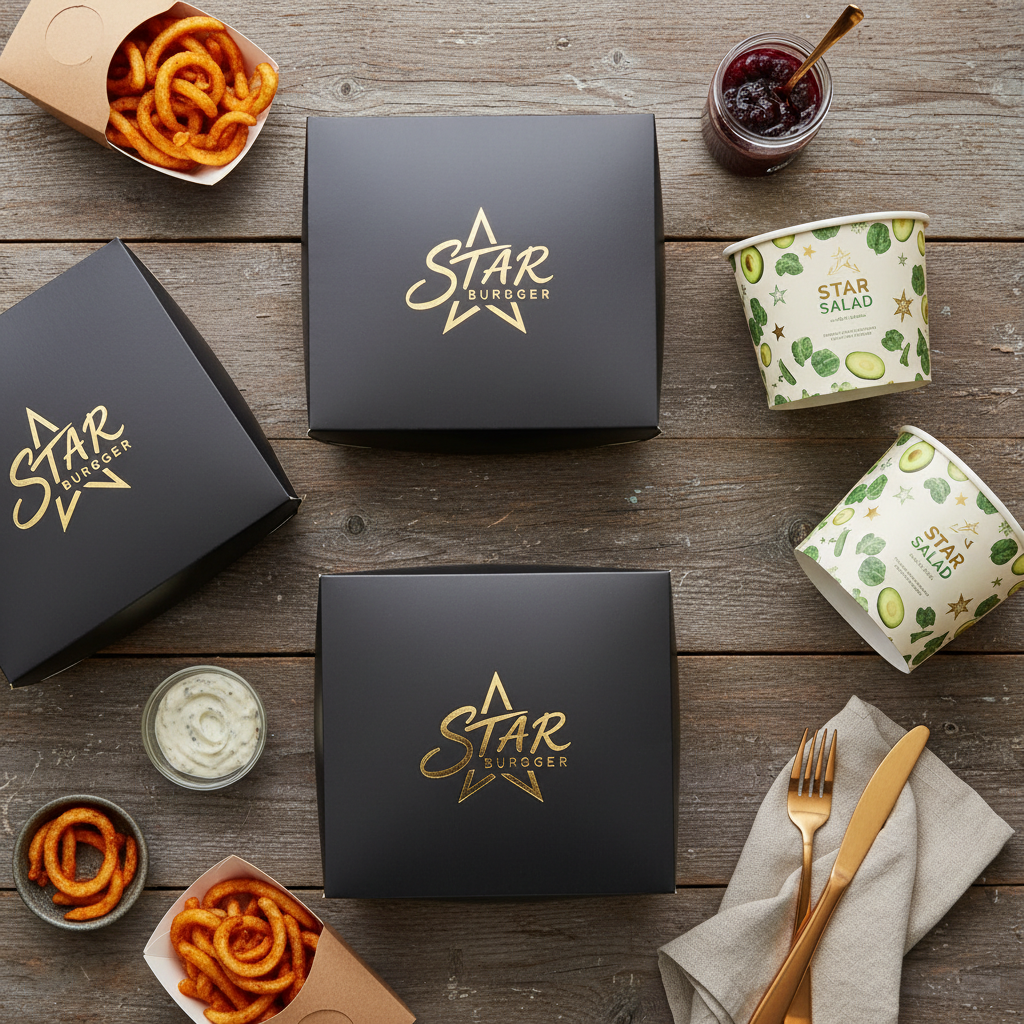
In the age of “unboxing” and social media, your packaging is a mobile billboard. High-quality printing transforms a utility item into a marketing asset.
Printing Technologies
- Offset Printing: Highest quality, suitable for detailed photographic images. High setup costs make it ideal for large runs (10,000+ units).
- Flexographic Printing: Cost-effective for simple logos and patterns (1-4 colors). Standard for high-volume fast food packaging.
- Food-Safe Inks: It is mandatory to use low-migration, vegetable-based, or water-based inks to prevent chemical contamination of the food, especially when high heat is involved.
Buying Guide: Ordering for B2B
Procuring custom packaging involves navigating Minimum Order Quantities (MOQs), lead times, and logistics. Here is how to streamline the ordering process.
1. Define Your Grease Load
Be specific about what you are packing. A box for dry onion rings requires less grease resistance (Kit 5-7) than a box for buffalo wings (Kit 10-12 + PE lining). Under-specifying leads to leaks; over-specifying wastes money.
2. Storage and Logistics
- Flat Packed: Most folding cartons and fry boxes ship flat. This minimizes shipping volume and storage space.
- Nested: Buckets, bowls, and formed trays ship nested. This takes up significantly more pallet space. Ensure your warehouse has the capacity before ordering nested products.
3. Sampling
Never place a bulk order without testing. Request samples to perform a “torture test”: fill the package with your hottest, greasiest product and let it sit for 45 minutes (typical delivery time). Check for sogginess, leaks, and structural collapse. You can contact our team to request specific material samples.
4. Volume and MOQs
Custom printing generally requires MOQs ranging from 5,000 to 30,000 units depending on the complexity and size of the box. Higher volumes significantly reduce the per-unit cost.
Sustainability in Greaseproof Packaging
The intersection of grease resistance and recyclability is a major topic in 2024. Traditional PE-lined boxes are recyclable only in facilities with specialized hydro-pulpers. For brands targeting zero-waste goals, consider:
- Water-based coatings: These break down easily in standard recycling streams.
- Compostable certifications: Ensure your PLA or bagasse options meet local composting standards (e.g., EN 13432 or ASTM D6400).
- Reusable options: For closed-loop environments (like cafeterias), durable food containers may be preferable to single-use disposables.
Conclusion
Packaging fried food is a science that balances heat retention against moisture release. By choosing the right combination of venting, grease-resistant coatings, and structural design, you ensure your product arrives at the customer’s door tasting as good as it did leaving the fryer.
At YBJ Packing, we specialize in helping brands navigate these technical choices. Whether you need high-performance fried chicken buckets or eco-friendly fry scoops, our manufacturing capabilities cover the full spectrum of food service needs.
Frequently Asked Questions (FAQ)
Q: What is the best material for keeping fries crispy during delivery?
A: An open-top scoop or a box with significant side venting is best. Avoid sealed containers. Materials like unbleached kraft board with a light dispersion coating offer a good balance of breathability and grease resistance.
Q: Can I print my logo on the inside of the box?
A: Yes, but it requires special considerations. Inside printing must use certified food-safe, low-migration inks to ensure no chemicals transfer to the food. It is often more expensive than exterior printing.
Q: What is the difference between PE and PLA lining?
A: PE (Polyethylene) is a standard plastic derived from petroleum. PLA (Polylactic Acid) is a bioplastic derived from plants. Both provide excellent grease resistance, but PLA is compostable in industrial facilities, whereas PE is not.
Q: How do I know if I need a liner or just a coated box?
A: For dry fried items (nuggets, fries), a coated box is usually sufficient. For wet or saucy items (honey-glazed wings, heavy burgers), a physical liner (PE or PLA) or a separate greaseproof paper sheet is recommended to prevent leaks.
Q: What is the typical lead time for custom printed fried food boxes?
A: Lead times vary by complexity and volume, but generally range from 3 to 5 weeks after artwork approval. Shipping times depend on your location relative to the manufacturing facility.
Ready to upgrade your packaging?
Protect your product quality and enhance your brand. Request a quote today to discuss your custom fried food packaging requirements with our specialists.