

Introduction: Elevating the Fry Experience Through Packaging
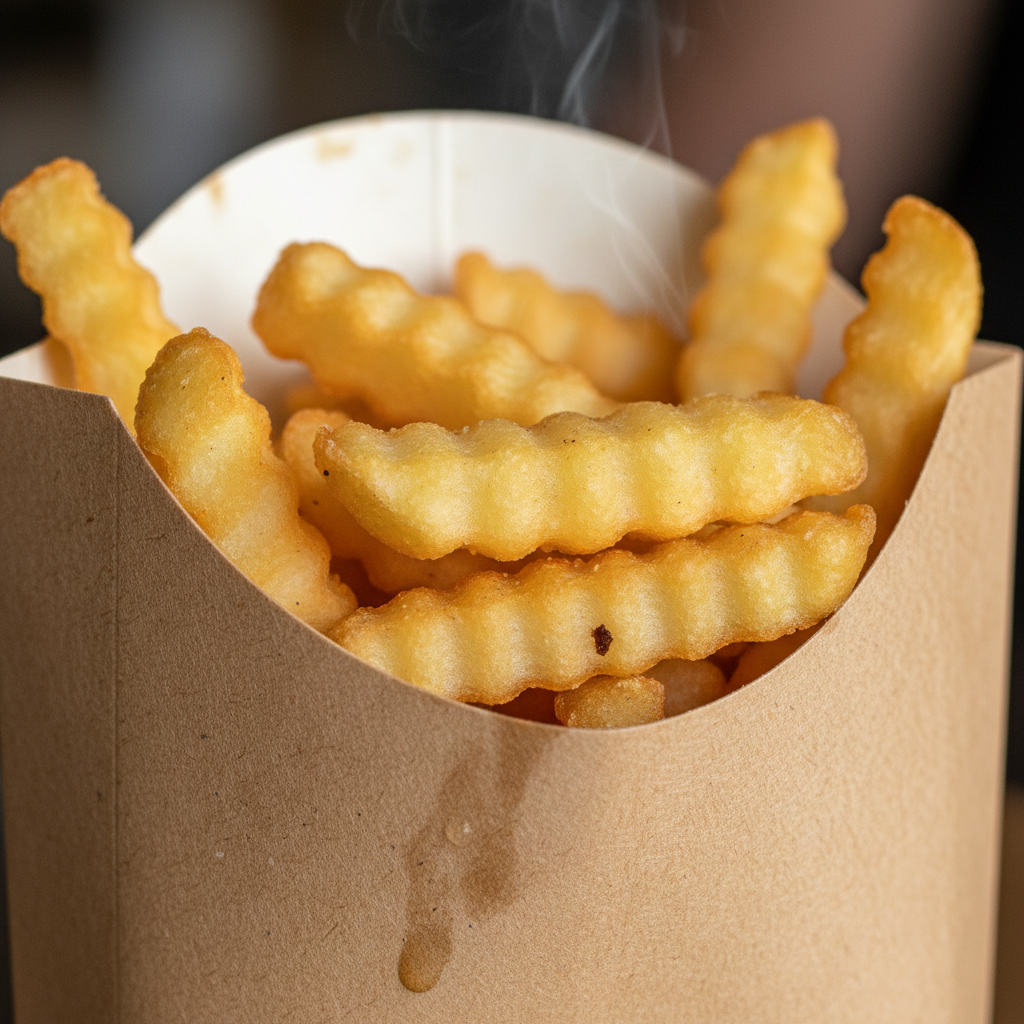
In the competitive landscape of quick-service restaurants (QSR) and food delivery, the humble french fry is often a high-margin staple. However, the quality of the consumer experience depends heavily on how those fries are transported from the fryer to the customer. A soggy, cold, or grease-soaked serving can tarnish a brand’s reputation instantly. This is where the engineering and design of the french fries box become critical.
For procurement managers, restaurant owners, and packaging distributors, selecting the right packaging is not merely an aesthetic choice—it is a functional necessity. The right box maintains heat, manages moisture to preserve crispness, prevents grease leakage, and serves as a mobile billboard for the brand.
This comprehensive guide explores the technical specifications, material science, customization options, and purchasing considerations for custom french fries boxes. Whether you are scaling a franchise or sourcing for a distribution network, understanding these details will ensure you make informed, cost-effective decisions.
1. The Anatomy of a High-Performance French Fries Box
Before diving into materials, it is essential to understand the functional requirements of fry packaging. Unlike dry goods, fried foods present a complex challenge: they are hot, oily, and emit steam. A high-performance box must balance three opposing forces:
- Grease Resistance: Preventing oil from spotting the paper or leaking onto the customer’s hands.
- Ventilation: allowing steam to escape so fries remain crisp rather than steaming themselves soggy.
- Insulation: Retaining enough heat to keep the product palatable during consumption.
Achieving this balance requires specific paper grades, structural designs, and coating technologies.
2. Material Specifications: Paperboard Grades and Weight
The structural integrity of a french fries box is determined by the raw material. In the B2B packaging market, several standard paperboards are utilized, each offering different benefits regarding stiffness, printability, and cost.
Ivory Board (White Cardboard)
Ivory board, often referred to as Solid Bleached Sulfate (SBS) or Food Board, is a premium material made from bleached chemical pulp. It is characterized by its smooth, bright white surface on both sides.
- Pros: Excellent print surface for vibrant, high-resolution graphics; conveys a clean, hygienic aesthetic; high stiffness.
- Typical GSM (Grams per Square Meter): 210gsm to 300gsm.
- Best For: Premium brands requiring complex artwork or full-color printing.
Kraft Paperboard (Brown/Natural)
Unbleached Kraft paperboard is made from virgin wood pulp and retains its natural brown color. It has become increasingly popular due to the global shift toward eco-friendly aesthetics.
- Pros: High tear resistance; communicates sustainability and “natural” ingredients; generally requires less processing than bleached boards.
- Typical GSM: 230gsm to 330gsm.
- Best For: Organic food brands, artisan burger joints, and businesses focusing on sustainability.
Corrugated Board (Micro-Flute)
For larger portions or delivery-specific packaging, micro-flute corrugated board (E-flute or F-flute) is sometimes used. This material consists of a fluted layer sandwiched between two liners.
- Pros: Superior thermal insulation; extremely rigid; prevents crushing during delivery.
- Cons: Higher volume to ship/store; rougher surface for printing compared to SBS.
- Best For: Large sharing buckets, heavy loads, or delivery-focused menus.
Choosing the Right GSM
The weight of the paper (GSM) dictates the box’s sturdiness. If the GSM is too low, the box will deform when held, especially when filled with hot, heavy fries. If it is too high, you are paying for unnecessary material.
- Small Scoop (3-4 oz): 210–230 GSM is often sufficient.
- Medium/Large Scoop (5-7 oz): 250–280 GSM provides the necessary rigidity.
- Family/Sharing Sizes: 300+ GSM or micro-flute corrugated is recommended.
3. Coatings and Grease Resistance Technologies
Raw paper is porous and will absorb oil immediately. To make a food packaging box functional for fried foods, a barrier layer is applied. Understanding the types of coatings is vital for compliance and performance.
PE Coating (Polyethylene)
This is the industry standard for moisture and grease resistance. A thin layer of food-grade polyethylene plastic is laminated onto the paperboard.
- Performance: Excellent barrier against oil and water.
- Finish: Can be applied to the inside (functional) or outside (glossy finish).
- Recycling Note: Requires specialized recycling facilities to separate the plastic from the paper pulp.
Aqueous Coating (Water-Based)
Aqueous coatings are becoming more common as brands seek plastic-free alternatives. These are water-based varnishes that dry to form a protective layer.
- Performance: Good grease resistance for short durations; breathable.
- Sustainability: Generally easier to recycle and compost than PE-lined boards.
Grease-Proof Paper (Kit Levels)
Instead of a coating, some papers are treated chemically during the manufacturing process to resist grease penetration. This resistance is measured in “Kit Levels” (usually 1 to 12).
- Kit 1-3: Low resistance (dry goods).
- Kit 6-8: Moderate resistance (pastries).
- Kit 9-12: High resistance (fried foods, oily items).
For french fries, a high Kit level or a PE coating is mandatory to prevent the unsightly “grease spot” effect on the bottom of the box.
4. Structural Design Options: Shapes and Use Cases
The shape of the box influences how the staff fills it, how the customer holds it, and how the fries cook (or steam) while inside.
The Classic Scoop (French Fry Scoop)
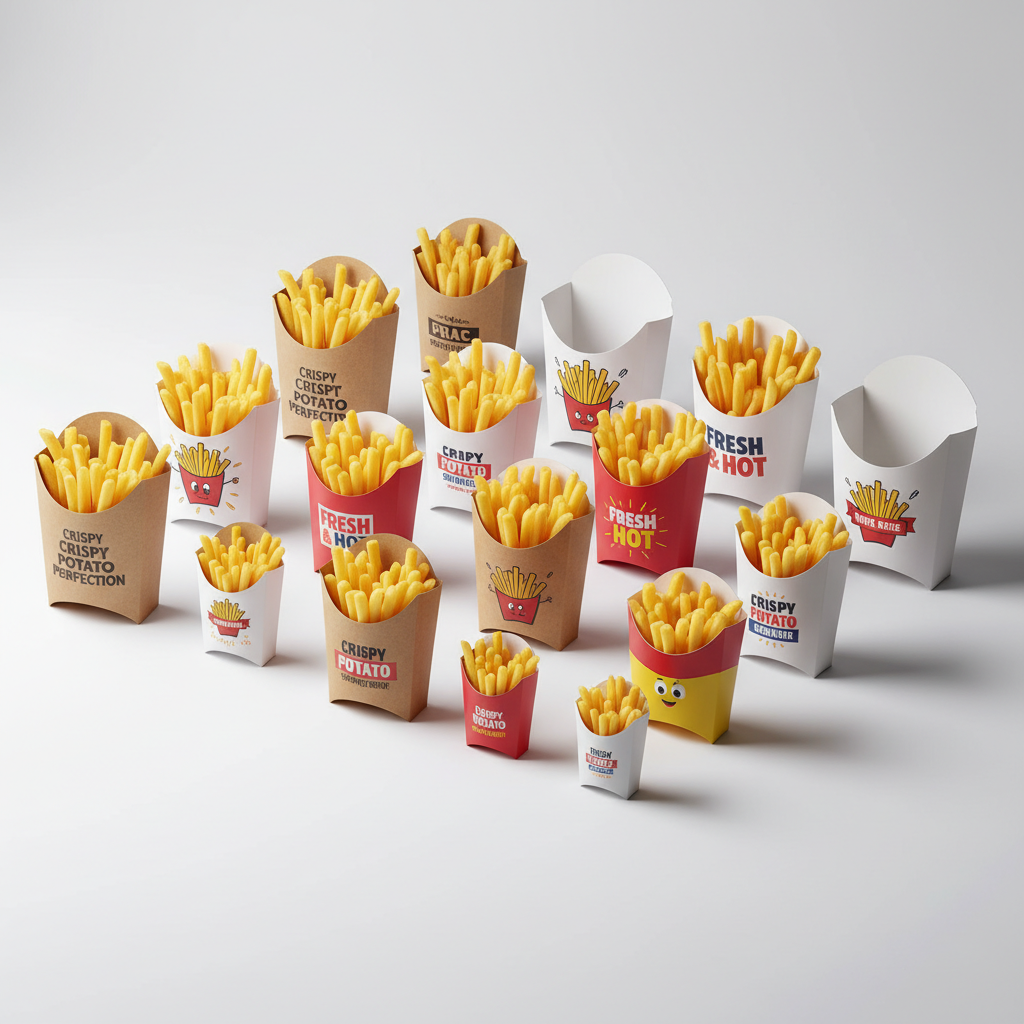
This is the iconic shape used by major global fast-food chains. It features a flat bottom so it can stand upright on a tray and a high back to support long fries, with a lower front for easy access.
- Use Case: High-volume fast food, dine-in trays, car cup holders.
- Advantage: Stackable (nestable) for efficient storage; easy to fill rapidly with a fry scoop tool.
The Conical Cone
Often seen in European street food or specialized “frites” shops. These often have a built-in dipping sauce pocket.
- Use Case: Street vendors, walking customers, festivals.
- Advantage: Ergonomic for holding in one hand while walking.
Square/Rectangular Open Cartons
These are tray-style boxes, often used for “loaded fries” topped with cheese, chili, or bacon.
- Use Case: Casual dining, gourmet burger restaurants, loaded fry menus.
- Advantage: Wide opening allows for toppings and fork access.
Clamshell / Closed Boxes
Essential for delivery. These boxes have a lid to protect the food during transport.
- Use Case: Delivery apps (UberEats, DoorDash), takeout.
- Critical Feature: Ventilation holes are non-negotiable here. Without vents, the steam trapped inside a closed box will turn crispy fries into a soggy mash within minutes.
5. Sizing Guide: Matching Volume to Profit
Selecting the right size is a direct variable in your food cost percentage. A box that looks full but holds fewer grams of product maximizes profit margins.
Common Size Classifications:
- Mini / Kids (approx. 2-3 oz): Ideal for children’s meals or sample portions.
- Small (approx. 3-4 oz): Standard side dish size.
- Medium (approx. 5-5.5 oz): The most common size for combo meals.
- Large (approx. 6-7 oz): Upsell size for hungry customers.
- Extra Large / Bucket (8+ oz): Sharing size.
Note: Dimensions vary by manufacturer. When ordering custom boxes, always request a die-line template to verify the exact volume capacity with your specific cut of fry (shoestring vs. steak cut vs. crinkle cut).
6. Printing and Brand Customization
In the age of social media, your packaging is your most visible marketing asset. A well-designed french fries box often ends up on Instagram, providing free advertising.
Printing Techniques
- Offset Printing: The gold standard for high-quality, photographic images and precise color matching. Ideal for large runs where branding consistency is paramount.
- Flexographic Printing: Cost-effective for simple logos and patterns, especially on kraft paper. Commonly used for very high-volume production runs.
Color Systems
- CMYK (Process Color): Used for full-color images or gradients.
- Pantone (PMS): Essential for brands with a specific trademarked color (e.g., “Coca-Cola Red” or “McDonald’s Yellow”). Ensuring your manufacturer matches your PMS code is critical for brand integrity.
Finishing Touches
- Gloss Lamination: Makes colors pop and adds a shiny, protective layer.
- Matte Lamination: Offers a sophisticated, modern, and tactile feel.
- Spot UV: Highlights specific areas (like a logo) with gloss against a matte background (rare for disposable fry boxes due to cost, but possible for high-end concepts).
7. Manufacturing and Quality Control
When sourcing from a manufacturer, understanding the production process helps in negotiating and quality assurance. The process generally involves:
- Material Sourcing: Verifying food-grade certification of the base paper.
- Printing: Applying the artwork to the large paper rolls or sheets.
- Die-Cutting: Cutting the specific shape of the box from the sheet.
- Gluing: Folding and gluing the side seams (for scoop cups).
- Packing: Stacking nested boxes into shipping cartons.
Quality Checkpoints
- Adhesion Test: Ensuring the glue withstands the heat of the fries without melting or popping open.
- Odor Test: Food packaging must be odorless. Low-quality inks or glues can transfer chemical smells to the hot food.
- Leakage Test: Verifying the grease barrier is continuous and effective.
8. Logistics and Storage Considerations
French fries boxes are high-volume, low-weight items. This impacts logistics significantly.
- Nesting vs. Flat-Packed:
- Scoop cups usually come pre-glued and nested (stacked inside each other). This takes up more shipping volume but allows for instant use at the restaurant.
- Fold-up cartons or clamshells often come flat. This saves massive amounts of warehouse space and shipping costs but requires labor to assemble on-site.
- Storage Conditions: Paper products are hygroscopic (absorb moisture). Boxes should be stored in a cool, dry place, off the ground, and inside their master cartons until use to prevent warping or contamination.
9. Buying Guide: How to Order Custom Boxes
Ready to place an order? Here is a checklist to ensure a smooth procurement process.
Step 1: Define Requirements
Determine your size, material preference (Kraft vs. Ivory), and estimated monthly usage. This helps in calculating the optimal order volume.
Step 2: Check MOQs (Minimum Order Quantities)
Custom printing requires setup (making printing plates and cutting dies). Therefore, manufacturers set MOQs. For custom print, this is typically higher (e.g., 10,000 to 30,000 units) compared to stock plain boxes. Higher volumes drastically reduce the unit cost.
Step 3: Prepare Artwork
You will need vector files (AI, PDF, EPS) of your logo and design. Ask the supplier for the die-line template so your designer can lay out the artwork correctly, respecting bleed lines and glue areas.
Step 4: Sampling
Before mass production, request a digital proof or a physical sample. A physical sample ensures the size fits your specific serving portion correctly.
Step 5: Lead Times
Factor in production time (usually 2-4 weeks after artwork approval) and shipping time (which varies by sea or air freight). Always order well in advance of running out of stock.
For detailed steps on initiating a partnership, visit our ordering process page.
10. Frequently Asked Questions (FAQ)
What is the difference between food-grade paper and regular paper?
Food-grade paper is manufactured under strict hygiene standards, uses virgin pulp (or safe recycled content), and contains no harmful chemicals or optical brighteners that could migrate into food. It is mandatory for direct-contact food packaging.
Can french fries boxes be composted?
It depends on the coating. Boxes with a PE (plastic) lining are not typically compostable in standard facilities. Boxes with aqueous coatings or no coating (just high-density paper) are generally compostable. Always check the specifications with your supplier.
Do I need a separate box for delivery orders?
It is highly recommended. Open scoop cups are great for dine-in but poor for delivery as they spill easily and lose heat. A closed, vented carton is superior for delivery to maintain temperature and hygiene.
How do I know what size box matches my portion weight?
Portion density varies by fry type (thin cut vs. wedges). The best method is to weigh your desired serving size and test it in physical samples provided by the manufacturer.
What file format do I need for my logo?
Vector formats like Adobe Illustrator (.ai) or PDF are required. These allow the image to be scaled without losing quality and allow for color separation during printing.
Why is there a setup fee?
The setup fee covers the creation of the printing plates and the cutting die specific to your design and shape. This is usually a one-time cost for the first order; reprints typically do not incur this fee unless the design changes.
Conclusion
Selecting the right french fries box is a strategic decision that impacts operation speed, food quality, and brand perception. By choosing the appropriate material, size, and print finish, you ensure that your customers enjoy their meal exactly as intended—crisp, hot, and delicious.
At YBJ Packing, we specialize in manufacturing high-quality, custom food packaging solutions tailored to the needs of the food service industry. Whether you need eco-friendly kraft scoops or high-gloss branded cartons, our team is ready to assist you.
Ready to upgrade your packaging? Contact our team today to request a quote or get a sample of our premium french fries boxes.