

In the competitive landscape of food service and beverage retail, the humble cup sleeve serves two critical functions: protecting the consumer from thermal injury and acting as a high-visibility mobile billboard for your brand. For procurement managers, coffee chain operators, and packaging distributors, selecting the right cup sleeve is not merely an aesthetic choice—it is a technical decision involving material thermal properties, supply chain logistics, and cost-efficiency.
This comprehensive buyer’s guide explores the technical specifications, material options, and customization possibilities for custom cup sleeves. Whether you are sourcing for a multinational franchise or a boutique coffee roaster, understanding these variables ensures you receive a product that meets safety standards, enhances brand perception, and fits your budget.
The Strategic Value of Cup Sleeves in Food Service

While double-wall cups are a popular solution for insulation, many operators prefer the combination of single-wall cups and separate sleeves. This approach offers inventory flexibility. You can stock generic single-wall cups for cold drinks or low-heat beverages and add sleeves only when serving piping hot coffee or tea. This modularity often results in lower overall warehousing costs and reduced material waste.
Furthermore, the surface area of a cup sleeve is prime real estate. Unlike the curved, sometimes coated surface of a cup which can be challenging to print with high complexity in small runs, sleeves are printed flat. This allows for higher definition graphics, promotional messaging, and seasonal rotation without changing the base cup inventory.
Material Specifications: The Foundation of Thermal Protection
The primary function of a cup sleeve, also known as a coffee clutch or zarf, is insulation. The material choice dictates the heat transfer rate, grip stability, and tactile experience for the customer. At YBJ Packing, we see several dominant material categories in the wholesale market.
1. Corrugated Paper (The Industry Standard)
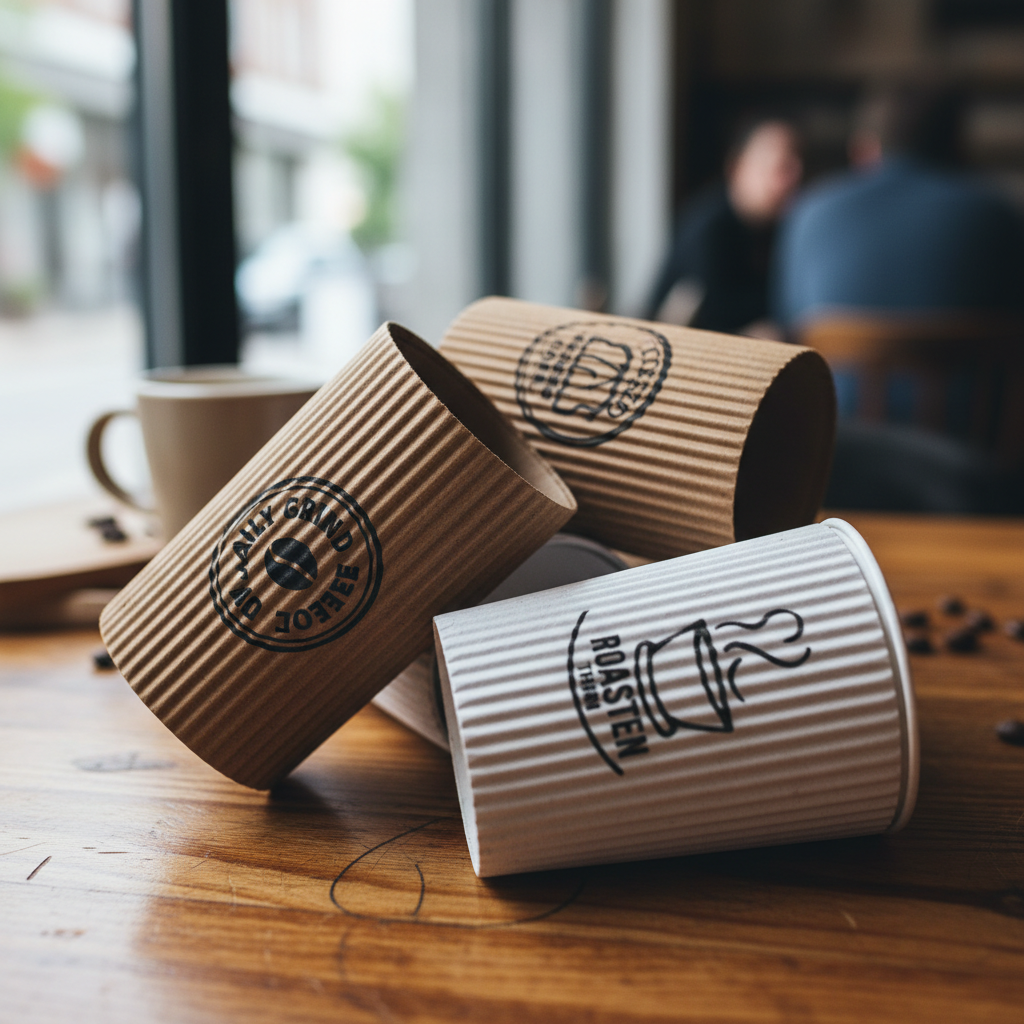
Corrugated sleeves are the most common choice for hot beverages. They rely on an inner layer of fluted paper sandwiched between two flat liners (or one liner and the face). The air gaps created by the flutes act as insulators, slowing conductive heat transfer from the cup wall to the customer’s hand.
- E-Flute: A fine flute profile (approx. 1.1mm – 1.6mm thick). It offers a good surface for printing while providing adequate insulation for standard coffee temperatures (approx. 80°C – 90°C).
- F-Flute: A micro-flute (approx. 0.8mm thick). It provides a smoother printing surface for detailed logos but offers slightly less insulation than E-flute. It is often used when print quality is the priority over extreme heat protection.
- B-Flute: Thicker and more robust, offering superior insulation but bulkier to stack and ship. Less common for standard coffee sleeves but used for very high-temperature applications.
2. Embossed Paperboard
Embossed sleeves use heavy paperboard that has been mechanically textured. The raised pattern reduces the surface area in contact with the hand, creating air pockets for insulation. These sleeves often have a premium, tactile feel and are less bulky than corrugated options, allowing for tighter nesting in shipping cartons.
3. Smooth Kraft or White Board
Some brands opt for a thick, smooth board (250gsm – 350gsm) without corrugation or heavy embossing. While the insulation value is lower, the smooth surface is ideal for high-resolution offset printing, metallic foiling, or complex artwork. These are often used with “warm” rather than “scalding” beverages or purely for branding on cold cups (to absorb condensation).
Sizing and Compatibility: Ensuring a Secure Fit
A poorly fitted sleeve is a safety hazard. If a sleeve slides down, the cup may tip; if it slides up, the customer risks touching the hot cup wall. Sizing compatibility is determined by the cup’s top diameter, bottom diameter, and taper angle.
Standard Capacity Ranges
Most wholesale cup sleeves are designed to fit a range of cup sizes due to the tapered design of standard paper cups. A single sleeve size often fits:
- 12oz to 24oz Cups: This is the “universal” large size. The taper allows the sleeve to settle at the midpoint of a 12oz cup and slightly higher on a 20oz cup.
- 8oz to 10oz Cups: Smaller cups require a dedicated smaller sleeve size to prevent the sleeve from sliding right off the bottom or covering the drinking lip.
Custom Die-Cut Shapes
While the trapezoidal shape is standard, custom dies can create unique brand interactions. Scalloped edges, die-cut windows, or interlocking tabs can differentiate your packaging. However, custom shapes must be tested rigorously to ensure they do not compromise the structural integrity of the glued seam.
For a wide selection of standard and custom options, explore our cup sleeve category.
Printing and Customization Checklist
When ordering printed cup sleeves, the printing method impacts cost, lead time, and visual quality. Here is a checklist for buyers to consider during the design phase.
Printing Technologies
- Flexographic Printing (Flexo): The standard for high-volume runs. It uses flexible relief plates. Ideal for simple logos, solid colors, and text. It is cost-effective for orders over 10,000 units but has limitations with gradients and photo-realistic images.
- Offset Printing: Offers the highest quality image reproduction, capable of sharp details, gradients, and complex CMYK imagery. It is typically used for smooth paper sleeves or high-end corrugated sleeves where the top liner is pre-printed before corrugation.
- Digital Printing: Suitable for short runs, prototypes, or seasonal campaigns. It requires no plates, allowing for quick turnaround, but the per-unit cost is higher.
Artwork Considerations
- Vector Files: Always supply artwork in vector format (AI, EPS, PDF) to ensure lines remain crisp regardless of scaling.
- Bleed Area: Ensure the design extends beyond the die-line (typically 3mm) to account for minor shifts during cutting.
- Warp Distortion: Because the sleeve is wrapped around a conical cup, artwork printed on a flat sleeve will appear curved when assembled. Designers must apply a warp distortion to the flat art so it looks straight when the sleeve is in use.
Coatings and Grease Resistance
While cup sleeves don’t hold liquid, they often encounter spills, condensation, or oils from customer hands.
- Uncoated Kraft: Offers a natural, eco-friendly look. Highly absorbent, which is good for condensation on cold cups but can stain easily with coffee drips.
- Matte/Gloss Varnish: A light coating protects the print from smudging and provides mild moisture resistance.
- Spot UV: A high-gloss finish applied to specific areas (like a logo) to create contrast against a matte background. This is a premium feature for luxury branding.
Manufacturing and Quality Assurance
Quality in cup sleeve manufacturing focuses on adhesion and consistency. A sleeve failure (popping open) can lead to burns and liability.
Glue Seam Integrity
The glued seam is the critical failure point. Manufacturers must use high-grade, heat-resistant adhesives that do not soften when in contact with a 90°C cup. At YBJ Packing, we perform heat stress testing to ensure the bond remains secure under operational temperatures.
Odor Control
Because the sleeve is brought close to the consumer’s nose while drinking, the materials used must be low-odor. We utilize food-grade inks and adhesives to prevent any chemical smell from interfering with the aroma of the beverage.
Logistics: Packing and Storage
For bulk buyers, logistics is a key cost driver. Cup sleeves are lightweight but can be voluminous.
- Nested Stacking: Finished sleeves are typically stacked in nested rows. This maximizes box density.
- Case Counts: Standard cases contain 1,000 to 2,000 units depending on the flute thickness.
- Storage: Paper products are hygroscopic. They must be stored in a dry environment to prevent the corrugated flutes from softening due to humidity absorption.
To view our full range of beverage solutions, visit our Cups & Accessories section.
Common Use Cases and Scenarios
1. The Specialty Coffee Shop
Requirement: High insulation, rustic aesthetic.
Solution: Kraft corrugated sleeves with a simple one-color black logo. The kraft material signals organic/natural values, and the corrugation handles the heat of fresh-brewed drip coffee.
2. Corporate Events and Trade Shows
Requirement: Maximum branding impact, short run.
Solution: Full-color offset printed sleeves on smooth white board. These sleeves serve as advertising space for sponsors or event schedules.
3. Bubble Tea and Cold Brew
Requirement: Condensation management.
Solution: Thick, absorbent uncoated board. The goal here isn’t heat insulation but preventing the cup from becoming slippery due to “sweating.”
Buying Guide: How to Order Custom Sleeves
Navigating the procurement process requires attention to detail. Here is a step-by-step guide to ordering from a manufacturer like YBJ Packing.
Step 1: Define Your Specs
Determine the cup sizes you are using. If possible, send physical samples of your cups to the manufacturer to ensure the sleeve die-cut fits perfectly. Specify the material preference (Kraft vs White, Corrugated vs Smooth).
Step 2: Volume and MOQ
Wholesale food packaging economics rely on scale.
MOQ (Minimum Order Quantity): Custom printing usually requires an MOQ of 10,000 to 30,000 units to amortize setup costs. For unprinted generic sleeves, MOQs are significantly lower (often by the case).
Step 3: Sampling
Before committing to a full production run, request a digital proof. For large orders, a physical pre-production sample is recommended to verify color accuracy and fit.
Step 4: Lead Times
Production times vary based on complexity. Standard lead times range from 2 to 4 weeks after artwork approval, plus shipping transit time. Expedited options may be available for urgent events.
Ready to start your project? Learn more about our process on our How to Order page.
FAQ: Custom Cup Sleeves
1. Can I print on the inside of the sleeve?
Generally, no. The inside of a corrugated sleeve is the fluted layer, which is difficult to print on and is not visible to the customer. Double-sided printing is possible on smooth, non-corrugated sleeves but adds cost.
2. Are your cup sleeves recyclable?
Yes, most paper cup sleeves are 100% recyclable and compostable, provided they do not have plastic laminates or metallic foils. We recommend using water-based inks to enhance biodegradability.
3. Do you offer sleeves for handle-less mason jars or pint glasses?
Yes, we can create custom dies to fit glassware. However, sizing must be precise as glass does not have the same taper as paper cups, so the sleeve relies on friction or a tighter fit.
4. What is the difference between Kraft and White corrugated?
Kraft is brown paper made from unbleached pulp, offering a natural look. White is bleached, providing a cleaner canvas for bright colors. White corrugated is often slightly more expensive due to the processing of the paper.
5. How do I know if my artwork is suitable for Flexo printing?
Flexo is best for bold lines and solid colors. If your design has photographic elements, shadows, or very fine gradients, we may recommend offset printing instead. Our design team can review your files and advise.
6. Can I use one sleeve size for both 12oz and 16oz cups?
In most cases, yes. Standard 12oz, 16oz, and 20oz cups usually share the same top diameter (approx 90mm) and taper angle. A universal sleeve is designed to fit this range effectively.
Conclusion
Selecting the right cup sleeve is a balance of functionality, branding, and budget. Whether you need a robust corrugated sleeve for scalding hot teas or a sleek, high-definition sleeve for a marketing campaign, the options are vast. By understanding the materials and printing processes, you can make informed procurement decisions that protect your customers and promote your brand.
At YBJ Packing, we specialize in high-volume, custom-printed food packaging solutions for the global market. Our team is ready to assist you with die-lines, material selection, and logistics.
Ready to enhance your beverage packaging? Contact us today to request a quote or get a sample of our premium cup sleeves.