


Table of Contents
- What Odor Testing Should Establish
- Packaging Odor, Food Taint, and Compliance
- Designing Food Packaging Odor Testing
- Sensory Sample Conditioning and Evaluation
- Which Check Answers Which Question?
- Product Formats and Investigation Priorities
- Writing a Sensory Approval Specification
- Packaging Complaint Investigation
- Sampling, Production, Storage, and Shipping
- Key Takeaways for Packaging Buyers
Build a repeatable sensory approval process that separates packaging odor from food taint, uses appropriate controls, and supports practical supplier investigations.
What Odor Testing Should Establish
Food packaging odor testing should establish whether packaging has an objectionable smell and whether it changes the odor or flavor of food under its intended conditions of use. A useful approval process compares traceable samples with controls, applies consistent conditioning, and assesses the complete packaging system. Smelling one empty box is an initial screen, not sufficient evidence of food compatibility.
For bakeries, cafes, food manufacturers, and importers, the purchasing decision is practical: will the specified pack preserve the expected sensory quality of the product? This guide focuses on sensory evaluation, control selection, and source investigation. It expands the odor checks in a broader food packaging quality control checklist.
Packaging Odor, Food Taint, and Compliance
Packaging odor is a smell detected from the packaging itself. Food taint is an unwanted odor or flavor acquired by food from an external source, potentially including its packaging. Packaging sensory testing uses human assessors under controlled conditions to evaluate these effects.
Headspace is the air above a sample inside a closed vessel. Conditioning means holding samples under defined conditions before evaluation. Set-off is transfer from one surface to another during stacking or winding; it can move substances from an outer printed surface toward a food-contact surface.
Odor intensity does not identify a chemical or establish safety. A pack can smell noticeable without causing detectable food taint, while an apparently odorless pack still requires appropriate compliance evidence. Sensory acceptance and food-contact compliance need separate documentation.
For EU destinations, Regulation (EC) No 1935/2004 requires food-contact materials, under normal or foreseeable use, not to transfer constituents that cause unacceptable changes in food composition or deterioration of organoleptic characteristics. The European Commission’s food-contact materials guidance provides regulatory context. Applicable requirements depend on the material and destination market.
Designing Food Packaging Odor Testing
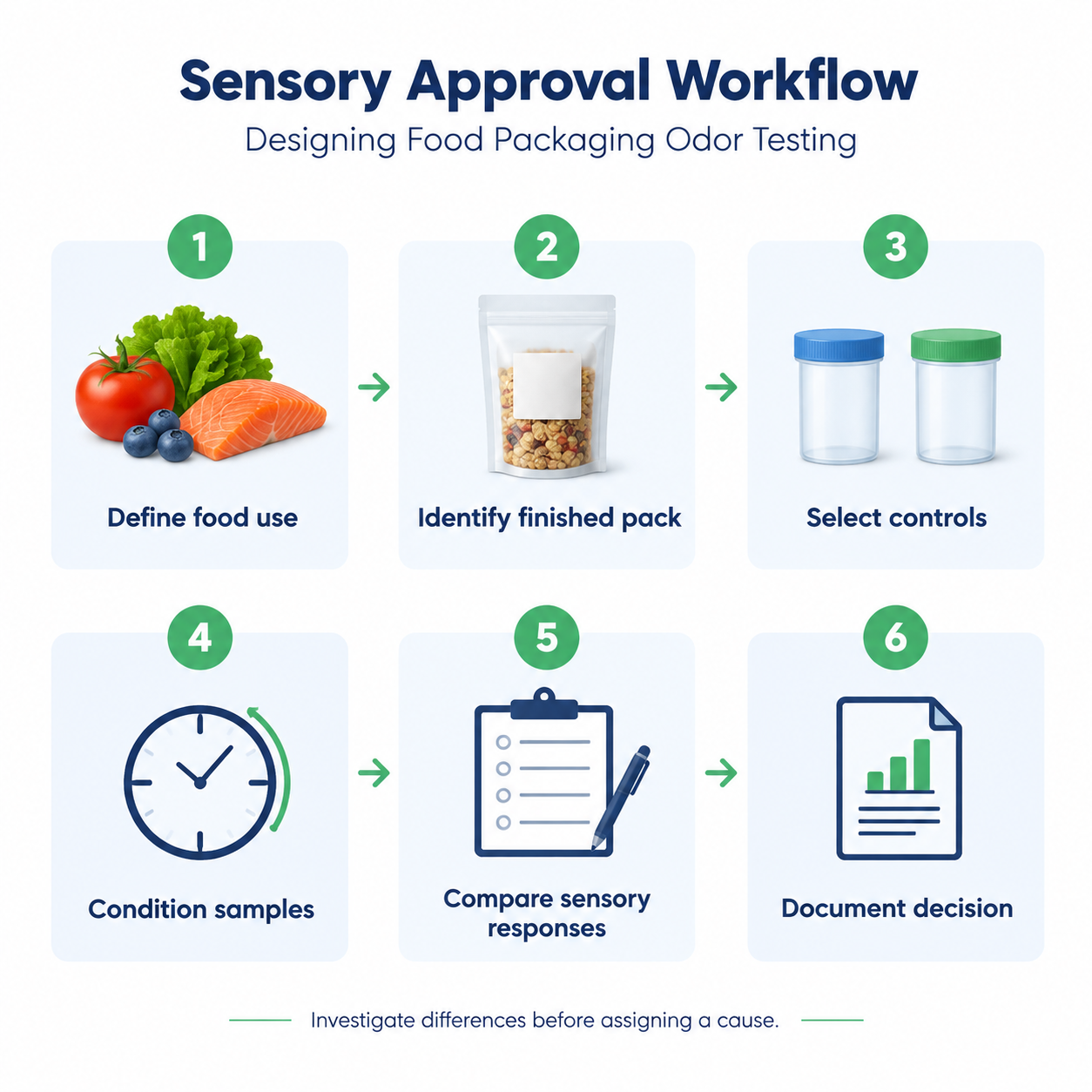
Start with the food application and the decision the test must support. Delicate bakery products, dry foods, fatty foods, and hot meals may respond differently to the same packaging. Define the actual contact conditions before selecting a method.
- Describe the use: record food type, portion size, contact duration, filling conditions, storage, and any intended reheating.
- Identify the finished system: include board or resin, coating, printing, adhesive, liner, lid, and accessories.
- Select controls: retain an approved packaging reference and, for food trials, the same food held in a suitable reference container. Include an empty test-vessel blank.
- Choose representative samples: cover relevant production stages or carton locations. Keep batch identity while hiding supplier identity from assessors.
- Agree the decision rule: specify the sensory method, evaluation scale, repeat procedure, and acceptance criteria before seeing results.
A useful control is comparable in age and storage history. An old approved box stored in a perfumed office can give a misleading baseline. Follow a recognized method where applicable, with a laboratory selecting its current version and appropriate conditions.
Sensory Sample Conditioning and Evaluation

Sensory sample conditioning must be consistent enough that differences reflect the packaging rather than sample preparation. Do not prescribe a universal heating temperature or exposure time: these depend on the method, material, and intended food use.
- Use clean, odor-neutral vessels and verify them with blanks.
- Standardize exposed sample area or mass, vessel volume, orientation, closure, conditioning time, temperature, and humidity where relevant.
- Record the interval between manufacture, receipt, opening, and testing.
- Prepare coded samples and vary presentation order to reduce expectation and sequence effects.
- Evaluate in a neutral environment away from perfume, cooking, cleaning products, and smoke.
- Use assessors familiar with the procedure; provide rest intervals and record individual responses before discussion.
Record intensity separately from character, using descriptors such as woody, musty, solvent-like, or burnt. These descriptions guide investigation but do not identify the source. A controlled difference test can establish whether samples are distinguishable; a separate acceptance assessment determines whether the difference matters.
Do not deliberately air out a complaint sample before documenting its as-received condition. If airing is investigated, treat it as a separate comparison. Food tasting should occur only within an appropriate food-safety protocol; unknown contamination requires investigation before ingestion.
Which Check Answers Which Question?
Choose complementary checks because each answers a different question. Food packaging odor testing usually begins with screening and moves to controlled food exposure or analytical investigation when warranted.
| Check | Main question | Useful comparison | Limitation |
|---|---|---|---|
| As-received odor screen | Is an unusual smell present when the pack is opened? | Complaint sample versus approved reference | Handling and surroundings can influence results. |
| Controlled headspace evaluation | Does packaging release a detectable odor under defined conditions? | Coded specimens, reference, and vessel blank | Does not establish transfer to food. |
| Food-contact sensory trial | Does the intended food acquire an unwanted sensory change? | Same food in test and reference packaging | Results apply to the tested food and conditions. |
| Component comparison | Which production stage or component is associated with the odor? | Unprinted, printed, coated, and assembled specimens | Differences suggest a source but need confirmation. |
| Targeted chemical analysis | Which substances may explain the finding? | Affected sample, controls, and process information | Detection alone does not prove sensory causation or compliance. |
A laboratory can advise whether analytical headspace testing or other chemical methods are appropriate. Sensory findings should guide that work rather than being replaced by an unexplained chemical list.
Product Formats and Investigation Priorities
Evaluate the complete pack, then isolate components if a difference appears. The following product table identifies investigation priorities rather than ranking materials as universally low-odor or odor-free.
| Packaging format | Components to compare | Application check |
|---|---|---|
| Printed paperboard bakery box | Base board, print, coating, glue, window film | Delicate product in the assembled closed box |
| Food wrap or greaseproof paper | Base paper, barrier treatment, print, stacked sheets | Actual direct-contact food and wrapping duration |
| Paper cup or bowl with lid | Body, lining, seam adhesive where used, lid | Filled assembly under specified service conditions |
| PP or PET container | Resin specification, additives, decoration, lid | Intended food and permitted use conditions |
| Bagasse container | Molded fiber, treatments, lid, storage history | Actual food, moisture, and closure conditions |
Paperboard odor can originate in the substrate or absorbed storage contaminants. Printed packaging odor may be associated with inks, coatings, drying or curing, adhesives, or set-off. Treat these as hypotheses. Use matched specimens to distinguish them.
For direct-contact wraps, specify the paper and barrier construction alongside the food wrap paper printing and ordering requirements. Material appearance alone cannot predict sensory performance.
Writing a Sensory Approval Specification
A sensory specification should make the approval decision reproducible. Avoid relying on the phrase “no smell” without a method, control, or agreed interpretation.
Minimum specification block:
- Identity: product code, dimensions or capacity, material, coating, print coverage, adhesive, lid, and batch.
- Exposure: food or justified test medium, contact arrangement, duration, and temperature.
- Procedure: conditioning, vessel, sample quantity, assessors, coding, and evaluation method.
- Decision: reference sample, defined sensory scale, acceptance criterion, repeat rule, and escalation route.
- Records: individual observations, deviations, sample age, photographs, and retained specimens.
Separate odor intensity from food acceptability. Agree whether a detectable difference requires investigation, rejection, or further confirmation. Any numerical limit must belong to the chosen method and buyer specification; there is no universal sensory pass score for every food package.
Packaging Complaint Investigation
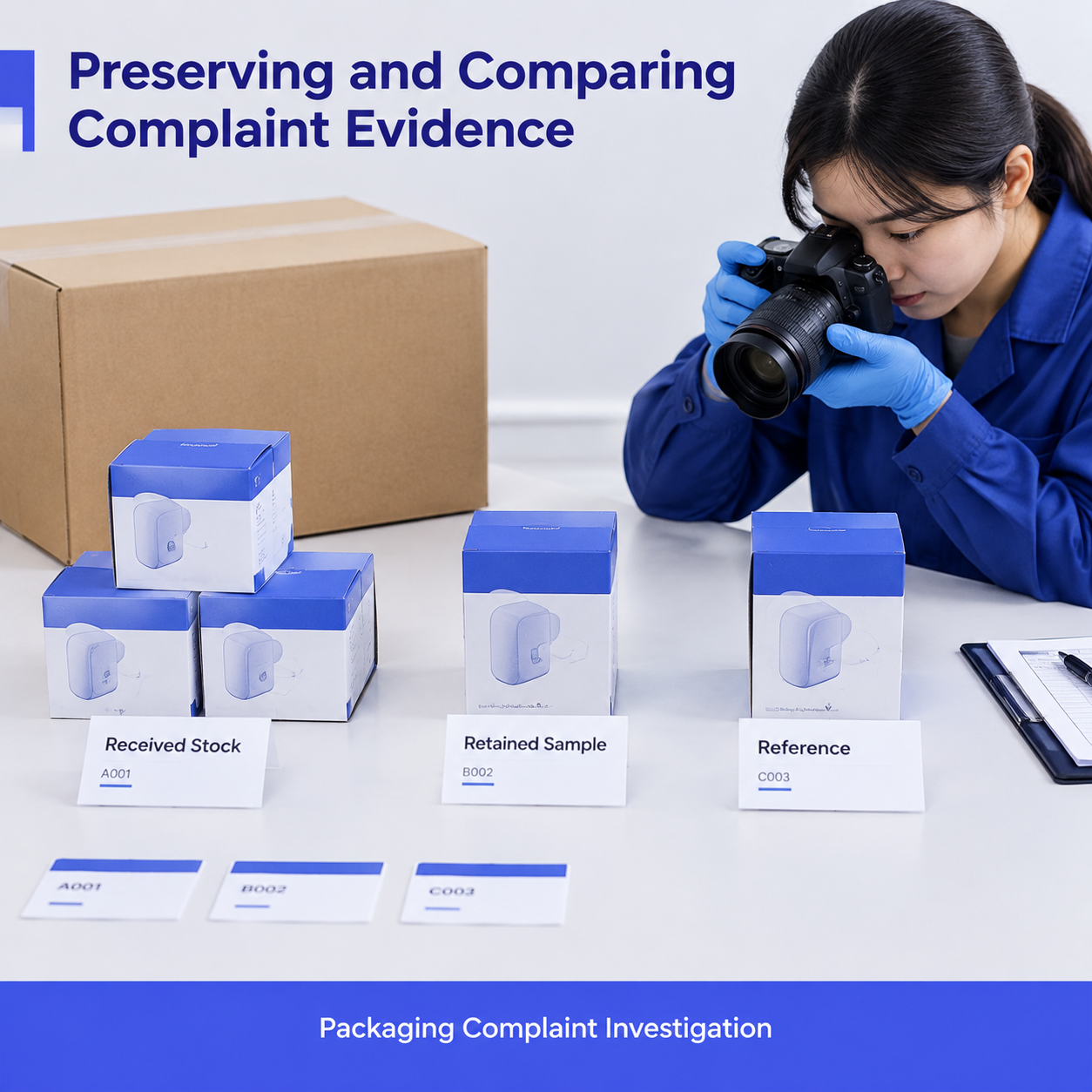
A packaging complaint investigation should preserve evidence and compare affected samples with unaffected material before assigning a cause.
- Contain: identify and hold potentially affected stock according to the quality procedure.
- Document: record batch, carton position, opening date, food involved, odor description, storage, and transport history.
- Preserve: retain original packaging and unopened cartons where possible. Agree sample containers and handling with the laboratory.
- Compare: assess complaint stock, factory retains, an adjacent batch, and the approved reference under matched conditions.
- Isolate: compare components and production stages; review substrate, ink, adhesive, drying or curing, and packing records.
- Confirm: verify the proposed corrective action with new finished packs and a relevant food-contact trial.
If warehouse samples smell different from factory retains, investigate cartons, pallets, cleaning chemicals, moisture, and mixed cargo. That pattern suggests a post-production contribution but does not prove it. Report observations, hypotheses, and confirmed findings separately.
Sampling, Production, Storage, and Shipping
Sensory approval should use samples representative of the final production structure. A blank prototype cannot establish the odor performance of a printed, glued, coated pack.
Request production-representative samples and explain which components differ from the proposed order. The guide to requesting packaging samples before mass production supports this approval stage. Keep an approved reference and agree re-evaluation triggers for changes to materials, inks, adhesives, suppliers, or processing.
MOQ, price, sampling arrangements, and lead time depend on the exact specification, print setup, quantity, test scope, and destination. Include testing, retain samples, and any trial run in the quotation discussion. Do not assume a small sample run behaves identically to commercial production.
Store packaging in clean, dry conditions away from strong-smelling goods. Assess secondary packaging and transport conditions as possible odor sources. Agree a receipt check after shipping, because approval at the factory does not establish the condition after transit.
Guangzhou YBJ Paper & Plastic Co., operating since 1998, supports custom packaging design, samples, production, quality control, and export service. Buyers should specify sensory requirements early so they can be considered alongside construction and printing.
Key Takeaways for Packaging Buyers
Food packaging odor testing is most useful when it connects a repeatable sensory method to the intended food application and a documented purchasing decision.
- Separate packaging smell, food taint, and regulatory compliance.
- Use representative finished packs, suitable controls, and consistent conditioning.
- Investigate suspected sources through matched comparisons.
- Confirm corrective actions and check packaging after transport.
Material performance and food-contact compliance depend on the exact structure, use conditions, and destination market. An approved sensory result supports that tested application; it does not justify unrestricted use.
FAQ
Does a packaging smell mean the material is unsafe?
A smell alone cannot establish safety or identify a substance. Investigate unusual odors and assess food-contact compliance separately using evidence appropriate to the material, use conditions, and destination market.
Can an empty-box odor check replace a food-contact trial?
An empty-box check screens packaging odor. It does not show whether food acquires taint. Use a controlled trial with the intended food, or a justified test medium, when food sensory compatibility is the approval question.
How should samples be conditioned before sensory testing?
Follow the selected method and document sample quantity, vessel volume, closure, time, temperature, and relevant humidity. Keep conditions consistent across samples and controls. No single conditioning temperature or duration suits every packaging application.
Should a buyer air out packaging that smells unusual?
Document and retain the as-received sample first. Airing can change the evidence and may not prevent food taint during actual use. Evaluate airing only as a separate controlled comparison, with supplier investigation and appropriate acceptance criteria.
What should a supplier receive with an odor complaint?
Provide product and batch identification, affected quantity, odor description, opening date, food application, storage and shipping history, photographs, and available unopened samples. Include an approved reference and request a documented investigation and verification of corrective action.
Need the Right Packaging for Your Food Product?
Tell us your product type, food application, packaging dimensions or capacity, material, coating, quantity, printing requirements, lid or accessories, and destination market. Include any odor concern, intended contact conditions, and available artwork. Our team will recommend a suitable structure and prepare sampling and quotation options based on your specification.