

Introduction: The Strategic Role of Packaging in Modern Catering
In the high-stakes world of professional catering, food quality is only half the battle. The other half is ensuring that the culinary experience survives the journey from the kitchen to the client’s table. Whether servicing corporate luncheons, large-scale events, or high-volume delivery operations, the packaging chosen plays a critical role in temperature retention, presentation, and brand reputation.
For B2B buyers, procurement managers, and catering operators, selecting the right packaging is not merely about finding a container; it is about engineering a solution that balances structural integrity with aesthetic appeal. A flimsy tray that collapses under the weight of a brisket, or a lid that pops open during transit, can ruin client relationships instantly. Conversely, high-quality, branded packaging reinforces professionalism and perceived value.
This comprehensive guide explores the technical and practical aspects of catering packaging—from material selection and compartment design to transport logistics and customization options. We will examine how to choose the right food containers and trays that align with operational needs and budget constraints.
1. Material Selection: Balancing Durability, Cost, and Sustainability
The foundation of any effective catering package is the material. For industrial buyers, understanding the trade-offs between different substrates is essential for specifying the right product.
Paperboard and Corrugated Board
Paper-based solutions are increasingly dominant due to their printability and eco-friendly profile. However, not all paper is created equal.
- Kraft Board: Known for its high tear resistance and natural, rustic aesthetic. It is often used for heavy-duty trays and boxes where structural rigidity is paramount. Unbleached Kraft suggests sustainability to the end consumer.
- White Virgin Board (SBS): Solid Bleached Sulfate (SBS) offers a pristine white surface excellent for high-resolution printing. This is the material of choice when vibrant branding and color accuracy are required.
- Corrugated Board: For large catering platters or heavy transport boxes, E-flute or F-flute corrugated board provides essential cushioning and stacking strength. It prevents the bottom from bowing out under heavy loads.
Barrier Coatings
Paper is naturally porous. To handle sauces, oils, and moisture, specific coatings are applied:
- PE (Polyethylene) Lining: The industry standard for grease and moisture resistance. It provides a robust barrier but can complicate recycling in some regions.
- PLA (Polylactic Acid) Lining: A bioplastic derived from renewable resources like corn starch. It offers similar performance to PE but is industrially compostable.
- Aqueous Coating: A water-based coating that provides moderate grease resistance and is fully repulpable, making it a top choice for brands prioritizing curbside recyclability.
Plastic and Hybrids
While paper is popular, clear plastic lids (PET or RPET) remain crucial for visibility. Buyers often opt for a hybrid approach: a rigid paper base for branding and stability, paired with a high-clarity plastic lid to showcase the food.
2. Catering Trays: Structural Design and Functionality
The tray is the workhorse of catering packaging. Its design dictates how food is arranged, how much can be packed, and how easy it is for staff to handle.
Open vs. Lidded Trays
Open trays, often referred to as “boats,” are ideal for immediate consumption environments, such as street food markets or casual corporate buffets. However, for drop-off catering, lidded options are non-negotiable. Secure lids prevent cross-contamination and allow for vertical stacking during delivery.
Construction Styles
- Glued Corner Trays: These arrive pre-formed and nested. They save labor time during the packing phase as no assembly is required, but they take up more warehouse space and incur higher shipping costs.
- Flat-Fold (Lock Corner) Trays: These are shipped flat and assembled on-site. They maximize shipping efficiency and storage density. The trade-off is the labor cost required to fold them during prep.
- Tapered Sides: Trays with tapered sides are designed for nesting. This feature is critical for high-volume kitchens with limited shelf space.
When sourcing food packaging boxes and trays, consider the workflow of your kitchen staff. If speed is the bottleneck, pre-formed trays are worth the extra logistics cost. If storage space is the bottleneck, flat-pack solutions are superior.
3. The Logic of Compartments: Portion Control and Presentation
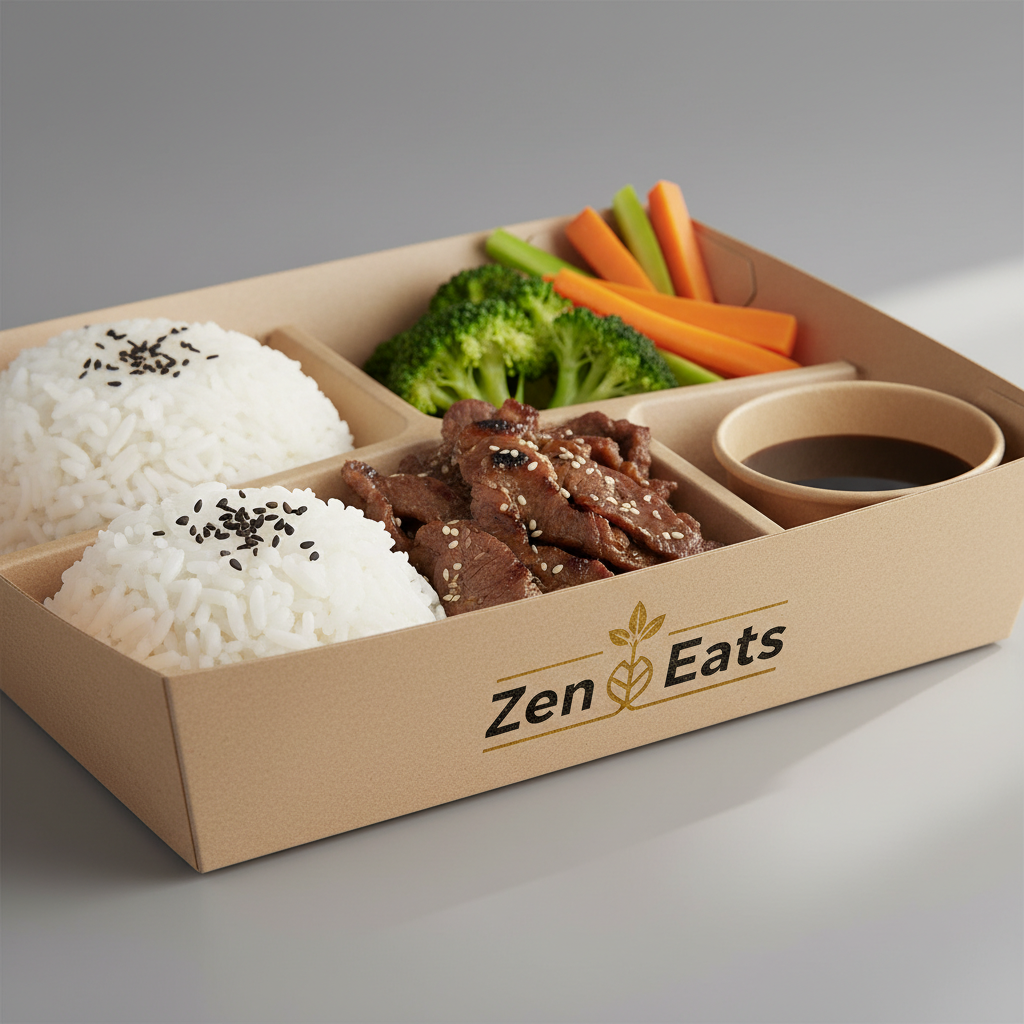
Compartment trays (often called Bento-style boxes) are sophisticated tools for menu engineering. They serve three primary technical functions:
1. Flavor Integrity
In catering, keeping wet and dry components separate is vital. A compartment tray prevents the dressing from wilting the salad or the sauce from making the rice soggy before the customer opens the lid. This extends the effective shelf-life of the meal during transit.
2. Portion Control
For catering businesses operating on tight margins, over-portioning is a silent profit killer. A defined compartment volume acts as a physical guide for kitchen staff, ensuring consistency across hundreds of meals without the need for weighing every scoop.
3. Visual Value
A well-organized tray looks more substantial and premium than a single chaotic container. The separation implies a multi-course experience, elevating the perceived value of the meal.
Customization Note: While stock molds are available for plastic trays, paper dividers or inserts can be custom-sized to fit specific menu items. This flexibility allows caterers to change menus without investing in new tooling for every season.
4. Lids, Seals, and Closure Mechanisms
A tray is only as good as its lid. The closure mechanism determines transport security and heat retention.
Snap-On vs. Heat Seal
- Snap-On / Friction Fit: The most common solution for catering. It allows for re-closing if the customer doesn’t finish the meal. Look for lids with “anti-fog” technology to ensure condensation doesn’t obscure the view of the food.
- Heat Sealing: This involves sealing a film over the tray. It provides a hermetic seal, making it 100% leak-proof and tamper-evident. This is ideal for soups, sauces, or long-distance transport but requires investment in sealing machinery.
Window Lids
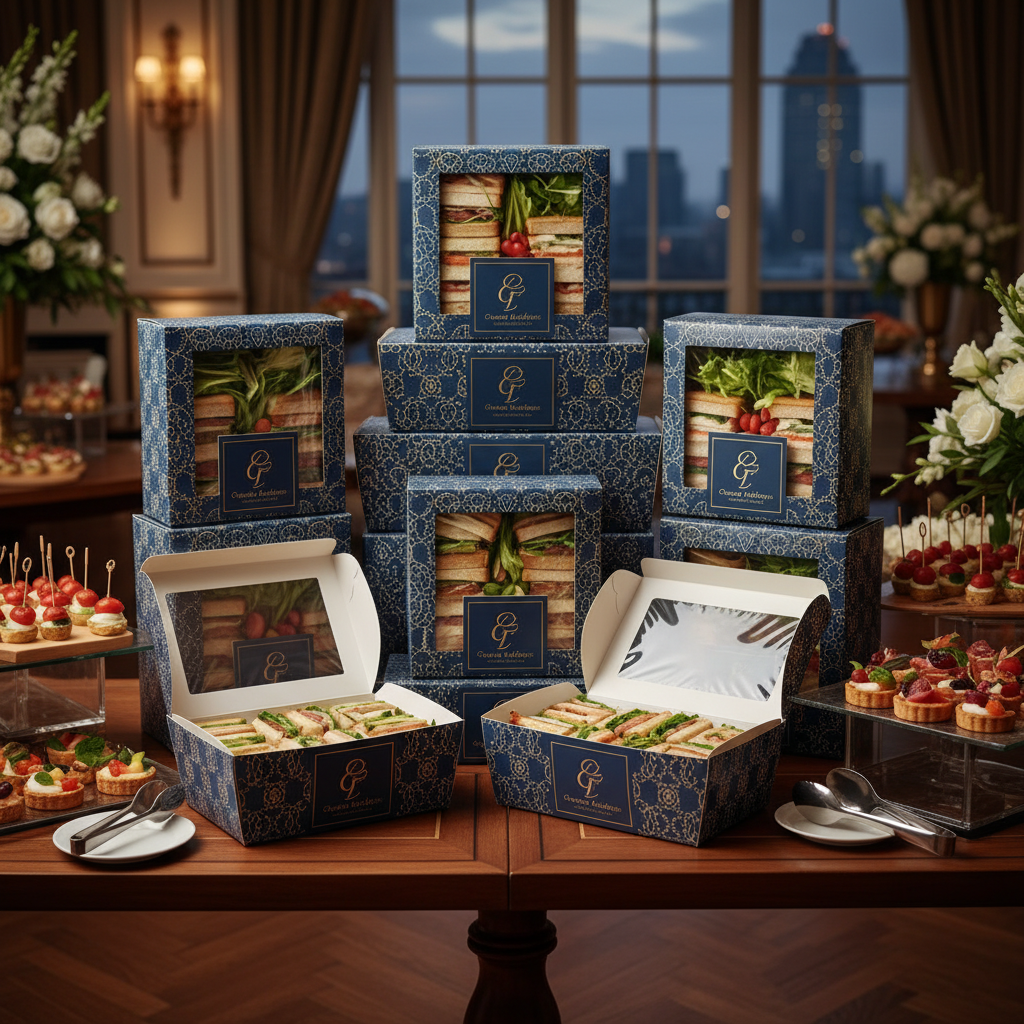
For paper boxes, a die-cut window with a clear film patch is a popular middle ground. It offers the structural strength of a paper lid (allowing stacking) while providing a view of the contents. This is frequently used in food packaging bags and bakery boxes to entice customers.
5. Branding and Custom Printing: The “Billboard” Effect
In B2B catering, the packaging often sits on a boardroom table or a conference hall desk for hours. It acts as a silent salesperson. Generic packaging represents a missed marketing opportunity.
Printing Technologies
- Offset Printing: Ideal for high-volume runs requiring photographic quality. It allows for complex gradients and sharp details. This is the standard for premium catering boxes.
- Flexographic Printing: More cost-effective for simpler designs, logos, and patterns. It is commonly used on corrugated boxes and kraft materials.
- Finishes: To add a premium touch, consider Spot UV (glossy highlights on a matte background), embossing (raised texture), or foil stamping (metallic look). These finishes signal luxury and attention to detail.
When working with a supplier like YBJ Packing, providing high-resolution vector artwork ensures that the final print matches your brand guidelines exactly. Custom printed packaging reinforces brand recall and encourages social media sharing by end-users.
6. Transport and Logistics Considerations
Buying packaging isn’t just about the product; it’s about the supply chain. Buyers must consider how the packaging impacts freight and storage.
Stacking Strength (BCT)
Box Compression Test (BCT) values indicate how much weight a box can support before collapsing. Catering platters are often stacked 5-10 high in delivery vans. If the bottom box fails, the entire stack can topple. Ensure your supplier understands your stacking requirements so they can recommend the appropriate board grade (GSM) and flute type.
Nesting and Volume
Shipping air is expensive. Tapered trays that nest inside each other significantly reduce freight volume compared to straight-walled rigid boxes. For international buyers importing packaging, maximizing the quantity per container is crucial for amortizing shipping costs.
7. Manufacturing and Quality Assurance
Reliable packaging comes from controlled manufacturing processes. When evaluating suppliers, consider their quality control measures.
Food Safety Compliance
All materials in direct contact with food must meet relevant food safety standards (such as FDA or EU regulations). This includes the paperboard, the inks (which should be low-migration), and the glues. Ask for material safety data sheets (MSDS) or compliance declarations.
Tolerance Levels
Industrial manufacturing has tolerances. A size variance of +/- 1-2mm is standard. However, for lids to fit securely, these tolerances must be tightly managed. A lid that is 1mm too loose causes leaks; 1mm too tight causes frustration. Consistent tooling maintenance by the manufacturer is key to avoiding these issues.
8. Buying Guide: How to Order Catering Packaging
Navigating the procurement process requires clear communication of specifications. Here is a checklist for buyers preparing to order.
Minimum Order Quantities (MOQ)
Custom printing usually carries an MOQ to offset setup costs (making printing plates, setting up die-cutters).
- Stock Items: Low MOQs, fast delivery, but generic appearance.
- Custom Print: Higher MOQs (typically starting in the thousands), longer lead time, but tailored branding.
The Sampling Process
Never commit to a full production run without seeing a sample.
1. Digital Proof: Checks artwork placement and spelling.
2. Plain Sample (Dummy): Checks size, structure, and fit with your specific food items.
3. Pre-production Sample: The final check with actual printing and materials. This may incur a cost but is insurance against mass production errors.
Lead Times
Factor in production time plus shipping time. Custom manufacturing might take 2-4 weeks, while ocean freight can add another 4-6 weeks depending on destination. Plan seasonal packaging (e.g., holiday catering boxes) at least 3-4 months in advance.
For specific inquiries on timelines and customization, visit our contact page or review our guide on how to order.
9. Sustainability Trends in Catering
The market is shifting away from expanded polystyrene (foam) and rigid black plastics. Buyers are increasingly requesting:
- Plastic-Free Solutions: Using water-based coatings instead of plastic laminates.
- Recycled Content: Board made from post-consumer waste (PCW).
- Compostability: Certified industrial compostable packaging that can be disposed of alongside food waste.
Aligning your packaging choice with your clients’ sustainability goals can be a deciding factor in winning catering contracts.
Frequently Asked Questions (FAQ)
Q1: Can paper catering trays hold liquids?
Yes, provided they are lined with a barrier coating like PE or PLA. Uncoated paper will absorb moisture and lose structural integrity. For soups or very saucy dishes, round containers with tight-fitting lids are recommended over folded corners.
Q2: What is the difference between CMYK and Pantone printing?
CMYK (Cyan, Magenta, Yellow, Black) is used for full-color images and gradients. Pantone (PMS) uses specific pre-mixed inks to achieve exact color matching, which is critical for consistent brand logos. Most packaging uses a combination or one of these depending on the design complexity.
Q3: How do I determine the right size tray for my menu?
Measure the volume of your food portions and the physical dimensions of your largest item (e.g., a sandwich or wrap). We recommend ordering plain samples to test-pack your menu items before finalizing the dimensions.
Q4: Are custom shapes available?
Yes, custom die-cutting allows for unique shapes, handles, and window placements. However, this requires the creation of a new cutting die, which involves a one-time tooling fee.
Q5: How does YBJ Packing ensure the lids fit tightly?
We use precision tooling and conduct rigorous quality checks during production to ensure the mating parts (tray and lid) remain within strict tolerance levels for a secure friction fit.
Q6: Can I print on the inside of the box?
Yes, inside printing is a growing trend for a premium unboxing experience. However, the ink used must be food-safe and low-migration, or a barrier film must be applied over the print to prevent direct food contact.
Conclusion
Selecting the right catering packaging is a balance of engineering, aesthetics, and logistics. From the robust protection of corrugated trays to the branding potential of custom-printed boxes, the choices you make directly impact your operational efficiency and your customer’s satisfaction.
At YBJ Packing, we specialize in helping businesses navigate these choices, offering a wide range of customizable solutions for the food service industry. Whether you need compartment trays for corporate lunches or elegant boxes for event catering, our team is ready to assist.
Ready to upgrade your catering presentation? Request a quote today or get a sample to see the quality firsthand.