


In the competitive landscape of the food industry, packaging serves two critical roles: protecting the product and selling the brand. While structural design and graphic layout are fundamental, the surface finish of your packaging is often the deciding factor in how a consumer perceives quality. A finish determines the tactile experience, the way light interacts with the package, and the durability of the print during shipping and handling.
For B2B buyers—whether you are sourcing for a bakery franchise, a frozen food line, or a gourmet snack brand—understanding the technical and aesthetic differences between matte lamination, gloss coating, spot UV, foil stamping, and embossing is essential. These choices impact not just shelf appeal, but also production costs, lead times, and sustainability metrics.
This comprehensive guide explores the most common food packaging finishes, their technical specifications, and how to choose the right combination for your specific application.
1. The Foundation: Lamination vs. Coating
Before diving into specific visual effects like “matte” or “gloss,” it is crucial to distinguish between the two primary methods of applying these finishes: Lamination and Coating (Varnish).
Lamination (Film)
Lamination involves bonding a thin plastic film (typically Polypropylene or Polyester) to the surface of the printed paperboard using heat and pressure.
- Durability: Lamination provides the highest level of protection. It prevents the paper from cracking at the fold lines—a common issue with heavy cardstock used in custom food packaging boxes.
- Moisture Resistance: The plastic film creates a solid barrier against moisture and grease, which is vital for food products.
- Thickness: It adds slight thickness and rigidity to the packaging material.
Coating (Varnish/Aqueous/UV)
Coatings are liquid finishes applied during or after the printing process, similar to ink. They dry or cure to form a thin protective layer.
- Cost: Generally less expensive than lamination.
- Flexibility: Ideal for high-volume runs where extreme durability is not the primary concern.
- Protection: Offers moderate protection against scuffing but does not reinforce structural integrity as well as lamination.
2. Matte vs. Gloss: The Primary Aesthetic Choice
The decision between matte and gloss sets the tone for your brand. This choice applies to both laminations and coatings.
Gloss Finish
Visual Effect: High shine, reflective, and vibrant.
Best For: Snack foods, frozen foods, and children’s products.
Gloss finishes enhance color saturation. If your artwork features high-contrast photography of food (e.g., a sizzling steak or a vibrant fruit salad), gloss will make the colors “pop.” It reflects light, catching the consumer’s eye from a distance.
Pros:
- Colors appear richer and darker.
- Highly resistant to dust and dirt; easy to wipe clean.
- Typically the standard, most cost-effective option.
Cons:
- Glare can make text hard to read under strong store lighting.
- Fingerprints are easily visible (though less so than on dark matte surfaces).
- Scratches are more apparent on dark glossy backgrounds.
Matte Finish
Visual Effect: Non-reflective, muted, and soft.
Best For: Organic products, luxury chocolates, gourmet coffee, and health foods.
Matte finishes diffuse light rather than reflecting it. This creates a sophisticated, understated look often associated with premium or natural products. When applied to food packaging bags and pouches, matte finishes convey a sense of modern elegance.
Pros:
- Excellent readability for text-heavy packaging (ingredients, nutritional facts).
- Perceived as “premium” or “luxury” by consumers.
- Smooth, velvety texture (especially with “Soft Touch” lamination).
Cons:
- Colors can appear slightly muted or “flat.”
- Standard matte lamination is prone to showing scuff marks during shipping (though “anti-scratch” matte options exist).
3. Spot UV: Creating Contrast and Focus
Spot UV (Ultraviolet) coating is a technique where a high-gloss varnish is applied to specific areas of the packaging, rather than the entire surface. This is cured instantly using UV light.
The Strategy of Contrast
Spot UV is rarely used alone; it is most effective when paired with a Matte Lamination. The contrast between the non-reflective matte background and the high-gloss Spot UV area creates a striking visual and tactile effect.
Common Applications in Food Packaging
- Logos: Making the brand name shine against a matte box.
- Patterns: Creating subtle, ghosted patterns (e.g., wheat stalks on a bakery box) that are only visible when the light hits them.
- Product Highlights: Adding gloss over a photo of the food product to make it look wet or freshly prepared.
Technical Note: Spot UV requires a separate plate or screen in production. Precision is key. Small text or very fine lines are generally not recommended for Spot UV due to potential registration (alignment) shifts during printing.
4. Foil Stamping: Metallic Elegance
Foil stamping uses heat and pressure to transfer a metallic foil onto the packaging surface. Unlike metallic inks, which can look dull and flat on uncoated paper, foil stamping provides a true, reflective metal finish.
Hot Foil Stamping
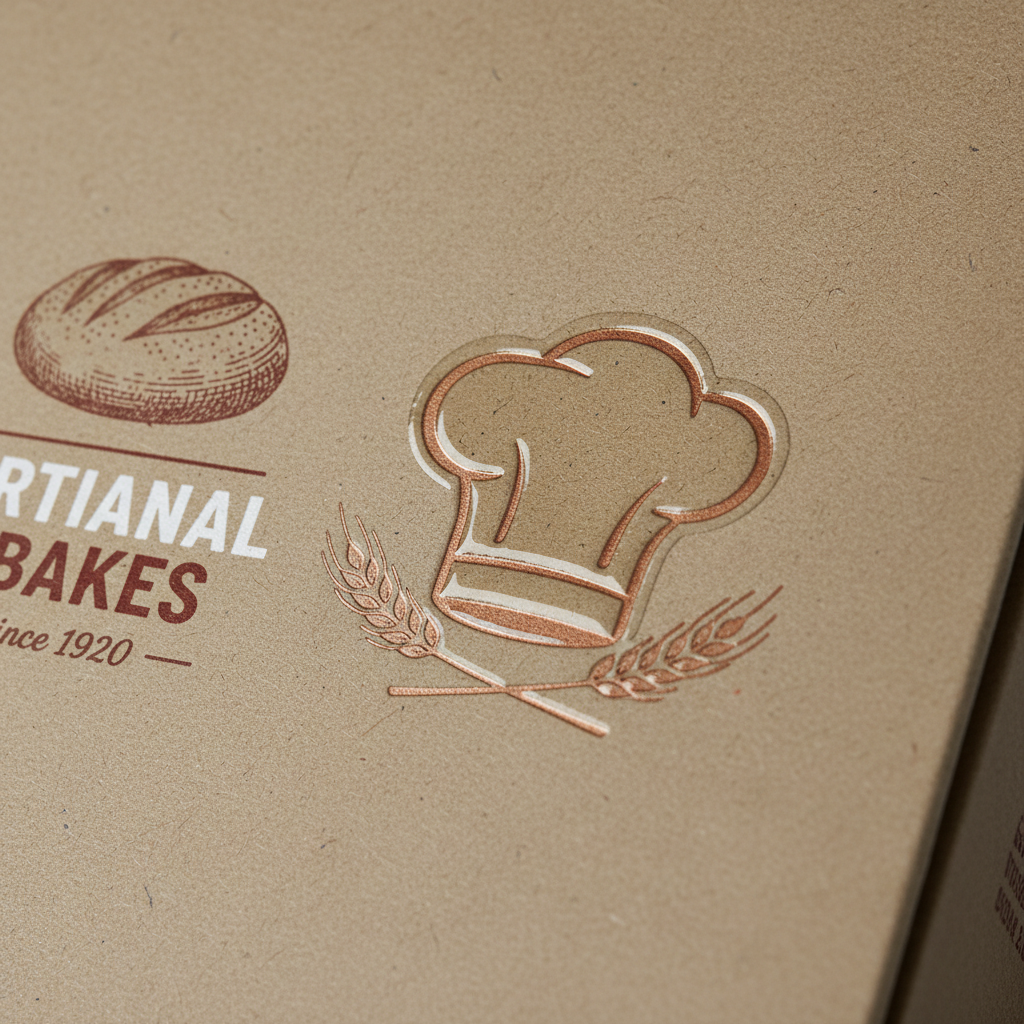
This is the traditional method. A heated die presses the foil onto the substrate. It actually slightly debosses the material, adding a tactile element.
- Colors: Gold and silver are standard, but copper, rose gold, holographic, and even pigmented (non-metallic) foils are available.
- Usage: Ideal for luxury food containers, confectionery boxes, and limited-edition runs.
Cold Foil
Cold foil is applied inline during the printing process using adhesive and standard printing plates. It is faster and cheaper for large runs but lacks the tactile depth of hot foil.
Food Safety Consideration
When using foil on food packaging, it is critical to ensure the foil does not come into direct contact with the food, or that food-grade compliant materials are used. Typically, foil is applied to the exterior of the secondary packaging (the box), while the food is sealed in a primary wrapper or bag inside.
5. Embossing and Debossing: Tactile Dimensions
Texture plays a significant role in consumer psychology. Embossing and debossing alter the physical shape of the paperboard.
- Embossing: Pressing the paper from underneath to create a raised image (3D effect sticking out).
- Debossing: Pressing the paper from the top to create a depressed image (indented).
Blind vs. Registered
- Blind Emboss: The raised area is not printed with ink or foil. The effect relies entirely on shadow and highlight created by the texture.
- Registered Emboss: The embossing aligns perfectly with a printed element or a foil stamp (e.g., a gold foil logo that is also raised). This requires high-precision tooling.
Structural Considerations
Embossing works best on thicker paper stocks (e.g., 300gsm+ folding box board). If the material is too thin, the emboss may flatten out or tear. Conversely, on corrugated cardboard, embossing can crush the fluting, reducing the box’s strength, so it is rarely done directly on corrugated material unless using a litho-laminate process.
6. Technical Comparison Table
To help procurement teams and engineers make informed decisions, here is a comparison of how these finishes perform across key metrics.
| Finish Type | Cost Impact | Scuff Resistance | Production Time | Best Substrate |
|---|---|---|---|---|
| Gloss Aqueous Coating | Low | Medium | Fast (Inline) | All Paperboard |
| Gloss Lamination | Medium | High | Medium (Post-press) | Folding Carton |
| Matte Lamination | Medium | Medium (Prone to scuff) | Medium (Post-press) | Folding Carton, Rigid Box |
| Soft Touch Lamination | High | Medium-High | Medium | Premium Rigid Box |
| Spot UV | Medium-High | Decorative Only | Slow (Requires curing) | Coated Paperboard |
| Hot Foil Stamping | High | High | Slow (Requires die) | Smooth Board / Art Paper |
7. Manufacturing & Quality Assurance
Achieving a flawless finish requires attention to detail during the pre-production and manufacturing phases. At YBJ Packing, we emphasize strict QA protocols to ensure consistency.
File Preparation
For finishes like Spot UV, Embossing, and Foil, your design files must include separate layers (masks). These should be vector-based (AI or PDF) and clearly labeled (e.g., “Die Line,” “Foil Mask,” “Spot UV Mask”). Never use raster images (JPEG/PNG) for finish masks, as the edges will appear pixelated on the final product.
Color Shifts
Lamination affects the final color of your print.
Gloss lamination tends to make colors appear deeper and more vibrant.
Matte lamination can reduce contrast and make colors appear slightly lighter or greyer.
Always request a wet proof or a laminated proof if color accuracy is critical for your brand guidelines.
Adhesion and Creasing
One of the most common defects in packaging is “cracking” at the fold lines. This happens when the paper fibers break under the stress of folding. Lamination prevents this by holding the fibers together. However, if a thick UV coating is applied over a fold line without lamination, it will almost certainly crack. Therefore, we recommend leaving fold lines free of heavy UV varnish or ensuring the base material is laminated first.
8. Sustainability and Environmental Impact
Modern buyers are increasingly concerned with the end-of-life of their packaging. How do finishes affect recyclability?
- Standard Lamination: Traditional PP (polypropylene) lamination makes paper difficult to recycle in standard paper streams because the plastic must be separated from the fiber. However, specialized facilities can handle this.
- Water-Based Coatings (Aqueous): These are generally fully recyclable and biodegradable. They break down easily during the re-pulping process.
- Foil Stamping: Surprisingly, hot foil stamping is often repulpable. The foil layer is so thin that it dissipates during the recycling process (depending on local facility capabilities).
- Biodegradable Films: New cellulose-based lamination films are entering the market, offering the protection of plastic with compostable properties.
If sustainability is your primary KPI, consider using a high-quality water-based varnish on uncoated board instead of a plastic laminate.
9. Buying Guide: MOQs and Lead Times
When ordering custom food packaging with specialized finishes, consider the impact on your supply chain.
Minimum Order Quantities (MOQ)
Processes that require specific tooling—like Hot Foil Stamping and Embossing—incur setup costs (making the metal die). Consequently, these are more cost-effective at higher volumes (typically 1,000+ or 5,000+ units depending on the box size). For smaller runs, digital foil or simple digital print with lamination may be more economical, though with limitations on effects.
Lead Times
Adding finishes adds steps to production.
Standard Print + Gloss/Matte Varnish: Fastest.
Lamination: Adds 1-2 days.
Spot UV / Foil / Emboss: Adds 3-5 days to production time due to the need for drying, curing, and multiple passes through different machines.
If you are launching a new product, engage with our team early to establish a timeline that accounts for these complex manufacturing steps. You can learn more about our process on our how to order page.
10. Frequently Asked Questions (FAQ)
Can I combine Matte Lamination with Foil Stamping?
Yes, this is a very popular and effective combination. The matte background provides a non-reflective surface that makes the metallic foil shine even brighter by contrast.
Is Spot UV food safe?
Standard UV coatings are generally not intended for direct food contact. They should be applied to the exterior of the packaging. For the interior, we recommend food-grade PE lamination or specific food-safe aqueous coatings.
What is “Soft Touch” lamination?
Soft Touch is a specialized matte film that has a tactile feel similar to peach skin or velvet. It adds a significant luxury feel but is more expensive than standard matte lamination.
Does embossing affect the strength of the box?
Deep embossing can slightly weaken the material at the point of the emboss. We ensure that the design does not compromise the structural integrity of the box, particularly for heavy items.
Can you print over foil stamping?
Yes, this technique is called “overprinting foil.” It creates a metallic sheen in specific colors (e.g., printing yellow ink over silver foil creates a metallic gold effect). However, it requires UV inks and careful curing.
Conclusion
Selecting the right finish for your food packaging is a balance of aesthetics, protection, and budget. Whether you need the high-barrier protection of lamination for a frozen food box or the tactile luxury of an embossed, foil-stamped chocolate carton, the finish communicates the value of the product inside.
At YBJ Packing, we specialize in helping brands navigate these technical choices to produce packaging that stands out on the shelf and performs in the supply chain. From simple gloss coatings to complex multi-finish designs, our manufacturing capabilities are tailored to global standards.
Ready to elevate your product packaging? Contact our team today to request a sample kit or get a custom quote for your project.