

Introduction: The Strategic Value of Branded Catering Packaging
In the high-stakes world of large-scale food service, packaging is rarely just a container. For catering companies, restaurant chains, and food distributors, the catering tray serves as the primary interface between the kitchen’s culinary standards and the client’s event experience. When sourcing custom catering trays wholesale, procurement managers and brand owners must navigate a complex landscape of material specifications, structural integrity, and print quality.
High-volume catering environments demand packaging that is robust enough to transport heavy platters of food without collapsing, yet aesthetically refined enough to serve directly on a boardroom table or at a wedding buffet. Furthermore, the shift towards branded experiences means that plain brown boxes are often missed opportunities for marketing. A well-printed tray reinforces brand identity the moment it enters the venue.
This guide provides an in-depth technical analysis for B2B buyers looking to source custom catering trays. We will cover material grades, grease-resistance technologies, printing specifications, and critical supply chain considerations to ensure your wholesale order meets both operational and branding requirements.
1. Material Specifications: Balancing Strength and Presentation
The structural integrity of a catering tray is dictated by the substrate selected during manufacturing. Unlike standard takeout boxes, catering trays often hold significant weight—ranging from dense sandwich platters to heavy pasta dishes. Choosing the right material grade is non-negotiable.
Corrugated Board vs. Solid Board
For wholesale catering trays, the two primary material categories are corrugated fiberboard and solid bleached sulfate (SBS) or folding boxboard (FBB).
Corrugated Fiberboard (The Industry Standard for Trays)
Corrugated board is the preferred choice for catering trays due to its high strength-to-weight ratio. It consists of a fluted inner layer sandwiched between two linerboards.
- E-Flute (approx. 1.5mm – 2mm thick): This is the most common flute profile for catering trays. It offers a flat surface that prints well (reducing the “washboard” effect seen in thicker flutes) while providing excellent crush resistance and stacking strength. It is ideal for standard sandwich and pastry platters.
- B-Flute (approx. 3mm thick): Used for heavier loads or larger tray footprints (e.g., full-sheet pans). It offers superior cushioning and vertical compression strength but has a rougher surface for direct printing compared to E-flute.
- F-Flute (approx. 0.8mm – 1.2mm thick): A “micro-flute” option that bridges the gap between carton board and corrugated. It provides a premium, sleek look with better rigidity than standard paperboard, often used for luxury catering items.
Solid Board / Folding Carton
For lighter applications or when a high-end, smooth cosmetic finish is prioritized over heavy-duty stacking strength, solid board is used. This is common for sushi platters or lightweight dessert trays. However, for bulk catering, corrugated is generally safer to prevent buckling during transport.
Paper Grades and Liners
The linerboard (the paper glued to the flute) determines the tray’s appearance and printability.
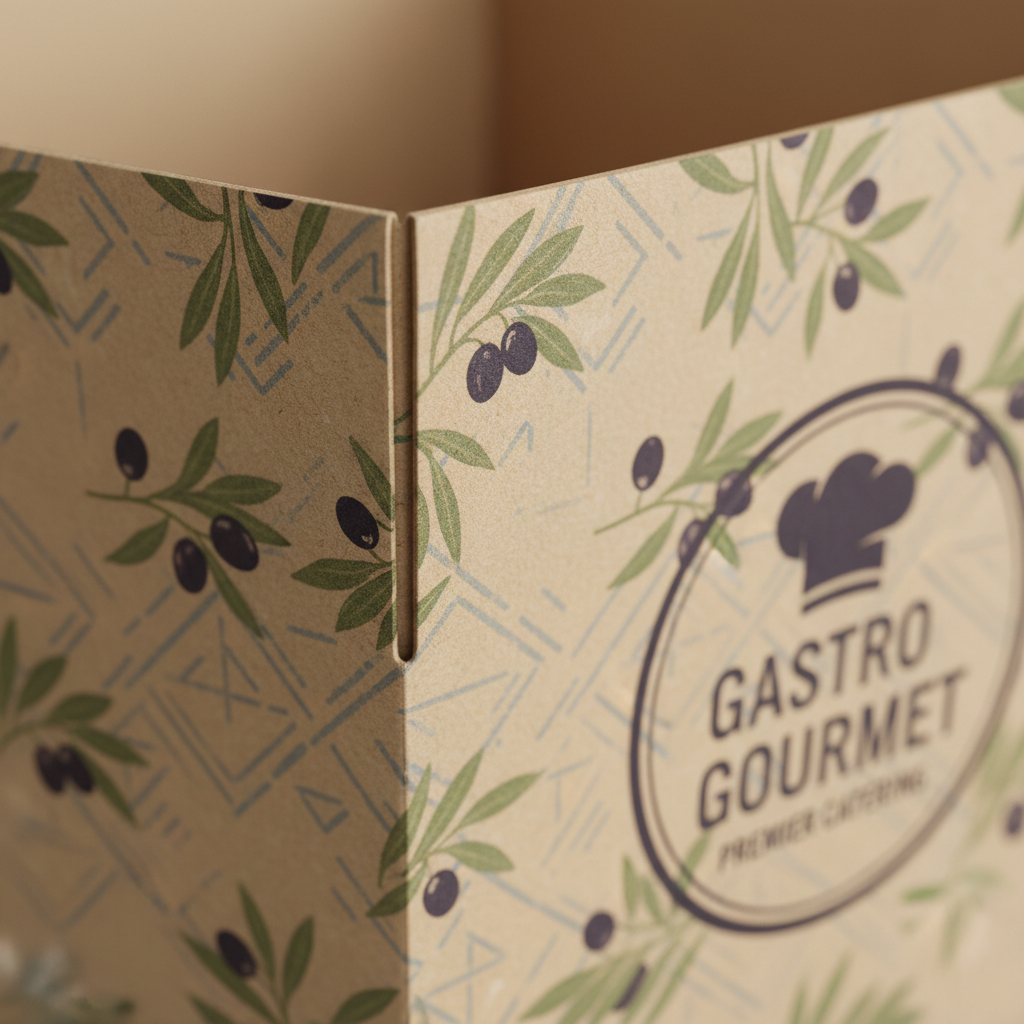
- Kraft (Brown): Made from virgin or recycled wood pulp. It communicates sustainability and rustic appeal. However, printing colors on Kraft requires opaque inks or results in muted tones.
- White Top Kraft / Test Liner: A white outer layer over a brown or gray interior. This provides a clean canvas for vibrant printing while maintaining the structural cost-benefits of standard board.
- Virgin vs. Recycled: Virgin fibers offer higher tear resistance and are necessary for direct food contact in some jurisdictions, whereas recycled fibers are cost-effective but may require a barrier coating for food safety.
2. Grease Resistance and Barrier Coatings
Catering menus are diverse, often including items with high fat, oil, or moisture content. A standard paper tray will absorb grease, leading to unsightly staining and structural failure (sogginess). Wholesale buyers must specify the correct barrier coating based on the food type.
Common Coating Technologies
- PE (Polyethylene) Coating: A thin layer of plastic laminated to the paperboard. It offers excellent grease and moisture resistance. It is the industry standard for “wet” foods but poses challenges for recycling in standard paper streams unless specialized facilities are available.
- Aqueous Coating (Water-Based): A varnish applied during the printing process. It provides moderate grease resistance and prevents ink rub-off. It is generally more eco-friendly than PE but may not suffice for very oily foods like fried chicken or marinated meats.
- Clay Coating: Often used on the exterior for print quality, but can also be applied internally. It provides a smooth surface but limited moisture protection compared to polymers.
- Dispersion Coatings (Plastic-Free): The modern alternative. These are water-based barriers that offer grease resistance comparable to PE but are fully repulpable and compostable. For brands focusing on sustainability, requesting dispersion-coated catering trays is a strong selling point.
The “Kit Test” for Grease Resistance
When specifying paper quality, you may encounter the “Kit Level” (ranging from 1 to 12). This standard measures the paper’s resistance to oil penetration.
- Kit 3-5: Suitable for dry baked goods (cookies, bread).
- Kit 6-8: Standard for sandwiches and general catering.
- Kit 9-12: Required for oily foods (fried items, heavy dressings).
Always ask your manufacturer to confirm the Kit Level if you are not using a physical laminate like PE.
3. Printing Options for Wholesale Orders
The printing method significantly impacts unit cost, lead time, and visual quality. Understanding the difference helps in planning your budget and timeline.
Flexographic Printing (Flexo)
Best for: High-volume, recurring orders (10,000+ units).
Process: Uses flexible relief plates to transfer ink. It is fast and cost-efficient for simple designs (logos, patterns, 1-4 colors).
Pros: Lowest cost per unit at scale; water-based inks are food-safe.
Cons: High initial setup costs (plate charges); lower resolution than offset; gradients can be difficult.
Offset Lithography (Offset)
Best for: Premium branding, photographic imagery, and complex artwork.
Process: Ink is transferred from a plate to a rubber blanket, then to the paper. Often involves laminating a high-quality printed sheet (litho-label) onto the corrugated flute.
Pros: Superior image quality; sharp details; accurate color matching (Pantone).
Cons: Higher tooling costs; longer setup times.
Digital Printing
Best for: Short runs, samples, seasonal promotions, or multiple SKU variations.
Process: Direct inkjet application.
Pros: No plate costs; quick turnaround; easy to change designs.
Cons: Higher cost per unit; slower production speed for massive volumes.
4. Structural Design & Features
Beyond the material and print, the physical design of the tray dictates its functionality in a busy kitchen.
Assembly Mechanisms
- Flat-Fold (Lock Corner): Trays ship completely flat to save shipping volume. Kitchen staff fold the corners to lock them in place. This is the most cost-effective option for logistics.
- Pre-Glued / 4-Corner Beers: The tray corners are glued at the factory and fold flat. To assemble, the user simply pulls the sides up, and the tray “pops” into shape. This costs slightly more to manufacture but saves significant labor time during food prep.
Lid Options
Catering trays almost always require lids for transport and hygiene.
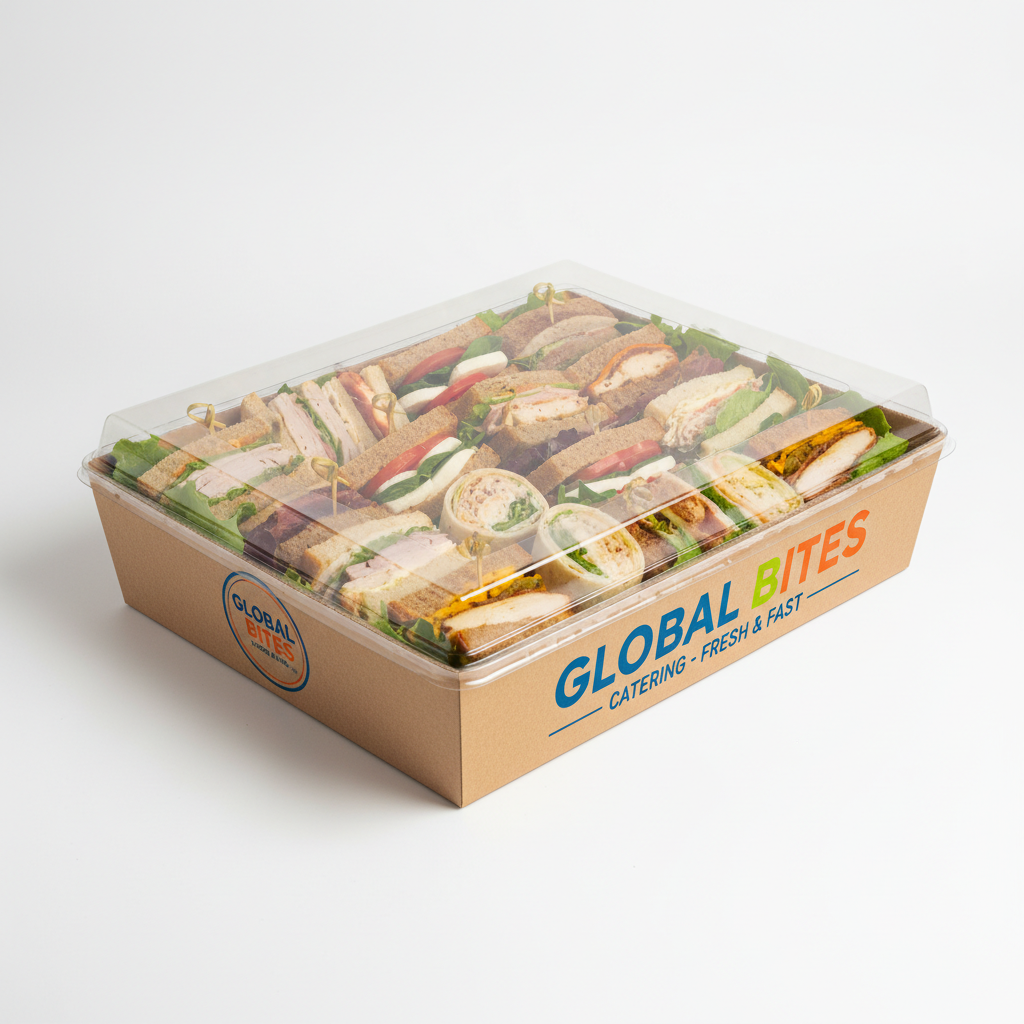
- Window Lids: A paperboard frame with a clear PET or PLA window. Essential for product visibility, allowing customers to check the order without opening it.
- Solid Board Lids: More secure for stacking heavy items but lacks visibility. Often used for hot foods where condensation might fog up a window.
- Slide-Over Sleeves: A premium alternative where the tray slides into a printed sleeve. Excellent for branding real estate.
Inserts and Dividers
For mixed platters (e.g., a combination of wraps, fruits, and dips), custom dividers prevent cross-contamination and movement during delivery. These can be integrated into the tray design or supplied as separate die-cut pieces.
5. Buying Guide: How to Order Wholesale Catering Trays
Navigating the procurement process with a manufacturer requires preparation. Here is a step-by-step guide to ensuring a smooth transaction.
Step 1: Define Your Dimensions and Capacity
Standard catering sizes often follow the “Gastronorm” logic or standard baking sheet sizes (Quarter sheet, Half sheet, Full sheet). However, custom sizes are common. Measure your specific food items arrangement. Ensure you account for the internal dimensions vs. external dimensions, as corrugated board thickness eats into the internal space.
Step 2: Determine Minimum Order Quantities (MOQ)
Custom manufacturing has high setup costs.
Typical MOQs:
- Digital Print: 500 – 1,000 units (High unit price).
- Flexo/Offset: 5,000 – 10,000+ units (Optimal unit price).
If you are a smaller chain, consider consolidating orders for 6-12 months of stock to reach the MOQ threshold for better pricing.
Step 3: Artwork Preparation
To avoid delays, have your design team prepare files correctly:
- Format: AI, PDF, or EPS (Vector files).
- Colors: Specify Pantone (PMS) codes for brand consistency, or CMYK for photographic prints.
- Bleed: Ensure artwork extends beyond the cut line (usually 3mm-5mm) to account for cutting tolerances.
- Dielines: Request the official dieline from the supplier before starting the design.
Step 4: Sampling and Prototyping
Never proceed to mass production without a sample.
Plain Sample: Confirms size and material quality. Usually fast and cheap.
Digital Print Sample: Confirms layout and text, but colors may not match the final mass-production press exactly.
Pre-production Sample: A sample made on the actual production equipment. Most expensive but guarantees 100% accuracy.
Step 5: Logistics and Warehousing
Catering trays are bulky. Even when flat-packed, a pallet of 5,000 corrugated trays takes up significant warehouse space. Ensure your receiving dock can handle pallets. If you are importing, factor in sea freight times (typically 4-6 weeks) plus customs clearance.
6. Quality Assurance Checklist
When evaluating a supplier or inspecting a shipment, check for these common defects:
- Flute Crushing: The corrugated waves should not be flattened (unless intended at fold lines), as this weakens the tray.
- Print Registration: Colors should align perfectly without blurry edges.
- Score Line Cracking: When folded, the paper liner should not crack or split, exposing the brown kraft underneath.
- Glue Adhesion: For pre-glued trays, pull firmly on the glued tabs to ensure the bond is stronger than the paper itself (fiber tear).
- Odor: Food packaging must be odorless. Strong ink or solvent smells are unacceptable and indicate improper curing.
7. Sustainability and Compliance
International buyers must be aware of regional regulations regarding single-use plastics and food contact materials (FCM).
- FSC Certification: Verifies that the wood pulp comes from responsibly managed forests.
- PFAS-Free: Many regions are banning PFAS (forever chemicals) often used in grease-proofing. Ensure your manufacturer uses PFAS-free alternatives.
- Recyclability Labels: Printing the correct recycling codes (e.g., PAP 20, PAP 21) on the bottom of the tray helps end-users dispose of the packaging correctly.
For businesses looking to enhance their eco-credentials, explore our range of sustainable options in the takeaway packaging category.
Conclusion
Sourcing custom catering trays wholesale is a balance of engineering and art. The tray must be a fortress for the food and a billboard for the brand. By specifying the right corrugated flute, choosing the appropriate grease barrier, and understanding print limitations, buyers can secure packaging that elevates their catering service.
Whether you need a simple kraft tray for a corporate lunch or a high-gloss, full-color box for a luxury event, clarity on specifications is key to a successful partnership with your manufacturer.
Frequently Asked Questions (FAQ)
1. What is the difference between E-flute and B-flute for catering trays?
E-flute is thinner (approx. 1.5mm) and has a smoother surface for printing, making it ideal for standard catering trays. B-flute is thicker (approx. 3mm) and offers more cushioning and stacking strength, suitable for very heavy platters or shipping containers.
2. Can I print inside the catering tray?
Yes, printing on the inside is possible and adds a premium unboxing experience. However, the inks used must be food-grade and safe for direct contact, or the print must be covered by a food-safe barrier coating.
3. How do I know if I need a PE coating or just a varnish?
If your food is wet, oily, or saucy (like BBQ wings or pasta), you likely need a PE coating or a high-performance dispersion barrier to prevent leaks. For dry foods like sandwiches or pastries, a standard aqueous varnish is usually sufficient.
4. What is the standard lead time for custom printed trays?
Lead times vary by manufacturer and complexity. Generally, allow 2-3 weeks for production after artwork approval, plus shipping time. Ocean freight for international orders can add 4-6 weeks.
5. Can I get a custom size tray to fit my specific platters?
Absolutely. Custom sizing is a standard part of wholesale manufacturing. You will need to pay a one-time tooling fee for the cutting die. Ensure you provide exact internal dimensions to your supplier.
6. Are window lids recyclable?
It depends on the material. If the window is made of PLA (corn starch), it is compostable. If it is PET plastic, it must be separated from the paper tray for recycling. Some modern designs use cellulose windows which are fully paper-recyclable.
7. How do I request a quote efficiently?
To get an accurate quote quickly, provide: Style (e.g., tray with window lid), Dimensions (L x W x H), Material preference (e.g., Kraft E-flute), Quantity, and number of print colors. Visit our How to Order page for more details.
Ready to upgrade your food service presentation? Request a quote or get a sample of our premium custom catering trays today.